Silver has been a mess lately. Big swings, fast reversals, and price action that keeps shaking out both sides. One day it looks strong, the next day it looks broken. That kind of tape pulls attention toward the metal itself and away from everything linked to it.
That’s why Otavio Costa flagged something most traders ignore during chaos: the silver miners-to-silver ratio. His point is simple. When silver gets all the headlines, miners can get left behind. And when that gap stretches to an extreme, it can mark a turning point.
- What Costa Posted, In Plain English
- What the Chart Is Measuring
- The “Margins Like Tech” Line
- The Risk That Can Break the Thesis
What Costa Posted, In Plain English
Costa’s tweet is a direct hit at sentiment.
Not long ago, the crowd was obsessed with silver clearing $50. Now silver is above that area, yet miner valuations don’t look like they’re pricing in a strong metals tape at all. He also highlights something that matters more than hype: costs. Some producers, he says, are running at sub-$15/oz costs even with higher silver prices. That’s a wide operating spread.
His message isn’t “miners can’t lose.” It’s “the market is pricing miners like it’s still a weak environment, even though the underlying metal price is much higher than it used to be.”
What the Chart Is Measuring
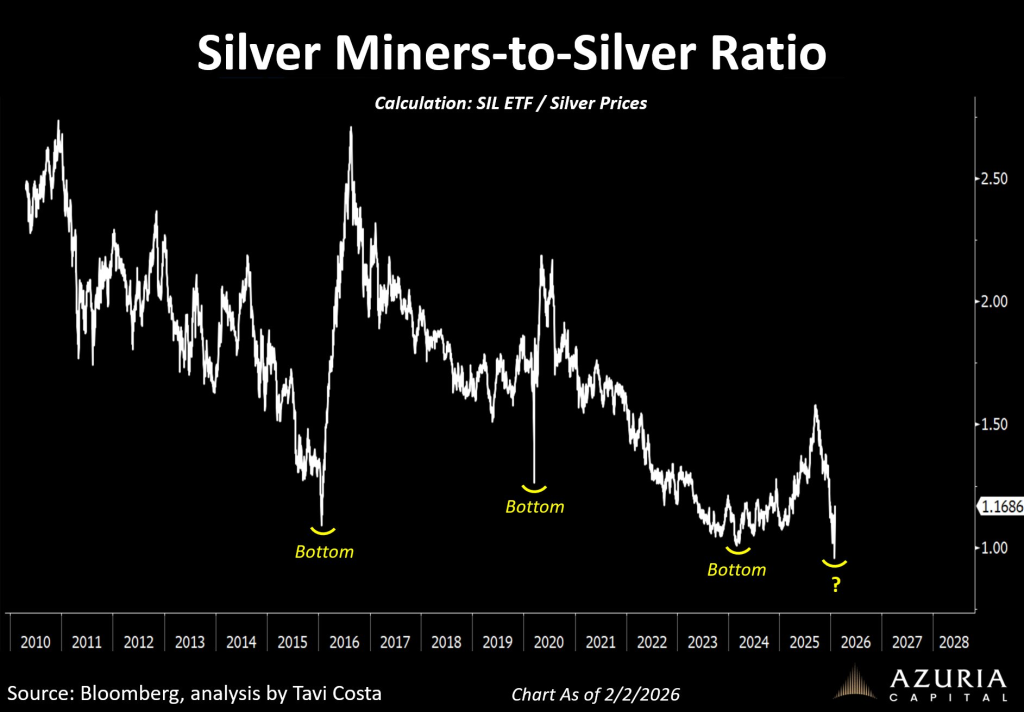
The chart title tells you the whole method:
Silver Miners-to-Silver Ratio
Calculation: SIL ETF / Silver Prices
Source: X/@TaviCosta
So this is not a chart of silver. It’s a relative performance chart. It tracks whether miners are outperforming or underperforming the metal.
- Ratio rising = miners are beating silver
- Ratio falling = miners are lagging silver
This matters because miners are leveraged to the metal in more ways than one. If silver holds up and operating costs stay controlled, miner earnings can expand fast. When the market starts pricing that in, miners can move harder than the metal.
Costa marks several “Bottom” zones on the chart. The ratio hit major lows around past stress periods and then bounced sharply after.
That pattern is the core idea here: extreme pessimism in miners can create a reset point. Miners often get punished for reasons that have little to do with the current silver price—equity market risk, financing fears, dilution worries, political risk, operational headlines. When investors get defensive, miners can be dumped even if the metal stays elevated.
A ratio near historic lows suggests one thing: the market has been willing to pay up for silver exposure, but not for the businesses digging it out of the ground.
Read also: Why Silver Price Just Had a Historic Crash: Paper Shorts Crushed the Market in a Coordinated Hit
The “Margins Like Tech” Line
Costa’s “tech-like margins” line is meant to wake people up.
If a producer’s all-in costs are near $15 and the realized price is far above that, the business can throw off serious cash. That’s the theory. The market usually rewards that setup, but it often waits for proof—clean quarters, improving guidance, stronger balance sheets, and capital returns.
The ratio being crushed implies the market is not paying for that possibility yet. It’s pricing miners like the good times are fragile.
This ratio needs miners to stop bleeding relative to the metal.
A few things typically push the ratio higher:
- Silver stabilizes instead of whipping around daily
- Risk appetite returns to equities
- Miners start printing stronger financial results
- Costs stay contained and guidance holds up
If those pieces line up, miners can start catching up fast.
The Risk That Can Break the Thesis
This is not a free trade.
Miners carry risks the metal doesn’t: jurisdiction issues, production misses, cost inflation, hedging mistakes, dilution, and broad stock market selloffs that hit everything with a ticker. Even if silver holds, miners can stay cheap longer than most expect.
That’s the real warning inside the chart. A low ratio can signal value, but it can also signal that investors don’t trust the sector.
If silver calms down and the tape stops punishing risk, miners don’t need a miracle to re-rate. They just need the market to stop treating them like a problem and start treating them like a business with real cash flow potential.
That’s the bet behind the tweet. Game on, but with eyes open.
Read also: Gold, Stocks, and Bitcoin Are Falling -Here’s What Might Be Breaking Behind the Scenes
Disclaimer: The information on this page may come from third parties and does not represent the views or opinions of Gate. The content displayed on this page is for reference only and does not constitute any financial, investment, or legal advice. Gate does not guarantee the accuracy or completeness of the information and shall not be liable for any losses arising from the use of this information. Virtual asset investments carry high risks and are subject to significant price volatility. You may lose all of your invested principal. Please fully understand the relevant risks and make prudent decisions based on your own financial situation and risk tolerance. For details, please refer to
Disclaimer.
Related Articles
Ethereum Breakout Signals Short-Term Upside
The recent bullish sentiment in the crypto market is driven by Ethereum's breakout from a downward trendline, indicating potential price targets of $2,050 and $2,085. While the volatility remains, analysts are optimistic about Ethereum's long-term prospects contingent on market adoption.
Coinfomania5m ago
SXP Price Surges 11.59%: What This Could Mean for Traders
SXP has surged 11.59% amid a generally declining crypto market, reaching $0.0231. This increase reflects heightened investor interest, driven by market dynamics and trading activity, as traders eye key resistance and support levels.
Coinfomania15m ago
BitMine increased its holdings by 60,976 ETH last week. The Executive Chairman states that ETH may bottom out in mid-month.
BitMine announced that as of March 8, its total assets reached $10.3 billion, including 4,534,563 ETH and 195 BTC. Executive Chairman Tom Lee stated that amidst market uncertainty, ETH has shown resilience, and its price is expected to bottom out between March 8 and 14. Meanwhile, BitMine is accelerating its ETH accumulation, with staked ETH reaching 3,040,483.
GateNews20m ago
Oil prices rise to $119, reaching a new high since 2022, Bitcoin remains at $67,000, and the Federal Reserve has a 99% probability of maintaining interest rates in March.
On March 9th, WTI crude oil prices rose to $119 per barrel, reaching a new high since 2022. Due to threats from Iran, global crude oil supply losses approached 20 million barrels. Bitcoin remained at $67,000, with no signs of panic selling. The probability that the Federal Reserve will keep interest rates unchanged is approximately 99%.
GateNews54m ago
Bitcoin order book data: Over $100 million in buy orders accumulated in the $65,000 range, with sell pressure around $68,000.
Gate News Report, March 9 — On the X platform, on-chain data analysis platform Coinglass released data showing that Bitcoin order books have accumulated buy orders exceeding $100 million in the $65,000 to $65,150 range. Meanwhile, order book data indicates significant sell pressure around the $68,000 level.
GateNews55m ago
Bitcoin short-term holder SOPR indicator was below 1.0 for 7 out of 8 days, with a supply decrease of 140,000 coins over two weeks.
The report shows that the SOPR indicator for short-term Bitcoin holders has been below 1 for 7 out of the past 8 days, indicating they are selling below cost. Additionally, the supply has decreased to 5.92 million BTC, reflecting realized losses or a shift to long-term holding.
GateNews1h ago


