Gateway to Learning

Want to invest in crypto but don't know where to start?

Learn crypto through the simplest words.

Featured Courses

More
Introduction to Cryptocurrency Options
Beginner
3 lessons
797 learners

Introduction to Cryptocurrency Options

In the fast-evolving cryptocurrency market, options are increasingly becoming indispensable tools for traders. Whether you're new to derivatives or have prior experience with options in traditional financial markets, this course provides a systematic foundation to help you navigate the unique threshold of crypto options. This course offers a comprehensive introduction to the fundamentals of cryptocurrency options. Through this course, you'll gain insight into basic concepts such as contract elements, trading interfaces, rules of settlement at maturity, and the types of options available on the Gate platform. Our goal is to equip you with a solid theoretical foundation and practical framework. Let's begin your journey into the world of crypto options!
Tools That Help You Trade Better: Moving Averages, Trend Lines, and Indicators
Advanced
17 lessons
7758 learners

Tools That Help You Trade Better: Moving Averages, Trend Lines, and Indicators

There are no trading rules that are applicable to any scenario. These courses will help you establish your own trading strategy, then test it and improve on it in practice
Basic Options Strategies & The Greeks
Intermediate
4 lessons
79 learners

Basic Options Strategies & The Greeks

After gaining a foundational understanding of options in the beginner course, the intermediate course explores the fundamental strategies used in digital currency options trading. Starting with the most common single-leg contracts—call and put options, we will be explaining when to use each strategy and how to calculate the profit/loss (PNL) breakeven point. Through this course, you'll gain an insight into the different types of blockchain options products available on Gate, learning basic concepts related to options pricing from a mathematical perspective, and get introduced to the key risk management metrics known as the Greeks. By the end of the first two chapters, you'll be able to place simple options trades on the Gate platform and manage your risk effectively.

Learn by Topic

Topics
Altcoins
Bitcoin
Blockchain
DeFi
Ethereum
Metaverse
NFT
Trading
Tutorial
Futures
Quant Trading
BRC-20
GameFi
DAO
Macro Trends
Wallets
Inscription
Technology
Meme
AI
SocialFi
DePin
StableCoin
Liquid Staking
Finance
RWA
Modular Blockchains
Zero-Knowledge Proof
Restaking
Crypto Tools
Airdrop
Gate Products
Security
Project Analysis
CryptoPulse
Research
TON Ecosystem
Layer 2
Solana
Payments
Mining
Hot Topics
P2P
Sui Ecosystem
Chain Abstraction
Options
Quick Reads
Video
Daily Report
Market Forecast
Trading Bots
VIP Weekly Industry Report
ETF
Top Stories
XRP
Pi Network
VIP Daily Industry Report
In-Depth Research
Gate Ventures
Weekly Report
Investment News
Perpetual DEX
Web3 For Beginners
Base
Protocols
DApp
Gate Private Wealth Management
Platform Highlights
The Latest News
TradFi
Difficulty
Beginner
Intermediate
Advanced

Latest Courses

More
How Is Liquidity Created? The Operating Logic of Market Makers and DeFi Markets
Intermediate
5 lessons
1 learner

How Is Liquidity Created? The Operating Logic of Market Makers and DeFi Markets

In both traditional finance and blockchain, liquidity is always the core force supporting smooth transactions. It not only affects price volatility and trading costs but also directly determines market stability and participants' decision-making space. This course will guide you from basic concepts to an in-depth analysis of the relationship between liquidity formation mechanisms, market structure, and trading behavior, while exploring the operational logic of market makers, order books, and DeFi automated market-making. Through systematic learning, you will understand how liquidity shapes market prices, reduces risk, and how it will play a crucial role in the future of on-chain finance.
Introduction to X Layer (previously X1 Network) and Its Ecosystem
Intermediate
9 lessons
83 learners

Introduction to X Layer (previously X1 Network) and Its Ecosystem

Explore X Layer (previously known as X1 Network) through our comprehensive course, designed to provide a deep dive into the architecture, functionalities, and strategic significance of this blockchain platform. This course is structured to equip learners with a thorough understanding of X Layer's role in advancing blockchain interoperability, its ecosystem components, and the future trajectory of blockchain technology. Delve into the mechanics of X Layer and discover how it is shaping the landscape of decentralized applications and services.
Understanding Meme Coins: Emotional Finance and Market Behavior
Intermediate
5 lessons
1 learner

Understanding Meme Coins: Emotional Finance and Market Behavior

Meme coins have long been regarded as a market phenomenon characterized by high volatility and low barriers to entry. However, the dynamics behind them are not entirely random. This course systematically analyzes the operational mechanisms and risk boundaries of the meme coin market from three perspectives: emotional finance, on-chain behavior, and capital structure. The goal is to help learners develop a clearer framework for participating in the meme coin market.

Latest Articles

More
What is PAXG? A comprehensive guide to Pax Gold's operational framework, value logic, and investment risks
Beginner

What is PAXG? A comprehensive guide to Pax Gold's operational framework, value logic, and investment risks

PAXG (Pax Gold) is a digital asset backed by physical gold, introduced by the fintech firm Paxos and issued as an ERC-20 token on the Ethereum blockchain. Its core design utilizes blockchain technology to tokenize gold, with each PAXG token representing a specific quantity of physical gold held in reserve. This structure allows investors to own and trade gold as a digital asset, while preserving gold’s role as a store of value.
2026-03-09 07:42:16
How is the price of PAXG determined? Pegging logic, market depth, and factors affecting price
Beginner

How is the price of PAXG determined? Pegging logic, market depth, and factors affecting price

PAXG (Pax Gold) is a tokenized asset backed by physical gold reserves, issued by fintech company Paxos and available on the Ethereum blockchain as an ERC-20 token. The core concept is to digitize real-world gold, allowing investors to hold and trade gold directly through the blockchain. Because each PAXG token is pegged to a fixed amount of physical gold, its price is designed to closely mirror the global gold market.
2026-03-09 07:30:57
How does PAXG operate? A detailed explanation of the physical gold tokenization mechanism
Beginner

How does PAXG operate? A detailed explanation of the physical gold tokenization mechanism

PAXG (Pax Gold) is a tokenized asset backed by physical gold, issued by the fintech company Paxos and traded on the Ethereum blockchain as an ERC-20 token. The core concept is to tokenize physical gold on-chain, with each PAXG representing a specific amount of gold ownership, allowing investors to hold and trade gold through digital assets.
2026-03-09 07:30:29

Latest Research

More
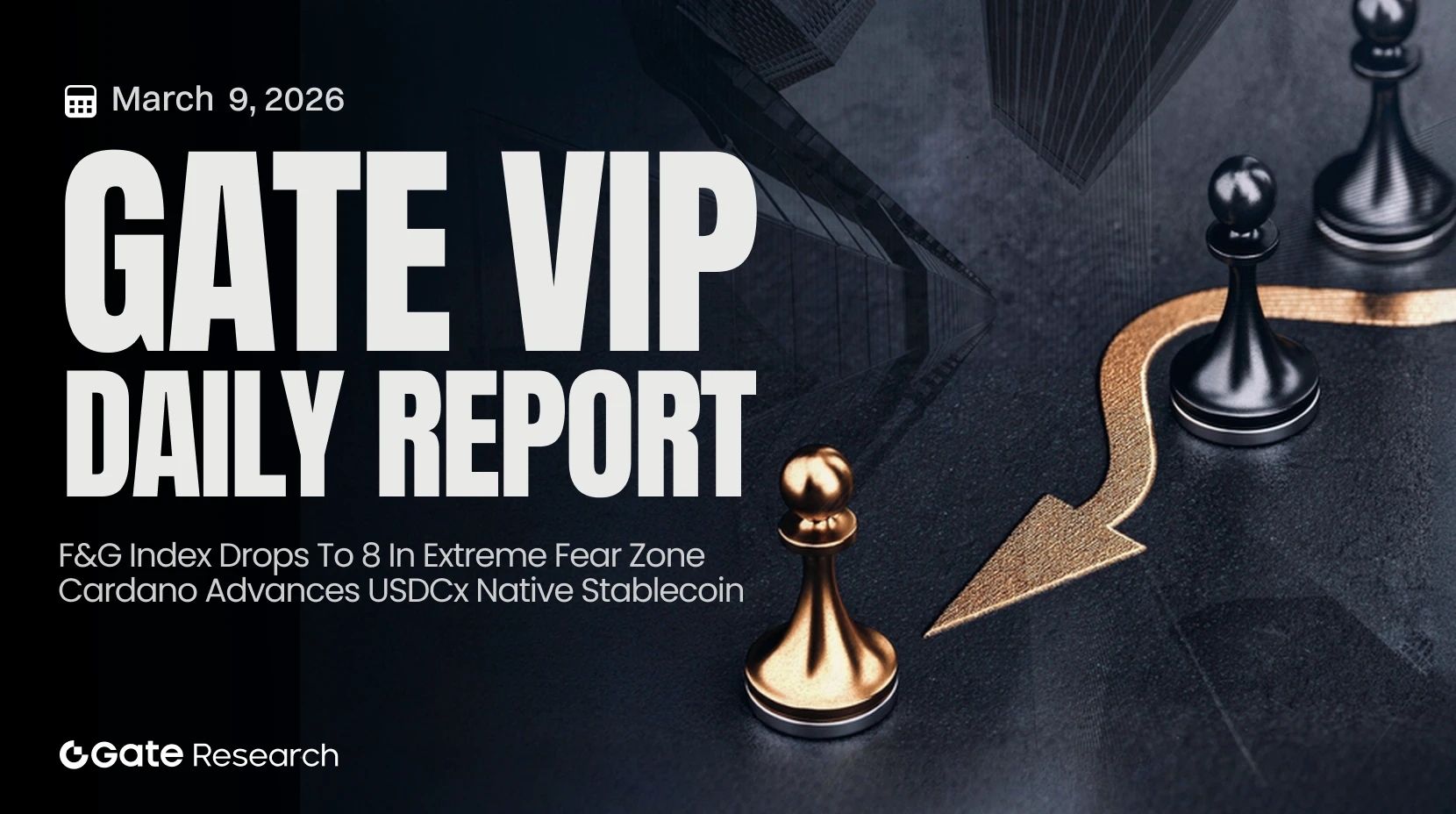
Gate Research: Panic and Greed Index Falls to 8, Indicating Extreme Fear | Cardano Moves Forward with Native USDCx Stablecoin
Advanced

Gate Research: Panic and Greed Index Falls to 8, Indicating Extreme Fear | Cardano Moves Forward with Native USDCx Stablecoin

Gate Research Institute: On March 9, the market’s primary focus remains defensive. BTC’s rebound after its decline was weak, ETH managed to find support but lacked a breakout, and GT’s independence contracted, transitioning into a range-bound game. The Fear and Greed Index is at 8 (Extreme Fear), signaling a continued contraction in risk appetite. While mid- and small-cap tokens like DEGO, BABY, and MBOX saw strong upward moves, these were event-driven and based on capital rotation, without forming sustained sector-wide resonance. Key developments include the enactment of Pakistan’s "Virtual Assets Act 2026," Brickken’s involvement in Spain’s UNE standardization efforts, and Cardano’s progress on USDCx infrastructure—all indicating the industry is shifting from narrative-driven competition to long-term competition centered on regulation, standards, and settlement capabilities.
2026-03-09 06:55:29
Gate Research Institute: Extreme Market Panic|Cardano Pushes Forward with Native Stablecoin
Advanced

Gate Research Institute: Extreme Market Panic|Cardano Pushes Forward with Native Stablecoin

Gate Research Institute Daily: On March 9, the crypto market remained weak and volatile, with BTC and ETH both declining as the overall market maintained a defensive posture. Among trending tokens, DEGO (+53.60%), BABY (+28.04%), and MBOX (+25.26%) recorded the highest gains among assets with market capitalizations over $10 million, with new capital primarily targeting highly elastic small- and mid-cap sectors. On the regulatory front, the enactment of Pakistan's Virtual Assets Act 2026 is advancing legal oversight; Brickken joined the UNE standards framework to support asset tokenization rulemaking; and Cardano is enhancing USDCx infrastructure to strengthen stablecoins’ core functionality in payments and RWA settlement. The industry’s main trajectory continues toward greater compliance and infrastructure maturity.
2026-03-09 06:33:36
Gate Research: SYND Surges Over 55% in 24 Hours | Short Seller Bets Against Ethereum
Advanced

vip
Gate Research: SYND Surges Over 55% in 24 Hours | Short Seller Bets Against Ethereum

Gate Research Daily Report: On March 6, BTC pulled back after briefly surging above $74,000 and is currently consolidating around $71,000; ETH retraced from a recent high near $2,190 and is now trading in the $2,070–$2,090 range; GT remains in a narrow $7.10–$7.20 consolidation zone, maintaining a recovery-driven structure. SYND became the top gainer with a +55.81% surge. Meanwhile, the RWA sector continues to gain traction as Ondo Finance secured regulatory approval in Abu Dhabi to support tokenized stocks and ETF trading; the AI agent economy is drawing attention, with stablecoins and blockchain seen as key infrastructure; and short seller Culper Research has taken a bearish position on Ethereum, arguing its latest upgrade may weaken ETH tokenomics and risk a potential “death spiral.”
2026-03-06 09:03:14

Glossary

More
apr
Annual Percentage Rate (APR) represents the yearly yield or cost as a simple interest rate, excluding the effects of compounding interest. You will commonly see the APR label on exchange savings products, DeFi lending platforms, and staking pages. Understanding APR helps you estimate returns based on the number of days held, compare different products, and determine whether compound interest or lock-up rules apply.
fomo
Fear of Missing Out (FOMO) refers to the psychological phenomenon where individuals, upon witnessing others profit or seeing a sudden surge in market trends, become anxious about being left behind and rush to participate. This behavior is common in crypto trading, Initial Exchange Offerings (IEOs), NFT minting, and airdrop claims. FOMO can drive up trading volume and market volatility, while also amplifying the risk of losses. Understanding and managing FOMO is essential for beginners to avoid impulsive buying during price surges and panic selling during downturns.
nft
An NFT (Non-Fungible Token) is a unique certificate recorded on the blockchain that represents ownership and attributes of a specific digital work or on-chain asset. NFTs are minted by smart contracts, which also store their metadata. Unlike fungible tokens, NFTs are indivisible and cannot be exchanged on a one-to-one basis. They are commonly used in digital art, in-game items, event tickets, and membership passes, enabling proof of ownership, provenance tracking, and trading. Some platforms also support creator royalties and cross-chain display of NFTs.
leverage
Leverage refers to the practice of using a small amount of personal capital as margin to amplify your available trading or investment funds. This allows you to take larger positions with limited initial capital. In the crypto market, leverage is commonly seen in perpetual contracts, leveraged tokens, and DeFi collateralized lending. It can enhance capital efficiency and improve hedging strategies, but also introduces risks such as forced liquidation, funding rates, and increased price volatility. Proper risk management and stop-loss mechanisms are essential when using leverage.
Learn Cryptocurrency & Blockchain

Your Gateway to Crypto World, Subscribe to Gate for a New Perspective

Learn Cryptocurrency & Blockchain