
Bitcoin’s circulating supply approaches 20 million coins, with over 95% already mined. The final 1 million coins will take a century to mine, drawing renewed attention to its scarcity.
The “King of Cryptocurrency,” Bitcoin, is preparing to reach a significant milestone: the 20 millionth Bitcoin is about to be issued. According to on-chain data platform Clark Moody Dashboard, approximately 19,996,979 Bitcoins have been mined and are in circulation, leaving only about 3,000 coins to reach 20 million. Based on the block production rate, it is estimated to happen in about 7 days.
At that point, over 95% of the total supply of 21 million Bitcoins will be in circulation, while the remaining 1 million will take more than a century to mine completely.
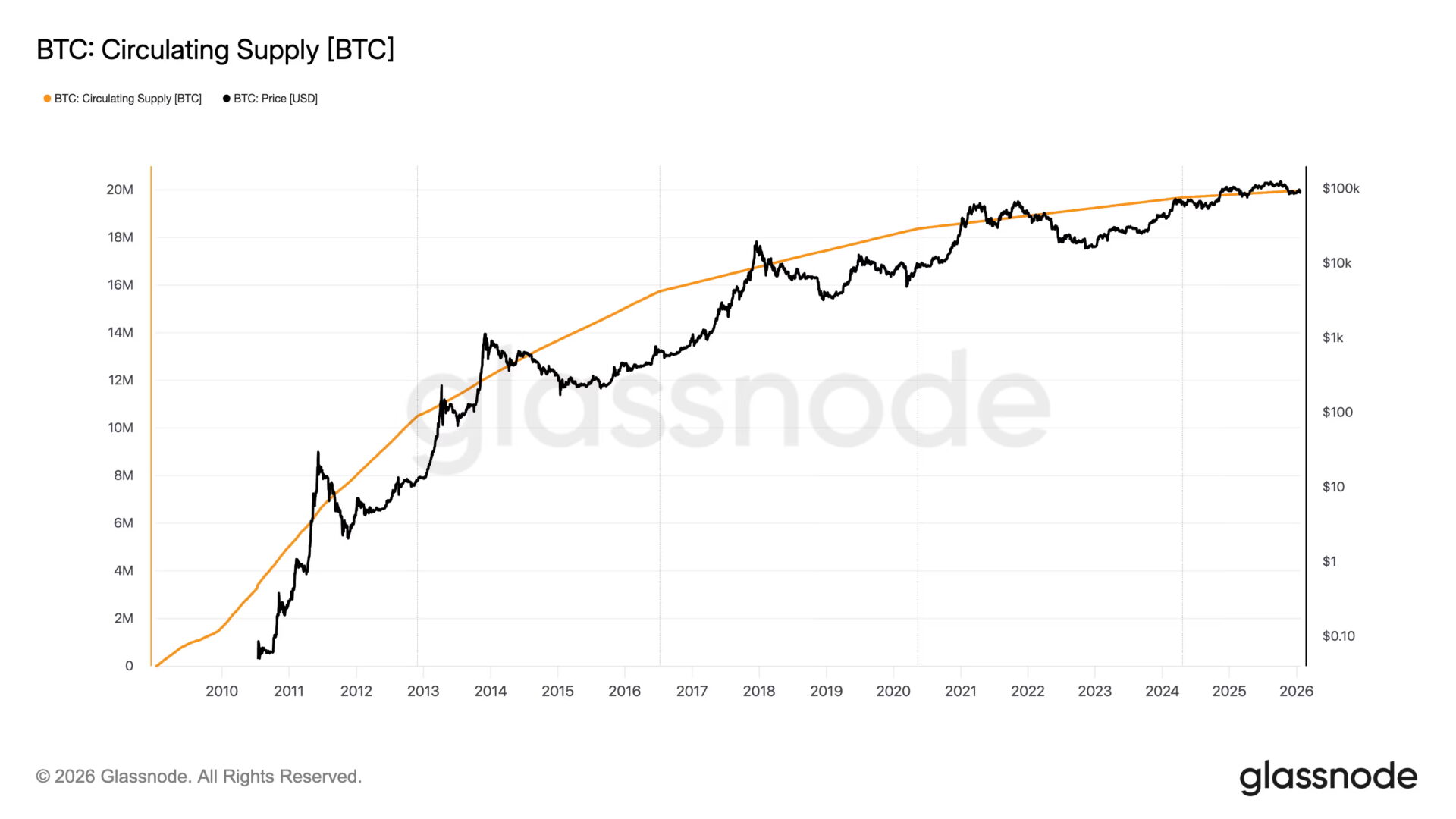
Image source: glassnode
When Bitcoin’s creator, Satoshi Nakamoto, designed the protocol, he set the maximum supply at 21 million coins in the original code, creating a form of currency with “absolute scarcity,” in stark contrast to fiat currencies issued by central banks, which can be increased at any time.
Although Nakamoto never publicly explained why he chose the number 21 million, this immutable cap has become an unshakable belief among Bitcoin enthusiasts. To them, any proposal to change the supply limit is a fundamental betrayal of Bitcoin’s value as a “hard currency.”
Bitcoin’s scarcity is often compared to gold and oil. However, in traditional commodity markets, if gold or oil prices surge, producers typically increase extraction or find new sources to boost supply and stabilize prices. Bitcoin is different; because its issuance curve is transparent and tamper-proof, no matter how wild the market prices become, the supply cannot be accelerated.
Bitcoin’s issuance rate decreases with each “halving event,” which occurs approximately every four years, halving the block rewards for miners and slowing new coin issuance. Currently, Bitcoin’s inflation rate has fallen below 1%, with about 450 new coins produced daily.
At this pace, 99% of the total supply will be mined by January 2035, and the last Bitcoin is expected to be mined around 2105. The remaining smaller fractions will continue to be released gradually until around 2140.
Once all Bitcoins are issued, miners will no longer rely on block rewards but will depend entirely on transaction fees for revenue. This means the long-term security and economic model of the Bitcoin network will ultimately depend on whether transaction demand can sustain miner income.
- This article is reprinted with permission from: “BlockCast”
- Original title: “Bitcoin Circulating Supply Approaching the 20 Million Milestone! The Last 1 Million Coins Will Take 114 Years to Mine”
- Original author: Block Sister MEL
Disclaimer: The information on this page may come from third parties and does not represent the views or opinions of Gate. The content displayed on this page is for reference only and does not constitute any financial, investment, or legal advice. Gate does not guarantee the accuracy or completeness of the information and shall not be liable for any losses arising from the use of this information. Virtual asset investments carry high risks and are subject to significant price volatility. You may lose all of your invested principal. Please fully understand the relevant risks and make prudent decisions based on your own financial situation and risk tolerance. For details, please refer to
Disclaimer.
Related Articles
The number of Americans holding Bitcoin has surpassed gold for the first time, with BTC holding steady at $63,700 becoming the key
The Bitcoin market is consolidating at high levels, and the number of holders surpassing gold owners indicates increased recognition of it as a new store of value. The US market demand is strong but faces a key technical test, requiring a steady hold above $63,700. The flow of funds will determine the future price trend.
GateNews4m ago
RWA tokenization volume soars to $25 billion: institutional funds accelerate entry, potentially reaching $50 billion by 2030
March 9 News, the real-world asset tokenization (RWA) market continues to expand in 2026, reaching a value of approximately $24.9 billion, nearly quadrupling. U.S. Treasuries and commodities have become the main drivers, and the market structure is gradually diversifying. The number of RWA holders exceeds 663,000, and stablecoin users are also increasing rapidly. The industry expects that by 2030, the RWA market could surpass $50 billion.
GateNews14m ago
Solana stablecoin settlement surpasses $650 billion: Funds flow out of Ethereum, on-chain USD payment landscape is changing
Stablecoins have seen a significant increase in blockchain settlement volume, with the Solana network performing outstandingly, reaching $650 billion in transfers by 2026. Their applications have expanded to cross-chain settlements, DeFi collateral, and other areas, with market attention on stablecoins becoming increasingly focused on their role as an important payment layer. User engagement has increased, and stablecoins are transforming into the foundational infrastructure for blockchain payments.
GateNews16m ago
XRP's unrealized loss exceeds $50 billion: Nearly 60% of circulating supply is in loss, but whales are increasing their holdings against the trend
The cryptocurrency market is volatile, with XRP prices remaining weak, declining nearly 28% since early 2026. Approximately 60% of circulating XRP is in loss, trading activity has decreased, and market liquidity has thinned. Despite retail investors being under pressure, some major whales are increasing their XRP holdings, indicating structural divergence in the market. In the short term, XRP's trend may continue to exhibit high volatility.
GateNews27m ago
The Arbitrum cross-chain bridge had a net inflow of $616 million over the past 7 days, ranking first among public blockchains.
Gate News Report, March 9th, data shows that in the past 7 days, the Arbitrum cross-chain bridge had a net inflow of $615.75 million, ranking first among all public chains. Following are Plasma and Avalanche, with net inflows of $442.33 million and $290.88 million respectively. During the same period, Ethereum, Mantle, and Hyperliquid experienced net outflows of $4.364 billion, $183.56 million, and $152.24 million.
GateNews51m ago
Tokenized gold trading explodes: XAUT's weekly trading volume on Solana surpasses $280 million, reigniting interest in the RWA sector
The blockchain real-world asset market is heating up, with tokenized gold Tether Gold (XAUT) experiencing a significant increase in trading volume on the Solana network, with weekly trading exceeding $280 million. As institutional investors participate more, the market demand for tokenized assets is rapidly expanding, indicating that the RWA market may continue to grow in the future.
GateNews51m ago


