March 3 News: The latest manufacturing data released in the United States has once again attracted attention from the crypto market. The US ISM Manufacturing Purchasing Managers’ Index (PMI) has remained above 50 for two consecutive months, indicating that economic activity is in an expansion phase. Some market analysts believe this macro signal could provide significant support for the altcoin market in 2026.
The latest data shows that in February 2026, the US ISM Manufacturing PMI was 52.4, slightly below January’s 52.6 but still significantly higher than the market expectation of 51.8. The PMI index is generally regarded as an important indicator of the US economic cycle; when the index is above 50, it indicates manufacturing activity is expanding.
Crypto market analyst Ash Crypto pointed out that historical experience suggests that when PMI remains above 50, corporate profitability and household income tend to improve simultaneously, which boosts investors’ risk appetite. In such an environment, capital is more likely to flow into high-risk assets, including Bitcoin and altcoins.
Ash Crypto believes that if the PMI continues to stay in the expansion zone in the coming months, the crypto market may gradually shake off its previous downturn and re-enter a period of active capital flow. Macroeconomic improvements often drive demand for risk assets, which has been a key factor in multiple past crypto bull markets.
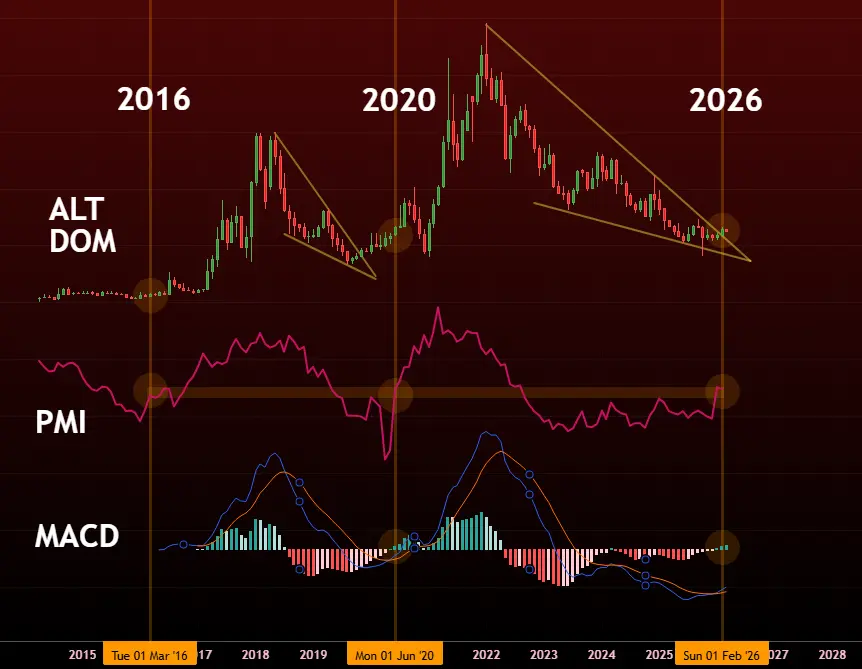
Another market analyst, Matthew Hyland, offers a more optimistic technical perspective. He stated that the current market cap share of altcoins has broken through the descending wedge pattern, and the monthly MACD-H indicator shows signs of recovery. These signals have historically appeared before the start of altcoin rallies.
However, the market still faces significant pressure. On-chain data provider CryptoQuant analyst Darkfost pointed out that about 38% of altcoin prices are still near historical lows, a proportion even higher than after the 2022 FTX incident, reflecting weak investor interest in altcoin assets.
Researchers believe that the altcoin market currently faces oversupply and liquidity shortages. Many projects competing for limited funds make it difficult for the market to form a broad upward trend.
Nevertheless, macroeconomic data, technical indicators, and capital cycles continue to send potential signals. If the US economic expansion persists and the crypto market’s funding environment improves, there remains a possibility of a new altcoin rally in 2026, though the pace and scale still require further market validation.
Disclaimer: The information on this page may come from third parties and does not represent the views or opinions of Gate. The content displayed on this page is for reference only and does not constitute any financial, investment, or legal advice. Gate does not guarantee the accuracy or completeness of the information and shall not be liable for any losses arising from the use of this information. Virtual asset investments carry high risks and are subject to significant price volatility. You may lose all of your invested principal. Please fully understand the relevant risks and make prudent decisions based on your own financial situation and risk tolerance. For details, please refer to
Disclaimer.
Related Articles
BTC 15-minute rally of 0.85%: Fed policy shift and ETF capital resonance drive buying momentum
From 2026-03-12 09:30 to 2026-03-12 09:45 (UTC), Bitcoin (BTC) experienced a rapid surge within a 0.93% volatility range, achieving a return of +0.85%, with prices fluctuating between 69678.0 and 70324.2 USDT. Trading volume increased approximately 38% compared to the previous hourly average. Market attention surged significantly, with short-term bullish sentiment amplified notably.
The primary driver of this market movement was the Federal Reserve Chair's early morning release of policy shift signals, hinting that the pace of future rate hikes may slow down. The market broadly interpreted this as a marginal improvement in the liquidity environment
GateNews40m ago
Why Didn't BTC Drop During Geopolitical Conflicts? Answers From Binance's Fund Structure and CVD
The article analyzes the relationship between Binance's BTC balance changes and market demand, indicating that the decrease in BTC balances in the short term is related to genuine demand, especially during the US-Iran conflict. The widening gap in spot trading volume suggests active buying activity, supporting the presence of real demand. Although short-term demand may stabilize BTC prices, the long-term trend still leans downward, and the process of demand recovery could be lengthy.
PANews47m ago
Germany's Long-Term Bitcoin Holdings Enjoy Tax-Free Advantages, Investor Interest Surges
Germany's long-term Bitcoin holding tax-exemption policy, which has been in effect since 2009 through 2026, encourages investors to hold for over one year to avoid capital gains tax. This policy reduces the tax burden and attracts global investors to build Bitcoin investment portfolios in Germany, driving market attention.
GateNews1h ago
Germany Offers Tax-Free Bitcoin Gains After 12 Months
Germany's longstanding rule allows Bitcoin holders to pay 0% capital gains tax if held for over a year, promoting long-term investment. Despite new EU transparency rules, this tax benefit remains a draw for investors.
Coinfomania1h ago


