The funding rates for Bitcoin perpetual futures on major cryptocurrency derivatives exchanges have fallen to -0.005%, -0.007%, and -0.011%, reflecting that bears currently dominate the derivatives market. Analysts point out that historically, extreme short interest ratios often precede sharp reversals, but whether macroeconomic conditions align remains a key variable.
Funding Rate Mechanism and Current Market Implications
In perpetual futures contracts, the funding rate is the periodic fee exchanged between longs and shorts to keep the contract price aligned with the spot market. When the funding rate is negative, it means shorts pay longs, typically indicating a strongly bearish overall market sentiment.
Analyst Amr Taha referenced Bitcoin liquidation data in a market update on February 27: there are large leveraged positions above the current price, with many short entries around $92,000. He noted that if Bitcoin breaks upward, these short positions will face forced liquidations, creating a short squeeze and amplifying price volatility.
Taha said, “If macroeconomic conditions improve, the likelihood of prices rising again in the short and medium term increases.” However, he emphasized that relying solely on the funding rate is insufficient for predicting market direction. Historically, large short interest combined with negative funding often signals a sharp reversal, but it requires additional indicators for comprehensive analysis.
Retail Return and Whale Movements: Contradictory Market Signals
CryptoQuant contributor Nino observed that retail traders are trading at significantly higher frequencies than the one-year average, indicating that individual funds are cautiously flowing back into the market, seen as a potential sign of improved sentiment.
However, whale activity suggests different signals. Taha tracked about 1,700 Bitcoin flowing from the “Octopus” wallet group (representing medium-term holders) into Binance. Notably, the same group had transferred 5,000 Bitcoin into Binance on February 2, 2025, after which Bitcoin declined from above $77,500. The current inflow is much smaller; Taha assessed, “This lower intensity suggests that selling pressure may not be as strong as before.”
Bitcoin tested the $70,000 level on February 26 but failed to hold it. At the time of writing, it was trading around $68,000, down 0.4% in 24 hours, and has been consolidating for seven days. Glassnode analysts pointed out that despite short-term stability, Bitcoin has yet to show real bottoming signals.
Key Bitcoin Market Data Snapshot
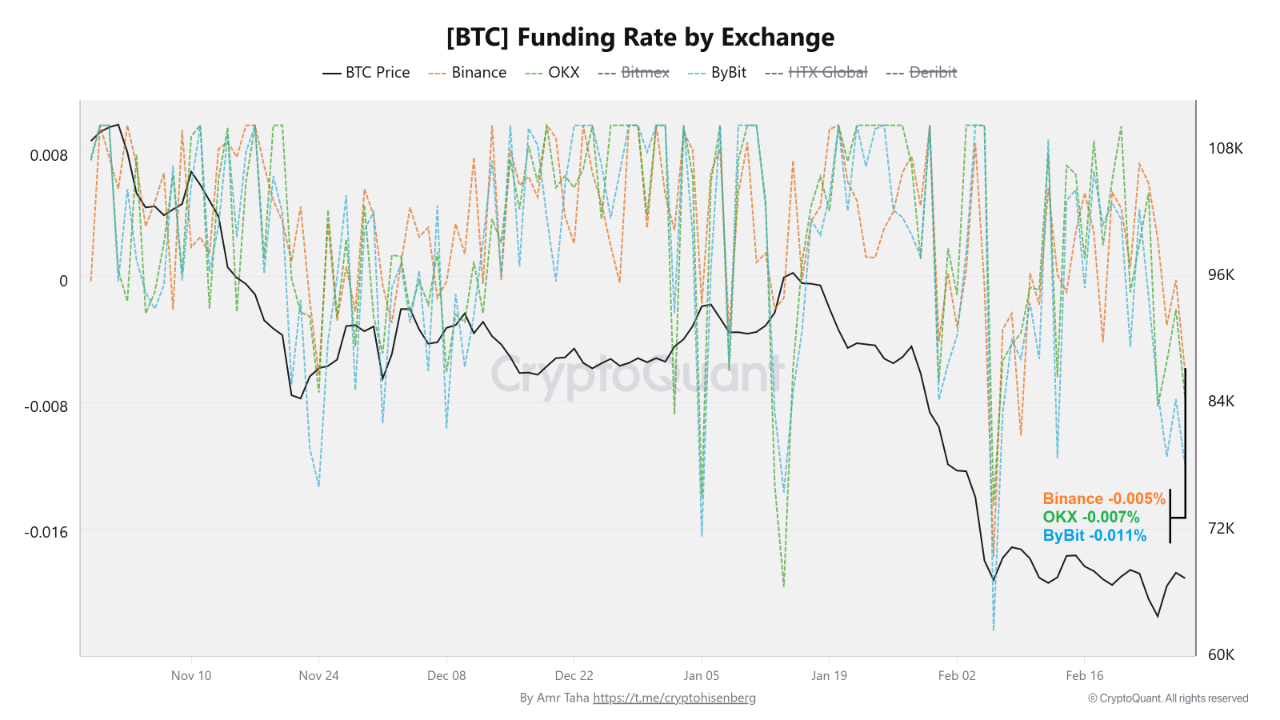
(Source: CryptoQuant)
Funding Rate: Negative across major exchanges, ranging from -0.005% to -0.011%
7-Day Trend: Sideways consolidation around $68,000 (0.4% decline in 24 hours)
30-Day Performance: Down approximately 24%
From All-Time High (October 2025): About 46% decline
Around $92,000: Liquidation map shows dense short positions; a breakout could trigger a short squeeze
Frequently Asked Questions
What does a negative Bitcoin funding rate mean, and what is its significance for retail investors?
A negative funding rate indicates a high proportion of shorts in the derivatives market, with shorts paying longs to maintain their positions. For retail investors, this metric reflects a generally bearish sentiment in the derivatives market, but it does not directly determine the spot market trend. It is usually used in conjunction with liquidation maps, open interest, and other indicators to analyze overall market structure.
What is a “short squeeze,” and how does a negative funding rate increase its likelihood?
A short squeeze occurs when a large concentration of short positions faces upward price movement, forcing traders to cover their shorts at higher prices, which further drives up the price in a chain reaction. Extremely negative funding rates suggest a large short interest, and combined with dense short positions shown on liquidation maps near $92,000, any upward catalyst could lead to significant forced liquidations, accelerating and amplifying upward price moves.
With Bitcoin down 46% from its all-time high, can we say the bottom is in?
A decline alone cannot confirm a bottom. Confirming a bottom typically requires multiple technical and on-chain indicators. Glassnode analysts noted that despite recent short-term stability, there are no definitive signs of a true bottom recovery. Investors should evaluate a combination of data points such as funding rates, ETF capital flows, retail activity, and other metrics rather than relying on a single indicator.
Disclaimer: The information on this page may come from third parties and does not represent the views or opinions of Gate. The content displayed on this page is for reference only and does not constitute any financial, investment, or legal advice. Gate does not guarantee the accuracy or completeness of the information and shall not be liable for any losses arising from the use of this information. Virtual asset investments carry high risks and are subject to significant price volatility. You may lose all of your invested principal. Please fully understand the relevant risks and make prudent decisions based on your own financial situation and risk tolerance. For details, please refer to
Disclaimer.
Related Articles
BTC surged to $74,000 before falling back below $69,000, with the total market capitalization evaporating approximately $110 billion.
This week, the cryptocurrency industry received positive news from Wall Street, but Bitcoin's price fell from $74,000 to $69,000, with a market cap evaporating approximately $110 billion. The strength of the US dollar and macroeconomic factors are putting pressure on risk assets. Short-term holders are taking profits, increasing selling pressure, but the US spot Bitcoin ETF recorded net inflows, indicating an improvement in the funding environment.
GateNews2h ago
Today, the cryptocurrency Fear & Greed Index dropped to 12, indicating the market is in extreme fear.
Gate News Report, March 7th, according to Alternative.me data, today the cryptocurrency fear and greed index dropped to 12, indicating the market is in a state of "extreme fear." Yesterday, the index was 18, also in the "extreme fear" zone.
GateNews2h ago
Kaspa Tops CoinMarketCap Community Sentiment With 90% Bullish Votes – Here’s Why
Kaspa’s price hasn’t had the best year. The coin is currently trading around $0.03, and on the yearly chart it’s still down roughly 60%. That kind of drop usually hurts sentiment in most crypto
CaptainAltcoin3h ago
Will XRP Hold $1.33 or Extend Toward $1.30 Before Rebound?
XRP is currently trading at $1.35, experiencing a 1.3% decline. Key support is at $1.34, while resistance is at $1.40. The price is testing around the Fibonacci levels of $1.33 and $1.30, crucial for potential upward movement or deeper decline.
CryptoNewsLand7h ago
Dogecoin Monthly Breakdown Pattern Reappears as Price Tests $0.0918
Dogecoin is currently trading at $0.09205 at a gain of 2.3, with support of above $0.08878.
As can be seen in the monthly chart, there are recurring breakdown areas that have been followed by significant expansions in price.
The short-term trading range is narrow and the immediate point o
CryptoNewsLand7h ago


