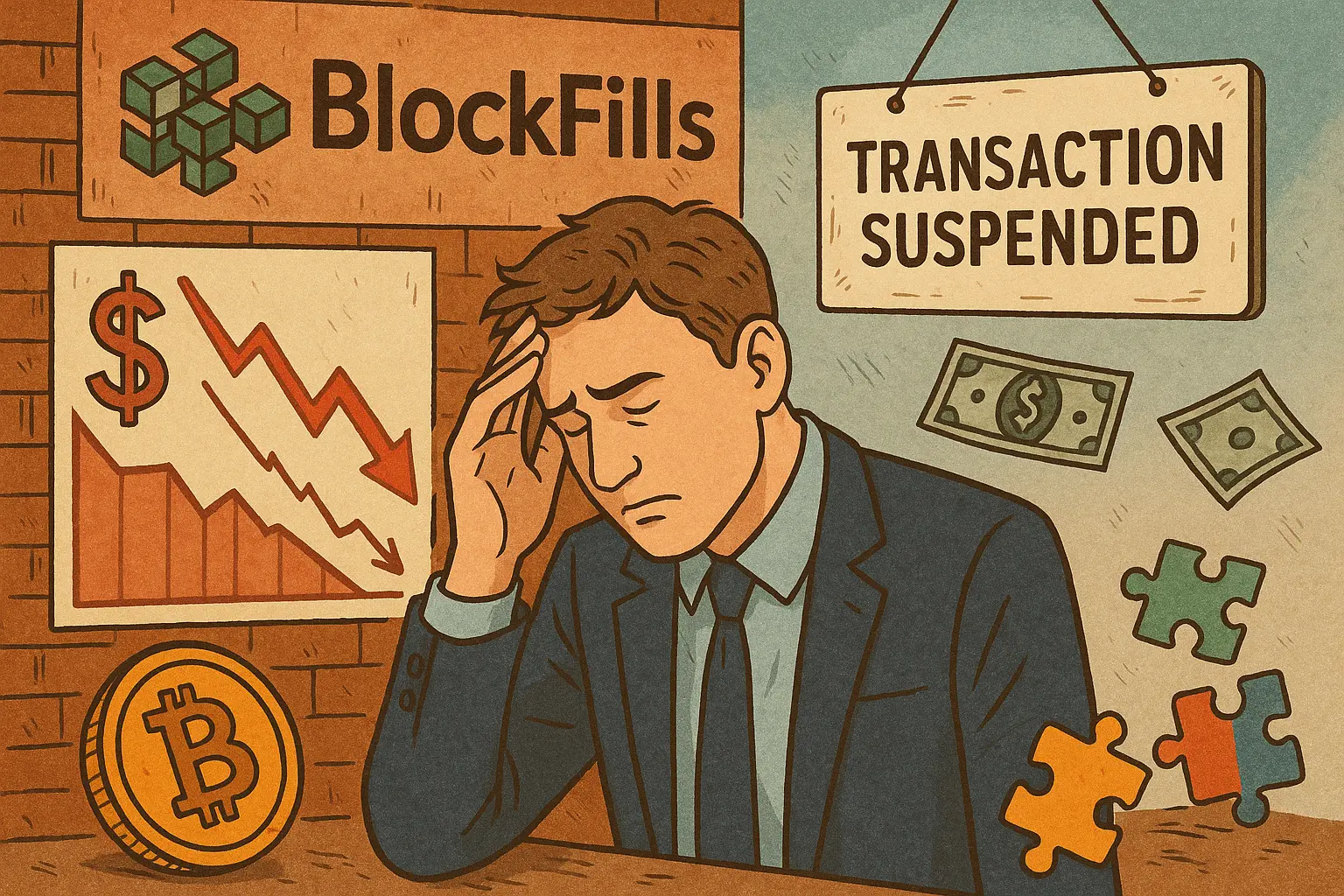
Chicago-based cryptocurrency liquidity provider and lending firm BlockFills has suspended all customer deposits and withdrawals starting February 11. Co-founder and CEO Nicholas Hammer subsequently resigned, with Joseph Perry appointed as interim CEO. The company reports approximately $75 million in losses from its crypto asset lending business, and withdrawal functions remain halted as it seeks buyers or strategic investors.
Timeline of Events: Causes of Loss, Freeze Decision, and Leadership Change
BlockFills primarily serves hedge funds, asset management firms, and high-net-worth institutional traders, focusing on liquidity provision and crypto asset collateralized lending. During a market downturn, the value of crypto collateral provided by borrowers continued to decline, causing loan coverage ratios to fall below minimum thresholds, ultimately resulting in an unrecoverable loss of about $75 million.
Notably, before the company officially announced the freeze, some clients received internal warnings advising them to withdraw assets before measures took effect, indicating management had some foresight of an impending liquidity crisis.
Key Facts of the BlockFills Incident
Loss Scale: Approximately $75 million from crypto lending operations
Freeze Effective Date: February 11, 2026, all customer deposits and withdrawals fully halted
Leadership Change: Nicholas Hammer resigned; Joseph Perry appointed as interim CEO
Early Warning: Some clients received warnings and completed withdrawals before the freeze
Next Steps: The company is actively initiating a sale process, seeking buyers or strategic investors
Systemic Vulnerability of Institutional Crypto Lending: BlockFills Is Not the First
The crisis at BlockFills highlights the structural weaknesses of institutional crypto lending during market volatility cycles. Its loss mechanism closely resembles that of several well-known lenders that collapsed in recent years: Celsius, Voyager, and Genesis all faced rapid declines in collateral value during market downturns, leading to unrecouped loans and operational halts.
The core issue with crypto assets as collateral is their volatility. During market rallies, coverage ratios are ample, but a swift correction can cause collateral values to fall below minimum liquidation thresholds in a short period. If lenders fail to liquidate or require additional collateral promptly, losses can accumulate rapidly. The case of BlockFills again demonstrates that even liquidity providers primarily serving institutional clients are structurally vulnerable to this systemic risk.
For institutional clients, the impact of the freeze is particularly direct: hedge funds and asset managers rely on liquidity providers for daily trading settlements. Funds frozen in assets will directly affect their overall liquidity management, creating chain reactions and counterparty risks.
Frequently Asked Questions
What is BlockFills, and why is this crisis noteworthy?
BlockFills is an institutional crypto liquidity provider and lender based in Chicago, mainly serving hedge funds, asset management firms, and high-net-worth institutional traders. Its client base’s institutional nature means that the withdrawal freeze has broad implications for counterparty risk and liquidity in the overall crypto market.
How did BlockFills incur a $75 million loss?
The loss stems from the company’s crypto asset collateralized lending business. During a market downturn, the value of collateral provided by borrowers sharply declined, leading to insufficient loan coverage and an unrecoverable loss of about $75 million. This is a typical risk scenario in institutional crypto lending during high volatility, similar to the collapses of Celsius and others previously.
What is the current status of client funds at BlockFills?
As of the end of February 2026, customer deposits and withdrawal functions remain suspended. The company is actively seeking buyers or strategic investors. Some clients who received early warnings have completed withdrawals, but whether remaining funds can be fully recovered depends on the outcome of the company’s sale or restructuring process.
Disclaimer: The information on this page may come from third parties and does not represent the views or opinions of Gate. The content displayed on this page is for reference only and does not constitute any financial, investment, or legal advice. Gate does not guarantee the accuracy or completeness of the information and shall not be liable for any losses arising from the use of this information. Virtual asset investments carry high risks and are subject to significant price volatility. You may lose all of your invested principal. Please fully understand the relevant risks and make prudent decisions based on your own financial situation and risk tolerance. For details, please refer to
Disclaimer.
Related Articles
Bonk.fun Hack Exposes Solana Users to Wallet Drainer Attack
Security experts discovered malicious code on Bonk.fun that exposed users to potential wallet-draining attacks.
However, security experts have expressed fears that users of decentralized sites remain
TheNewsCrypto37m ago
Pump.fun Cumulative Revenue Reaches $1.08 Billion, Becoming Solana's First Platform to Surpass $1 Billion
Since its launch in early 2024, Pump.fun has generated $1.08 billion in revenue, becoming the first platform on the Solana blockchain to surpass the $1 billion mark. In 2024, its revenue reached $321.3 million, and its buyback program has repurchased approximately $323.4 million worth of PUMP tokens. However, the PUMP token price remains below its initial issuance price, and the platform has expanded to other blockchain networks.
GateNews46m ago
US Stock Pre-market Crypto Concept Stocks Show Mixed Performance, CRCL Up 0.21%
U.S. stock market pre-market crypto concept stocks showed mixed performance, with BMNR, SBET, COIN, and MSTR all declining, while CRCL rose slightly. As a decentralized trading platform, msx.com has listed multiple RWA tokens.
GateNews1h ago
The risk of escalation in the U.S.-Iran conflict rises to 70%, with experts warning that Bitcoin may face a short-term crash
US-Iran conflict escalates, tensions may persist through May, oil prices break $95, global markets face risks. Bitcoin under short-term pressure, investor risk-aversion sentiment rises, focus on geopolitical risks and asset allocation strategies.
GateNews2h ago
Musk Clarifies He Doesn't Hold Shiba Inu, Triggering Brief SHIB Volatility
Elon Musk recently clarified that he does not hold Shiba Inu (SHIB) tokens, putting an end to market speculation about his potential SHIB accumulation. This statement has drawn investor attention to SHIB's price fluctuations. Although Musk has not invested in SHIB, his association with Dogecoin continues to influence market sentiment around SHIB. The SHIB price has declined approximately 93.55% from its historical high.
GateNews2h ago
Mainstream CEX Listing Pi Coin Countdown, Market Bullish Sentiment Heats Up Before Pi Day
Pi Network community receives positive news with mainstream exchanges listing Pi coin on March 13, with market attention surging dramatically. Technical analysis shows PI/USDT in an uptrend with strong buying pressure, though short-term pullback risks warrant attention. This event could drive Pi coin to break through current price levels and form a new wave of upward momentum.
GateNews2h ago


