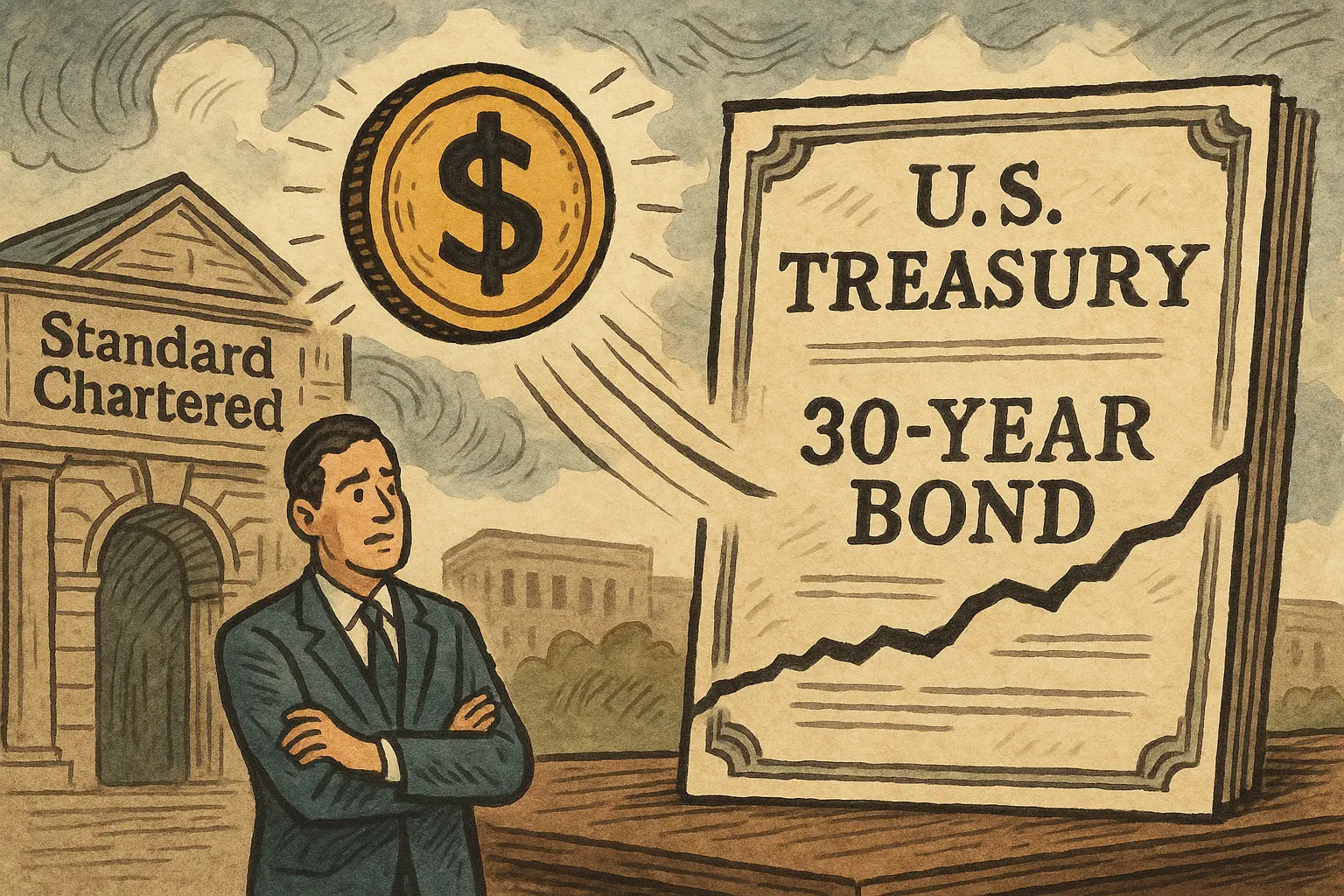
A recent report from Standard Chartered reveals that stablecoin issuers’ demand for U.S. short-term government bonds is accelerating rapidly. It is estimated that by the end of 2028, this new demand will reach $1 trillion. When including the Federal Reserve’s bond purchase programs, the total demand for short-term government bonds could exceed $2.2 trillion. This structural shift may compel the U.S. Treasury to reconfigure its debt portfolio or even suspend 30-year bond auctions for up to three years.
Stablecoins Are Becoming the Invisible Major Buyer of U.S. Treasury Bonds
(Source: Standard Chartered)
Standard Chartered analyst Jeff Kendrick notes in the report that stablecoin issuers typically need to hold large amounts of highly liquid, top-rated assets to maintain their peg stability, with U.S. Treasury bills (T-bills) being the preferred choice. These emerging buyers are quietly transforming the demand structure in the U.S. short-term debt market.
The bank’s forecast figures are striking. By the end of 2028, the additional demand for T-bills driven by stablecoins is expected to range between $800 billion and $1 trillion. When factoring in the Fed’s ongoing bond purchases and the refinancing of maturing mortgage-backed securities, the total demand in the short-term government bond market could reach $2.2 trillion, fundamentally reshaping U.S. debt financing strategies.
Who Is Driving This Demand?
Emerging Market Stablecoins: Expected to account for two-thirds of the total new demand, representing net new capital inflows globally rather than internal fund shifts.
Developed Market Stablecoins: Demand mainly comes from replacing existing holdings, contributing relatively little to market growth.
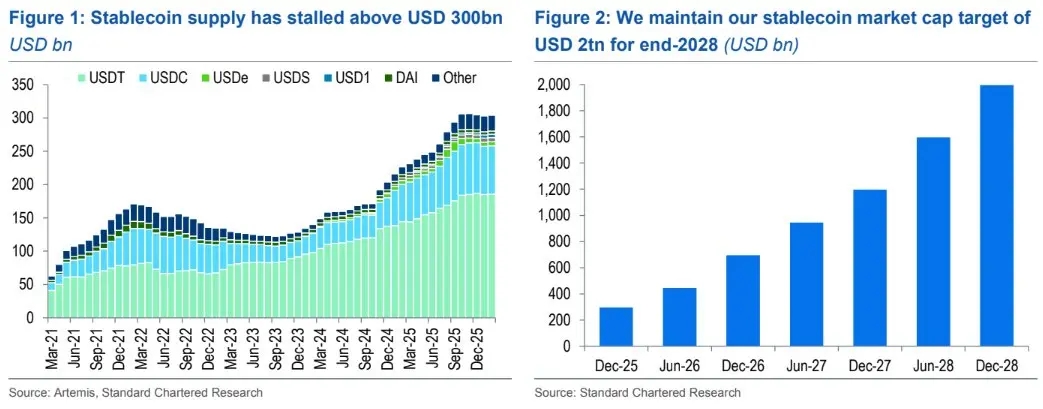
Total Stablecoin Market Cap: Currently around $304 billion, with Standard Chartered predicting it will surpass $2 trillion by 2028.
This structure highlights a key reality: the growth in stablecoin demand is not an internal cycle within the crypto market but is systematically channeling new capital from emerging markets worldwide into the U.S. short-term debt market.
U.S. Treasury Faces a Historic Dilemma: Shortening Debt Maturity
(Source: Standard Chartered)
This enormous demand for short-term securities presents the U.S. Treasury with an unprecedented policy opportunity, as well as a challenging structural choice.
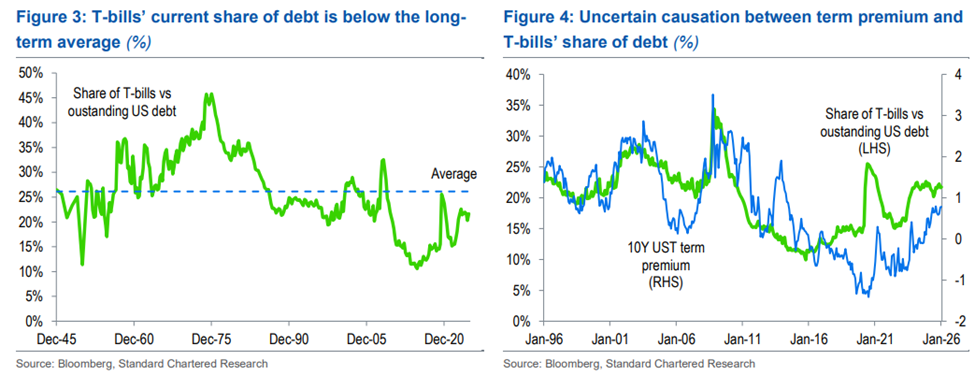
Standard Chartered warns that the Treasury might respond to the excess demand for stablecoins by significantly increasing the proportion of T-bills in its overall debt portfolio, while reducing the issuance of 30-year bonds or even suspending long-term auctions for up to three years. Historically, the Treasury suspended 30-year bond auctions from 2002 to 2006 — but the fiscal deficit environment then was far less severe than today, which is a critical difference highlighted by the bank.
If Treasury Secretary Yellen chooses to increase T-bills’ share by 2.5% over three years, roughly releasing an additional $900 billion in short-term supply, it could offset the excess demand from stablecoins and keep the 10-year Treasury yield within manageable levels.
However, Standard Chartered also cautions that this approach is not without costs. Rising term premiums, ongoing fiscal deficits, and rollover risks could produce more complex effects on the overall yield curve in the medium to long term. The short-term bull flattening effect does not equate to long-term rate stability.
Regulatory Lag Is the Biggest Uncertainty
Although Standard Chartered remains optimistic about the long-term demand for stablecoins, short-term growth has indeed stalled. Currently, the total stablecoin market cap is about $304 billion, still far from the $2 trillion target. The main reasons are recent weakness in the crypto market and the slower-than-expected implementation of regulatory frameworks following the passage of the U.S. “Genius Act.”
The bank characterizes these obstacles as cyclical rather than structural bottlenecks. As regulatory clarity gradually improves, institutional adoption of stablecoins will accelerate, and the profound impact on the U.S. short-term government bond market will follow.
Disclaimer: The information on this page may come from third parties and does not represent the views or opinions of Gate. The content displayed on this page is for reference only and does not constitute any financial, investment, or legal advice. Gate does not guarantee the accuracy or completeness of the information and shall not be liable for any losses arising from the use of this information. Virtual asset investments carry high risks and are subject to significant price volatility. You may lose all of your invested principal. Please fully understand the relevant risks and make prudent decisions based on your own financial situation and risk tolerance. For details, please refer to
Disclaimer.
Related Articles
Retail investors are not trading cryptocurrencies but stocks? Cryptocurrency market liquidity is moving to the US stock market, AI helps interpret financial reports and boosts confidence
Wintermute's research indicates that retail cryptocurrency funds are flowing heavily into the US stock market, reversing the correlation to become negatively correlated. As liquidity in the crypto market declines, retail investors prefer mature stock markets, aided by generative AI enhancing their investment capabilities. Cryptocurrencies are gradually becoming part of asset allocation.
CryptoCity1h ago
ETH drops 1.36% in 15 minutes: Deteriorating macro sentiment and liquidity crunch trigger spot selling pressure
From 02:45 to 03:00 on March 8, 2026 (UTC), ETH prices fluctuated sharply within the range of 1,936.0 to 1,969.18 USDT. The 15-minute candlestick yield was -1.36%, with an amplitude of 1.68%. The short-term downtrend intensified, market attention significantly increased, trading activity was high, and panic sentiment dominated.
The main driver of this anomaly was the widespread decline in global risk assets and escalating extreme panic sentiment. Major US stock indices experienced a sharp pullback, and the VIX fear index soared to 29.49 (+24.17%), leading to
GateNews3h ago
BTC drops 0.71% in 15 minutes: Weak macro data and miner sell-off resonate, increasing selling pressure
2026-03-08 02:45 to 03:00 (UTC), Bitcoin (BTC) price candlestick data shows a 15-minute return of -0.71%, with the lowest at 66,837.0 USDT and the highest at 67,402.7 USDT, with an amplitude of 0.84%. Short-term volatility has attracted market attention, with on-chain risk signals rising to 0.84, above the historical average, indicating cautious investor sentiment and increased market fluctuations.
The main driver of this anomaly is the US February employment data, which significantly underperformed expectations, with a sharp decrease in new jobs and the unemployment rate rising to 4.4%, combined with the US
GateNews3h ago
Iranian President unusually apologizes for "indiscriminate attacks on Middle Eastern neighboring countries"—what's the underlying motive?
Iranian President Ebrahim Raisi issued a rare apology on March 7, apologizing to neighboring Middle Eastern countries attacked, aiming to prevent escalation of conflict, stabilize internal affairs, buy time for leadership transition, and shape a pragmatic image to facilitate Western negotiations. Following this move, oil prices surged, attracting market attention and potentially impacting U.S. interest rate policies.
動區BlockTempo3h ago
Hedge Fund CIO warns: If there is no reopening signal for the Strait of Hormuz before Monday, commodity prices will surge again.
Experts warn that U.S. military action against Iran could cause a surge in oil prices. If the Strait of Hormuz cannot be reopened quickly, other measures will have limited effect. Some criticize the government's response strategy as too hasty, while others defend it, believing that high oil prices are a temporary phenomenon.
GateNews3h ago
The Wall Street Journal: International situation and employment data put the Federal Reserve in a dilemma, and it may remain on the sidelines in the short term
The Wall Street Journal reporter Timiraos analyzed that recent employment reports have intensified the Federal Reserve's dilemma between combating inflation and protecting jobs. Minneapolis Fed President Kashkari warned against repeating the mistakes of 2021, predicting that the Fed will not rush to adjust interest rates in the short term. If the unemployment rate rises, rate cuts may resume around mid-year, but if inflation risks increase, internal opposition voices will grow. Overall, the central bank faces a difficult choice.
GateNews3h ago


