
Wood believes that AI is not a bubble but a long-term investment. The recent decline in Bitcoin stems from emotions and liquidity, and investors should return to assessing technological maturity and overall economic conditions, considering multiple factors.
Cathie Wood (Wood) expressed her views on the resurgence of recent AI bubble rumors and the collective panic among Bitcoin investors during the Ark Invest program. She reminded investors to identify investment value through technological maturity, asset valuation, and macro liquidity. The following summarizes her viewpoints from the video, analyzing her perspective on artificial intelligence, crypto assets, and the current financial environment.
Is artificial intelligence a bubble? Elderly veterans who experienced past bubbles are overly worried
Wood explained with a chart that the capital expenditure in the tech industry as a percentage of GDP has approached historical highs, similar to previous bubble periods, causing concern among investors. She stated that she knows many experienced investors who were young during the internet bubble era and are now gray-haired seniors. Having gone through that bubble period, they believe in protecting themselves and their companies from the impact of bubbles. They tend to be more conservative in corporate decision-making, trying to avoid repeating past mistakes.
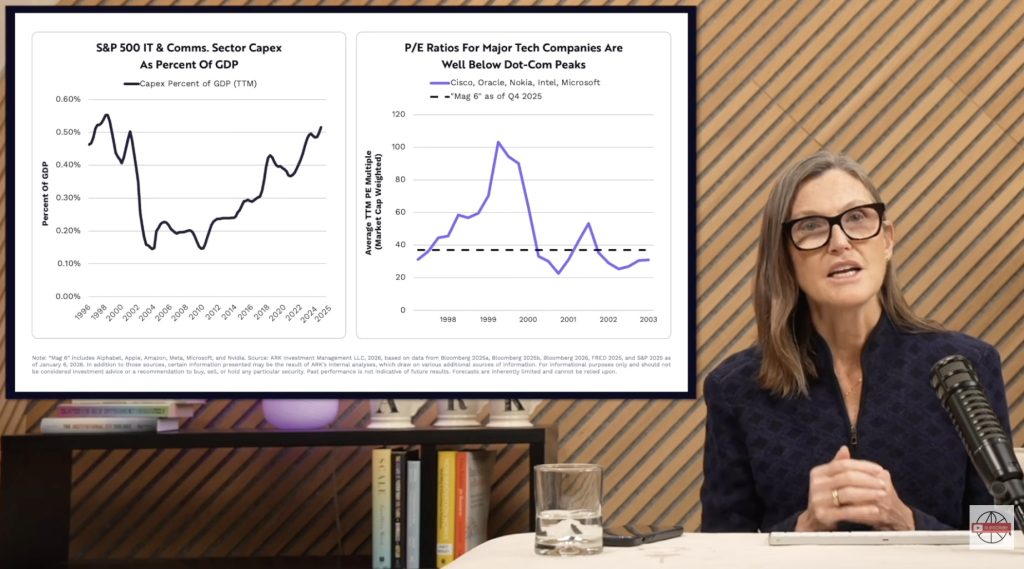
Wood said that the capital expenditure cycle related to artificial intelligence will be longer than in the past. The core debate is not just about the scale of spending but whether these technological investments can translate into stable and sustainable productivity in the future. During the internet bubble era, most technologies were immature and costly. Today’s price-to-earnings ratios are completely different from before. Now, a major disruption called artificial intelligence has emerged. Companies must invest in AI to stay competitive; they need to seize the opportunity. However, some shareholders focused only on short-term gains do not share this view.
Bitcoin rumors spread, intensifying market volatility
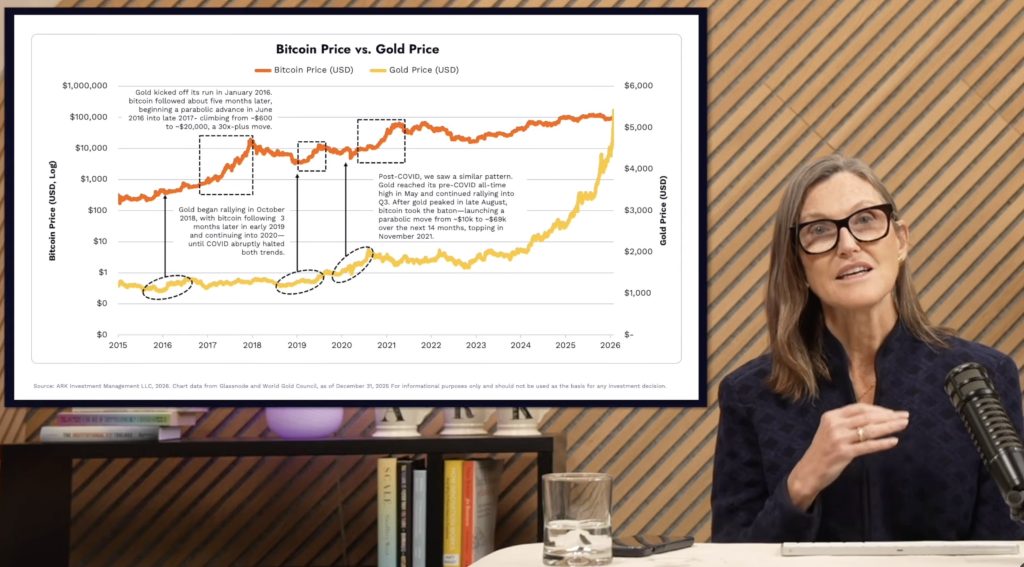
In recent years, gold prices have continued to rise, but Bitcoin has noticeably retreated from its highs. Wood pointed out with a chart that since 2019, the correlation between Bitcoin and gold returns is only about 0.14 (note: 1 indicates perfect correlation), indicating that Bitcoin’s price behavior differs significantly from gold and is more similar to high-volatility risk assets rather than traditional safe havens.
She noted that recent negative rumors have dampened market sentiment, putting downward pressure on prices and triggering phased sell-offs. Such situations are common in highly volatile assets and often amplify short-term price fluctuations.
Wood also mentioned that recent Bitcoin volatility partly stems from renewed attention to quantum computing issues. However, she believes that within the foreseeable next ten or more years, quantum computing is not yet capable of posing a substantial threat to current blockchain architectures. In contrast, changes in macro liquidity have a more direct impact on the market, including government budget uncertainties, employment data, Federal Reserve’s benchmark interest rate, and international interest rate trends—all of which create tightening pressures on the capital environment and amplify market turbulence.
Finally, Wood reminded that every time the market experiences sharp fluctuations, there are often opinions afterward that missed the low entry point. However, when the actual lows occur, market sentiment tends to turn into intense panic. She believes investment decisions should not only focus on price trends but also incorporate a comprehensive assessment of technology, macro environment, policy regulation, and market structure to reduce decision errors.
- This article is reprinted with permission from: Chain News
- Original title: Wood: Elders Fear AI Bubble, Rumors Cause Bitcoin Panic
- Original author: DW
Disclaimer: The information on this page may come from third parties and does not represent the views or opinions of Gate. The content displayed on this page is for reference only and does not constitute any financial, investment, or legal advice. Gate does not guarantee the accuracy or completeness of the information and shall not be liable for any losses arising from the use of this information. Virtual asset investments carry high risks and are subject to significant price volatility. You may lose all of your invested principal. Please fully understand the relevant risks and make prudent decisions based on your own financial situation and risk tolerance. For details, please refer to
Disclaimer.
Related Articles
PlanB: The S2F model predicts Bitcoin could reach $500,000 in this cycle, but the market questions whether the model has failed.
Crypto analyst PlanB on X platform stated that Bitcoin is currently priced at $67,000, but its S2F model predicts a future value of up to $500,000, suggesting that the current price is undervalued and may present a long-term buying opportunity. The market questions the validity of the model, and PlanB asked about Bitcoin's future trend.
GateNews2m ago
Dogecoin, Pepe, and Shiba Inu Slide as Bitcoin Falls Below $70K
Bitcoin's drop below $70K triggers a selloff in meme coins like Dogecoin and Shiba Inu, causing increased market volatility. Despite a surge in Shiba Inu's burn activity, its price declines alongside Dogecoin, which struggles with weak momentum.
CryptoBreaking57m ago
77% of Corporate Bitcoin Holdings Now Underwater, Data Shows - U.Today
Bitcoin's price has dropped 46.5% from its October 2025 high, affecting crypto treasury companies, with 77% reportedly in losses. Notably, Michael Saylor's Strategy company is facing significant unrealized losses as Bitcoin trades below its acquisition cost.
UToday2h ago
ETH drops 0.92% in 15 minutes: macroeconomic bearish data and support loss resonate, triggering price pressure
2026-03-08 11:00 to 2026-03-08 11:15 (UTC), ETH fluctuated within the range of 1952.51 to 1974.42 USDT, with an amplitude of 1.11%. The final 15-minute return was -0.92%. Trading volume briefly increased during this period, on-chain active addresses rose, and market attention intensified, leading to significant short-term volatility during the session.
The main driver of this movement was the US February non-farm payrolls data falling short of expectations, with the unemployment rate rising to 4.2%, which stimulated global risk aversion sentiment and caused capital to flow into dollar assets. Major US stock markets
GateNews2h ago
The fear and greed index in the cryptocurrency market drops to "extreme fear" level
Crypto Fear and Greed Index (Crypto Fear and Greed Index) – one of the most popular gauges for assessing investor sentiment in cryptocurrencies – has dropped back to the "extreme fear" level after showing a slight recovery last Wednesday.
According to data from CoinMarketCap, this index
TapChiBitcoin2h ago


