
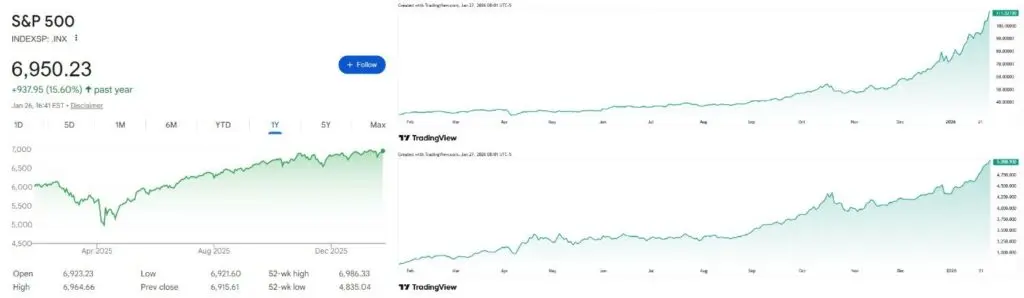
Senior Trader NoLimit warns of an “imminent total crash countdown” on Sunday, citing White House sources indicating that the market pattern in early 2026 bears a startling resemblance to the 2008 Great Recession. Key indicators include a surge in Federal Reserve repurchase tools, imbalance and breakdown of support in gold and the S&P 500, and the Sam Rule hovering in the danger zone between 0.35% and 0.50%. The real estate debt bomb, corporate bankruptcies, and de-dollarization trends form a potential perfect storm for a collapse.
Sam Rule Triggers Early Warning Signs of Economic Recession
(Source: Trading View)
Senior trader NoLimit posted on social media on January 26, listing multiple pieces of evidence suggesting the US and global economies are nearing collapse. Among the most concerning is the warning signal from the “Sam Rule,” a proven early warning indicator of recession developed by former Federal Reserve economist Claudia Sahm.
The logic behind the Sam Rule is relatively simple but highly effective: it measures the three-month moving average (MA) of the national unemployment rate. Specifically, when this indicator rises by 0.50% or more above its lowest point in the past 12 months, historical data shows a recession is almost inevitable. The rule has successfully predicted every US recession since the 1970s without false alarms.
Current data shows that this indicator has been oscillating in the “danger zone” between 0.35% and 0.50%. This range is particularly alarming because it indicates that unemployment is accelerating upward and is just one step away from officially triggering a recession warning. Once it surpasses the 0.50% threshold, history suggests that a recession typically begins within a few months.
The reliability of the Sam Rule lies in its ability to capture critical turning points in the economic cycle. When companies start layoffs, rising unemployment leads to decreased consumer spending, which in turn forces more companies to cut costs and lay off workers, creating a self-reinforcing vicious cycle. The 0.50% threshold marks the point where this cycle begins to spiral out of control.
NoLimit emphasizes that the current upward trend in unemployment is particularly concerning because it is occurring against the backdrop of the Federal Reserve already beginning to cut interest rates. Normally, rate cuts are meant to stimulate economic activity and employment growth, but if unemployment continues to rise during a rate-cutting cycle, it often indicates that the economy has entered a downward spiral that the central bank’s policies cannot reverse.
Surge in Fed Repos and Asset Imbalance Warnings
In addition to the Sam Rule, the second key indicator identified by NoLimit is the recent spike in the Federal Reserve’s emergency repurchase (repo) operations. Repo operations are mechanisms through which the central bank injects short-term liquidity into the financial system. When the interbank lending market experiences tension, the Fed provides temporary funds via repo transactions.
A sudden increase in the use of emergency repo tools usually signals liquidity stress within the financial system. This stress can stem from various factors: banks’ concerns over counterparty credit, difficulties in managing balance sheets, or cash hoarding due to uncertainty about future economic prospects. Before the 2008 financial crisis, similar tensions appeared in the repo market, with many institutions suddenly finding it difficult to borrow short-term funds at reasonable costs.
NoLimit also points out that the ratio between gold and the S&P 500, a key market risk preference indicator, has recently broken below a critical technical support level. This ratio reflects internal market contradictions. Typically, when investors are optimistic about economic prospects, they increase holdings in risk assets like stocks, causing the S&P 500 to outperform gold. Conversely, during panic or recession fears, capital flows from equities into safe-haven assets like gold.
Key Indicators of Economic Recession
Sam Rule: 3-month unemployment rate MA oscillating in the 0.35%-0.50% danger zone
Repo Surge: Unusual increase in Fed emergency liquidity tools
Gold/S&P Ratio: Break below key technical support, indicating internal market contradictions
Corporate Bankruptcies: Recent significant rise in major corporate bankruptcies
Currently, the market presents a contradictory picture: the S&P 500, gold, and silver are all reaching or near historic highs. This “all-around rise” may seem healthy, but in reality, it could reflect deep market divisions. The stock rally may be driven mainly by a few large tech stocks, while the strong performance of gold and silver indicates fundamental investor concerns about fiat currencies and the stability of the financial system. When these splits reach extremes, they often foreshadow a crash.
Real Estate Debt Bomb and Corporate Bankruptcy Wave
NoLimit’s third major warning is the “real estate debt bomb.” The US commercial real estate market faces multiple pressures: the normalization of remote work post-pandemic has increased vacancy rates in office buildings, rising interest rates have sharply increased refinancing costs, and banks are tightening commercial real estate lending.
Many developers and investors who borrowed heavily during low-interest periods now face difficulties refinancing maturing debt at affordable costs. When these debts default, banks holding related loans will face significant losses. This scenario resembles the 2008 mortgage crisis, but the epicenter is now in the commercial real estate sector.
Small and medium-sized banks are particularly vulnerable because they often have high concentrations of commercial real estate loans. If multiple banks suffer losses from real estate loans, it could trigger a chain reaction similar to the Silicon Valley Bank incident in 2023, leading to broader financial instability and ultimately a full-blown recession.
An increase in corporate bankruptcies is another worrying trend. NoLimit notes that recent major corporate bankruptcies have risen sharply, a typical feature of late-stage economic cycles. When borrowing costs rise and economic growth slows, companies that overexpanded during boom times or relied on cheap credit to sustain operations are the first to fail.
Bankruptcies not only impact shareholders and creditors but also have ripple effects through layoffs and supply chain disruptions, affecting the broader economy. Large-scale bankruptcy waves often precede recessions by months, as they reflect underlying economic stress that has yet to fully manifest in macroeconomic data.
Additionally, NoLimit mentions the external instability caused by the Department of Justice’s criminal investigation into Federal Reserve Chair Jerome Powell. While details and credibility of this investigation remain unverified, any legal uncertainty involving central bank leadership could undermine market confidence in monetary policy and weaken the Fed’s credibility and ability to act at critical moments.
De-dollarization Trend and Government Shutdown Risks
(Source: Bloomberg)
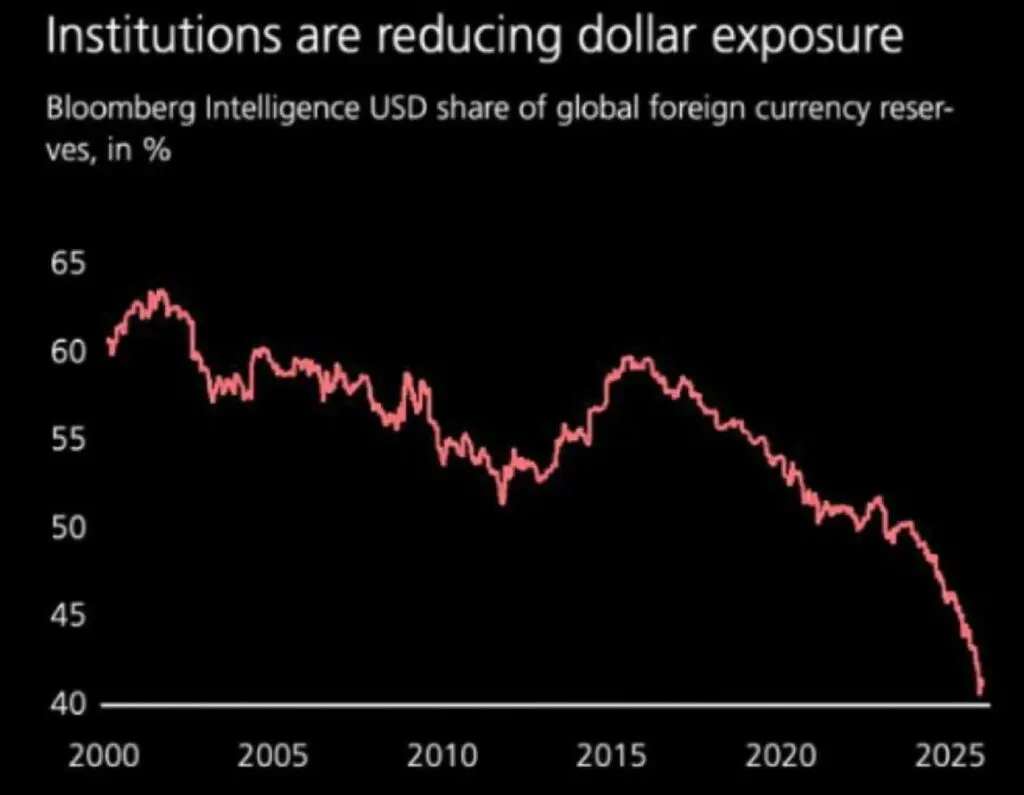
NoLimit considers the global de-dollarization trend one of the biggest risk factors facing most investors and urges them to sell off dollars. Supporting this advice, he points out that trade settlements between countries like China and Russia increasingly bypass US currency, using their own currencies or alternative methods.
However, this argument requires more nuanced analysis. While de-dollarization is indeed an observable long-term trend, data shows that over the past 30 years, the share of global reserve assets held in dollars has decreased from about 70% to around 40%, but the dollar still remains the dominant reserve currency. Moreover, according to a Bloomberg report on January 22, the overall use of the dollar in international settlements actually hit a new high in December last year.
This contradictory data indicates that de-dollarization is a gradual and complex process rather than a sudden collapse. Although some bilateral trade relationships may reduce dollar usage, the depth, liquidity, and legal framework of the dollar in the global financial system still make it an indispensable medium of exchange. For investors, the key question is not whether the dollar will completely lose its status, but the speed and impact of its relative decline.
The most controversial part of NoLimit’s post is the accusation of a “White House mess” and the prediction that the US government will soon face a new shutdown, possibly as early as January 31. He claims that the main reason for advising to sell dollars is concern over the government losing control of domestic affairs, and that besides constant claims that everything will improve, the government has no concrete plans.
Government shutdowns indeed can have negative economic impacts, including disruption of federal employee incomes, suspension of government services, and declining business confidence. However, historically, multiple shutdown events have caused short-term chaos but did not directly trigger recessions. More important are the long-term fiscal policy directions, debt sustainability, and the government’s capacity to respond to economic downturns.
Related Articles
Solana News Today: Stablecoin Transfers Reach 650 Billion, Surpassing Ethereum, Infrastructure Role Elevated
In February 2026, Solana's stablecoin transfer volume reached $650 billion, surpassing Ethereum and TRON, indicating a shift from speculation to real-world applications on its network. Solana's low transaction fees, fast confirmation times, and high throughput are its main competitive advantages, signaling its growth potential in DeFi and payment scenarios. Technically, the key support level for SOL is $80, with resistance at $92.
MarketWhisper10m ago
Meme coin watchlist: Who is cultivating true fans, and who is manipulating the data?
Written by: Michael Nadeau
Compiled and organized by: BitpushNews
Whether you like it or not, we believe memecoins will have a long-term presence. This article will share macro perspectives on the industry and delve into the memecoins we are closely monitoring.
Let's get started.
Why Focus on Memecoins
Our Methodology
Some people love memecoins, while others despise them. We try to step outside of this debate and simply observe the market. From our observations, memecoins have taken root. From the perspective of "Product-Market Fit (PMF)," they seem to be the ultimate crypto "game." People enjoy trading, gambling, social interactions, and the risk-reward dynamics. Moreover, we believe participants are very clear about what kind of game they are playing.
Having witnessed PEPE in the market,
PANews41m ago
BitMine is sweeping up 60,000 ETH! Tom Lee confidently states: "The mini crypto winter" is coming to an end.
Bitmine Immersion Technologies recently purchased 60,976 Ethereum, totaling approximately $120 million, to support the crypto market. Despite facing $7.8 billion in unrealized losses, Chairman Tom Lee remains actively buying, believing the market is close to the bottom. The company plans to stake all its Ethereum, with an estimated annualized return of $259 million, urging investors to seize the bottoming opportunity.
区块客1h ago
MICA Daily|ETH Open Interest Hits a One-Year Low, Possibly Indicating Market Revival
Recently, Binance's ETH derivatives market has shown significant changes, with the total open interest around $4.26 billion, approaching historical average levels, and no signs of excessive leverage. The 30-day moving average has dropped to its lowest since 2025, reflecting a decrease in leverage usage, with traders reducing risk, indicating increased market uncertainty.
区块客1h ago
Long and short positions are balanced for the first time in history, revealing the true story of crypto deleveraging through Ethena's sharp decline
Author: Kyle Soska, Chief Investment Officer of Ramiel Capital
Compiled by: Felix, PANews
The crypto market has been in a risk-averse state for several months. Kyle Soska, Chief Investment Officer of Ramiel Capital, has been carefully analyzing various market data to look for signs of a potential market turnaround. This article will explore the market structure of perpetual contracts and combine
PANews1h ago
Bitcoin returns to $70,000: Geopolitical conflict concerns ease, ETF fund inflows continue to drive BTC rebound
On March 10th, Bitcoin broke through $70,000 during the East Asian trading session, completing a recovery after the weekend sell-off. As volatility in the energy markets eased, selling pressure on risk assets diminished. Market data shows that institutional capital inflows continue to support Bitcoin, investor sentiment is improving, and short-term upside potential is increasing.
GateNews2h ago


