Michael Saylor believes the biggest risk to Bitcoin is internal protocol changes rather than quantum computing, advocating for protocol rigidity. Coinbase has established a Quantum Committee, with members including Stanford Professor Dan Boneh and Ethereum researcher Justin Drake. Support for BIP-110 has reached 2.38%, leading to a split; by 2025, over 10% of mailing list discussions involve post-quantum security. The quantum threat is at least 5 years away.
Michael Saylor advocates for protocol rigidity to counter internal change risks
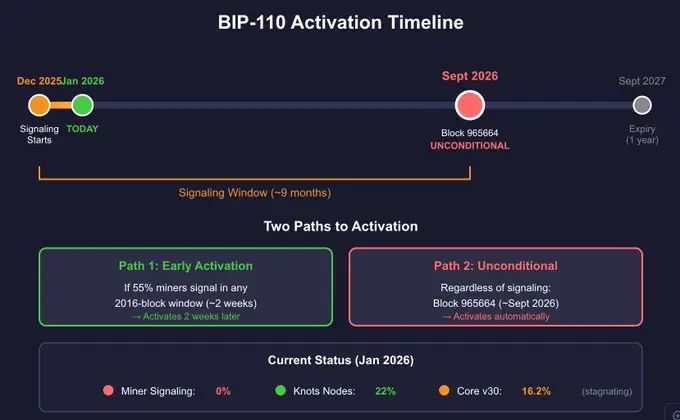
(Source: The Bitcoin Portal)
MicroStrategy co-founder Michael Saylor warns that the greatest risk facing Bitcoin is from ambitious opportunists promoting protocol changes. This statement comes as Coinbase and the Ethereum network take measures to address one of Bitcoin’s most severe long-term threats—quantum computing. Saylor believes that protocol rigidity is Bitcoin’s main defense. He points out that attempts to internally “improve” the network are more dangerous than external technological threats.
This highlights Bitcoin’s role as a neutral digital currency amid debates like the BIP-110 soft fork proposal. As of January 25, 2026, BIP-110 has gained support from 2.38% of nodes, aiming to temporarily limit transaction data (e.g., OP_RETURN restricted to 83 bytes) to combat non-monetary spam. This discussion has caused community divisions—one side supports Bitcoin Knots purists, the other uses Bitcoin Core for broader applications.
Saylor’s view represents the “rigid” faction within the Bitcoin community. This camp believes Bitcoin’s greatest value lies in its predictable and stable rules. Any protocol change, even well-intentioned improvements, could introduce unknown risks or be exploited by malicious actors. They see Bitcoin as a store of value that should remain unchanged like gold, rather than an evolving technological platform.
Some developers worry about hasty or politically motivated changes, while others emphasize that ignoring emerging risks could itself be a burden. This internal tension has intensified with the emergence of the quantum threat. If the Bitcoin community refuses to upgrade to post-quantum cryptography due to rigidity, it may be caught unprepared when quantum computers become a reality. Conversely, premature upgrades could introduce vulnerabilities from immature technologies or fracture consensus.
Coinbase establishes Quantum Advisory Committee to address 5-year threat
As Coinbase announces the formation of an independent advisory committee dedicated to quantum computing and blockchain security, this tension becomes more pronounced. The committee will study how future large-scale quantum computers could threaten Bitcoin’s cryptographic foundations. They will publish public research reports, risk assessments, and technical guidance for the broader ecosystem.
The core issue revolves around elliptic curve cryptography (ECC), which underpins Bitcoin’s ECDSA and Schnorr signatures. In theory, a sufficiently powerful quantum computer running Shor’s algorithm could derive private keys from public keys, enabling attackers to forge transactions or steal exposed wallets. While such machines are at least 5 years away, the long lead time needed for security protocol transitions makes quantum resilience an increasingly urgent task.
Coinbase’s advisory committee includes top experts in cryptography and quantum research, such as Stanford Professor Dan Boneh, University of Texas quantum theorist Scott Aaronson, Ethereum Foundation researcher Justin Drake, and EigenLayer founder Sreeram Kannan. Coinbase states that the committee will operate independently, releasing position papers on the state of quantum computing. They will also provide guidance to developers and institutions and respond promptly to breakthroughs in the field.
Four main functions of Coinbase’s Quantum Committee
Risk Assessment: Regular reports on quantum computing threats to blockchain
Technical Guidance: Recommendations for post-quantum cryptography migration paths for developers
Real-time Response: Rapid analysis of major breakthroughs in quantum research
Public Research: Publishing independent reports for the entire ecosystem
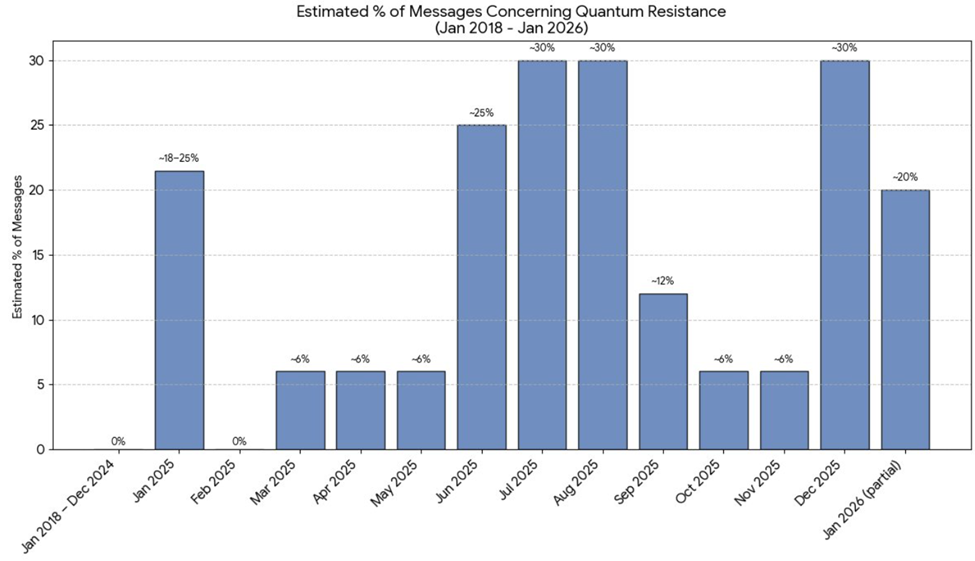
(Source: X)
This initiative reflects a broader shift in the Bitcoin development community’s approach to the issue. Data from 2025 shows a significant increase in discussions related to quantum technology on Bitcoin mailing lists, with over 10% of technical exchanges involving post-quantum security. Notably, this occurs after years of near silence. The discussions have shifted from abstract hypotheses to concrete engineering challenges, including how Bitcoin can transition from ECC to post-quantum signatures via soft forks without disrupting the network.
Philosophical conflict between Bitcoin’s rigidity and upgrade advocates
Despite the momentum, most researchers caution against hasty protocol changes. The mainstream view favors waiting until post-quantum cryptography standards, such as those developed by NIST, are fully mature. This contrasts with forced upgrades that could introduce new vulnerabilities. In this sense, Coinbase’s move is seen as a form of preparation rather than panic. It aims to ensure Bitcoin and other blockchains have reliable migration paths before quantum attacks become feasible.
The contrast with Ethereum is also becoming clearer. The Ethereum Foundation recently announced that post-quantum security is a top strategic priority. They have assembled dedicated teams, funded cryptography research, and run real-time post-quantum development networks. Ethereum now joins Coinbase’s advisory committee, highlighting that quantum preparedness is increasingly viewed as a cross-chain, industry-wide challenge.
This contrast underscores the fundamental philosophical differences in governance between Bitcoin and Ethereum. Ethereum embraces rapid iteration and active upgrades, with developers accustomed to regular hard forks to implement new features. Bitcoin, on the other hand, is highly conservative; any protocol change requires extensive discussion and broad consensus. Saylor’s rigid faction sees this conservatism as an advantage, protecting Bitcoin’s stability as a store of value. The upgrade advocates worry that excessive rigidity could make Bitcoin slow to respond to real threats.
As quantum research accelerates and institutions play a more active role in building future-proof cryptographic infrastructure, maintaining this balance may become more difficult. Ultimately, the Bitcoin community will have to choose between “keeping the protocol unchanged” in its purity and “upgrading to address quantum threats.”
Disclaimer: The information on this page may come from third parties and does not represent the views or opinions of Gate. The content displayed on this page is for reference only and does not constitute any financial, investment, or legal advice. Gate does not guarantee the accuracy or completeness of the information and shall not be liable for any losses arising from the use of this information. Virtual asset investments carry high risks and are subject to significant price volatility. You may lose all of your invested principal. Please fully understand the relevant risks and make prudent decisions based on your own financial situation and risk tolerance. For details, please refer to
Disclaimer.
Related Articles
Glassnode: Whales on Hyperliquid Maintain Long Positions, Expect Bitcoin Breakout
Gate News message, April 24 — According to Glassnode data, large traders on Hyperliquid have maintained sustained long positions in Bitcoin, anticipating a breakout from the current trading range.
Over the past two months, these whales have steadily increased their confidence and long positions, re
GateNews20m ago
Willy Woo: Bitcoin Price Action Mirrors Nasdaq, May Need Decade to Gain Recognition as Safe Haven
Gate News message, April 24 — Crypto analyst Willy Woo stated that while most Bitcoin holders view BTC as a safe-haven asset, the reality is more nuanced. Bitcoin does possess safe-haven characteristics—for instance, it enables cross-border asset transfers via seed phrases during wartime and
GateNews28m ago
Strive's SATA Stock Purchases 69 BTC After Hitting $100 Face Value
Gate News message, April 24 — According to ChainCatcher, Strive's SATA stock purchased approximately 69 BTC yesterday (April 23) after reaching a $100 face value.
Over the past two days, SATA has accumulated a total of 137 BTC.
GateNews33m ago
Bitcoin Technical Signals Show Multi-Dimensional Convergence, $73K Becomes Key Reversal Confirmation Level
Gate News message, April 24 — According to BIT on Target's weekly report, Bitcoin's bear market phase may be nearing its end as multiple technical signals across different timeframes are forming a convergence pattern. The weekly stochastic oscillator has retreated to levels not seen since
GateNews1h ago
Bitcoin ETF Inflows Turn Positive for the Year as All Flow Metrics Hit Green
Gate News message, April 24 — Bitcoin spot ETFs are gaining momentum as all flow metrics tracked by Bloomberg turned positive for the first time in months, according to Bloomberg Senior ETF Analyst Eric Balchunas. The cumulative one-day inflows for all 12 spot bitcoin funds reached over $335
GateNews2h ago
Bitcoin Short-Term Holders Discount Narrows to -5.7%, SOPR Signals Recovery
Gate News message, April 24 — Bitcoin short-term holders (STH) are showing signs of recovery as their discount narrowed from -21.6% to -5.7%, according to on-chain analyst Axel Adler Jr. The STH-SOPR (Spent Output Profit Ratio) 7-day moving average has climbed back above 1.0, indicating that short-t
GateNews2h ago


