Bitcoin spot ETF funds in the US just experienced their worst trading week since February 2025, with total net withdrawals reaching $1.33 billion during a shortened four-day trading week.
This development marked a sharp reversal from the previous week, when the same group of funds attracted $1.42 billion in net inflows. The market closed on Monday due to the Martin Luther King Jr. holiday, leaving only four trading sessions for the week.
Withdrawal pressures were concentrated heavily in the middle of the week. Wednesday alone saw $709 million pulled from Bitcoin ETFs, followed by $483 million on Tuesday. The withdrawal trend eased towards the end of the week, with $32 million and $104 million being withdrawn on Thursday and Friday, respectively.
This is the largest weekly net outflow since late February 2025, when Bitcoin ETFs lost $2.61 billion during a period of high volatility as Bitcoin’s price plummeted from over $109,000 to below $80,000. This period was dubbed the “February Freeze” by analysts, including a record single-day withdrawal of $1.14 billion on February 25.
BlackRock’s IBIT, the largest Bitcoin spot ETF by assets under management, experienced withdrawals in all four trading days last week. The most significant withdrawal pressures occurred on Tuesday and Wednesday, contributing notably to the overall decline. IBIT currently manages approximately $69.75 billion in assets, accounting for nearly 3.9% of the total Bitcoin supply.
Since its launch in January 2024, Bitcoin spot ETFs in the US have accumulated total net inflows of about $56.5 billion, with total net assets reaching approximately $115.9 billion.
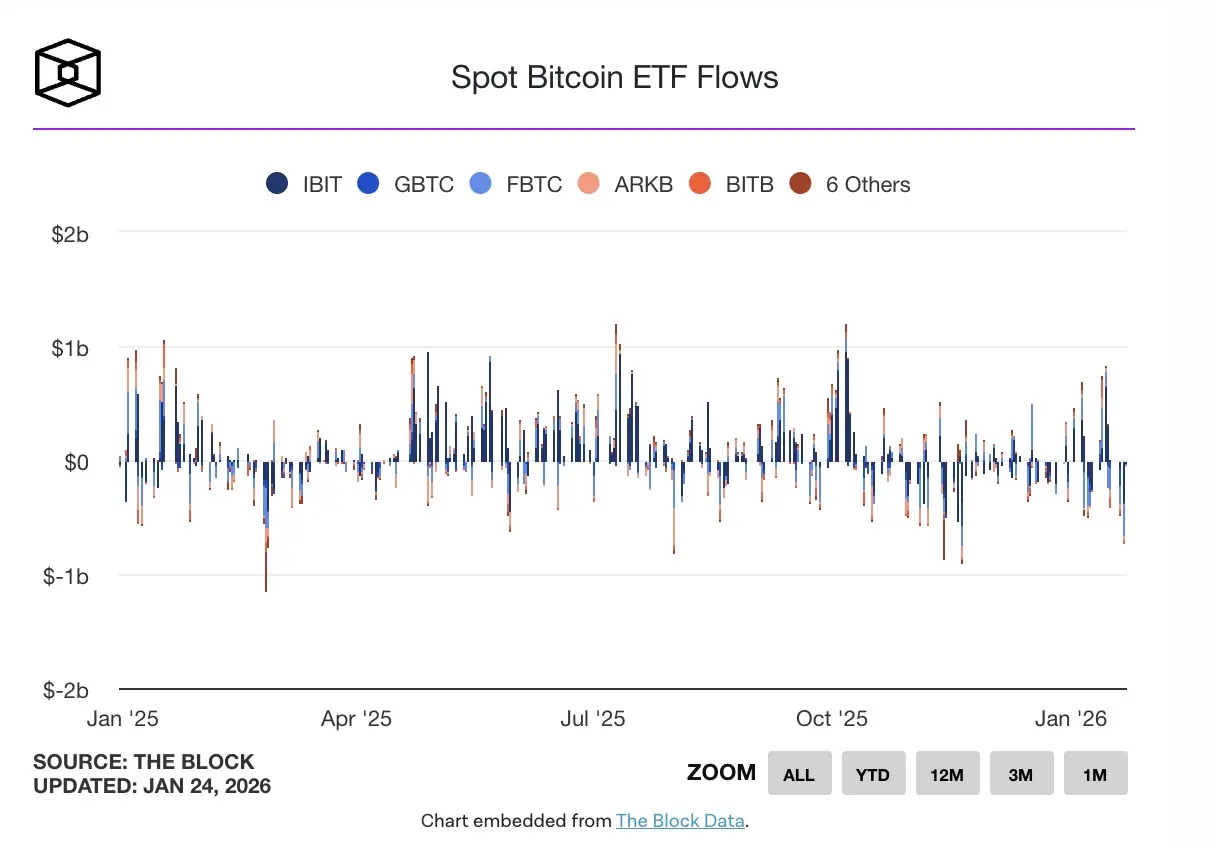 Cash flow from Bitcoin spot ETFs## Ethereum ETFs also face pressure
Ethereum spot ETFs experienced similar trends, with $611 million in net outflows during the week. Wednesday was also the worst day for this group, with $298 million withdrawn, followed by $230 million on Tuesday.
This result marked a significant reversal from the previous week, when Ethereum ETFs attracted $479 million in net inflows, mainly driven by strong capital flows into BlackRock’s ETHA fund and Grayscale products.
The total net assets of Ethereum ETFs currently stand at around $17.7 billion, with cumulative net inflows reaching $12.3 billion since their launch in July 2024.
Solana ETFs defy the trend, XRP fluctuates
Contrary to Bitcoin and Ethereum, Solana spot ETFs maintained a positive momentum, with $9.6 million in net inflows over four trading sessions. This product group has seen consecutive weeks of capital inflows, with Bitwise’s BSOL leading in assets under management.
Meanwhile, XRP ETFs experienced more volatile trading weeks, with total net outflows of $40.6 million. Tuesday alone saw $53 million withdrawn, before a slight return of capital in the remaining sessions, with daily inflows ranging from $3 to $7 million. This withdrawal occurred after the first daily net outflows for XRP ETFs since their launch in mid-November, observed in the first week of January.
Market sentiment shifts to defensive
According to analysts, crypto is underperforming compared to other asset classes as investors tend to feel more comfortable with stocks than with crypto. This trend is clearly reflected in both price movements and ETF capital flows.
On-chain data also indicates broader changes in market structure. Bitcoin holders have started realizing losses for the first time since October 2023. Over the past 30 days, the market has shifted from a “profit-taking” phase to a “stop-loss” phase, with a total realized loss of approximately 69,000 BTC since December 23. The current on-chain structure is considered to resemble the transition from a bull to a bear market in the 2021–2022 cycle.
Vương Tiễn
Disclaimer: The information on this page may come from third parties and does not represent the views or opinions of Gate. The content displayed on this page is for reference only and does not constitute any financial, investment, or legal advice. Gate does not guarantee the accuracy or completeness of the information and shall not be liable for any losses arising from the use of this information. Virtual asset investments carry high risks and are subject to significant price volatility. You may lose all of your invested principal. Please fully understand the relevant risks and make prudent decisions based on your own financial situation and risk tolerance. For details, please refer to
Disclaimer.


