


Pi coin rebounds after falling below $0.15! Trading volume plummets over 40%, turning into a ghost chain
Pi coin dropped to a historic low of $0.15 this week, plummeting 93% from its peak. Weekly trading volume collapsed by 41% to just $16 million, indicating liquidity exhaustion. Over the next 12 months, 1.25 billion tokens will be unlocked. The Pi Foundation holds over 90 billion tokens, resulting in extreme centralization, and the lack of practical applications has turned it into a “ghost chain.”
Double Top and Rising Wedge Bearish Patterns Confirmed
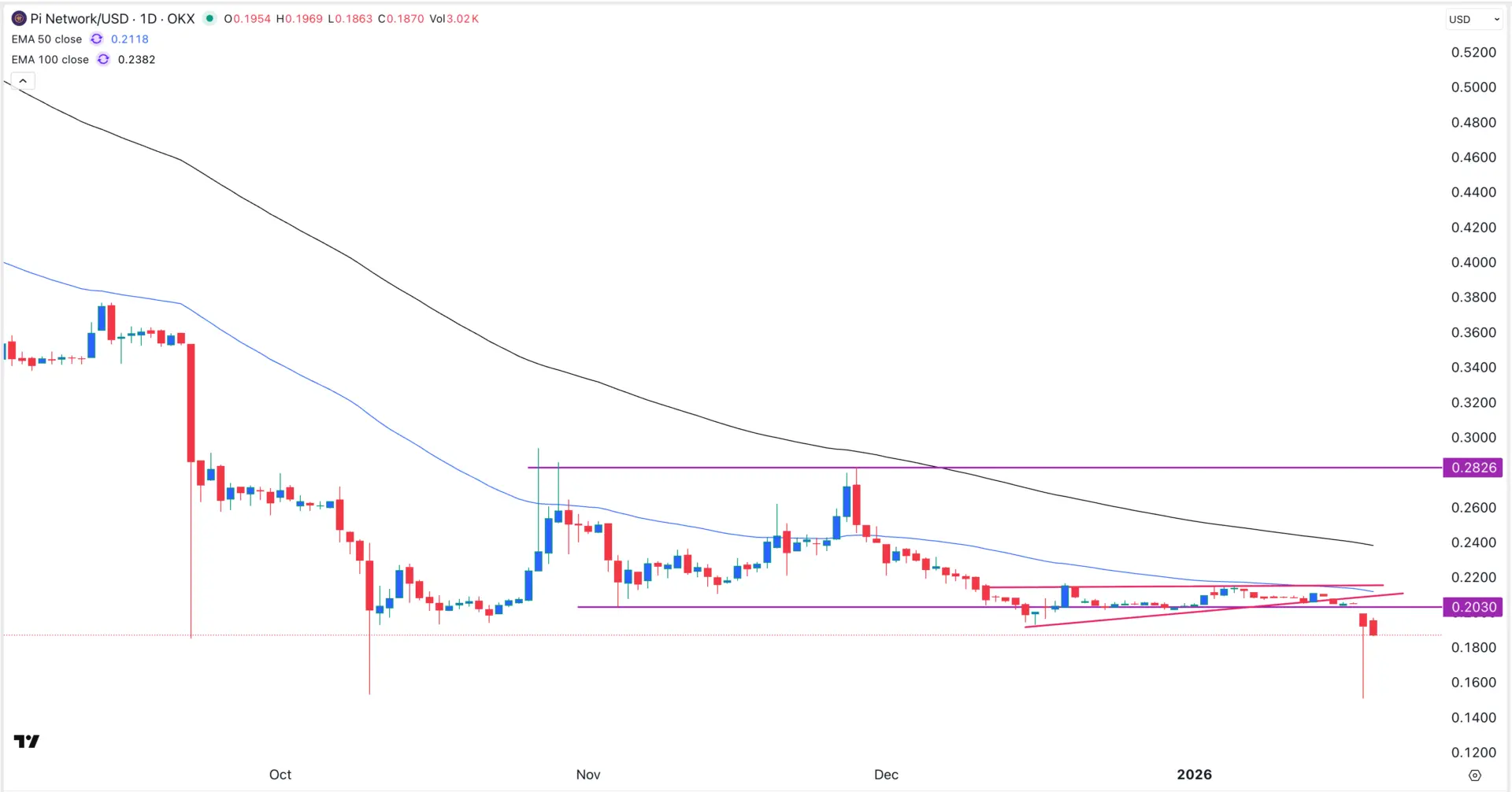
(Source: Trading View)
The price of Pi coin plummeted to a record low this week, forming a bearish chart pattern. These formations are clearly visible on the daily chart. It formed a double top pattern, with peaks on October 29 and November 28 last year, with a neckline at $0.2030, and the lowest point on November 4 last year. The double top is one of the most common bearish reversal patterns in technical analysis.
The token also formed an ascending wedge pattern, composed of two rising and converging trendlines. The breakout occurred after the two trendlines approached convergence. Pi’s price has also remained below the 50-day and 100-day EMA and the Supertrend indicator. In most cases, these patterns and technical indicators tend to lead to strong downward breakouts.
Confirmation of the double top pattern requires the price to break below the neckline. Once confirmed, the target usually equals the distance from the head to the neckline. From Pi’s chart, this distance may indicate a deeper decline. The breakdown of the ascending wedge also has technical significance; this pattern often appears at the end of an uptrend, indicating exhaustion of bullish momentum. A downward breakout often triggers accelerated declines.
The overall bearish configuration of technical indicators further reinforces downward pressure. The price remains below the 50-day and 100-day EMA, indicating a fully bearish short- to medium-term trend. The Supertrend indicator also signals a sell, which is a composite indicator combining price volatility and trend. When the price is below the Supertrend line, it generally suggests holding short positions.
This explains why the token crashed on Monday and why it may continue to decline in the short term. Although technical analysis cannot predict absolute prices, the simultaneous appearance of these bearish patterns greatly increases the probability of further declines. For technical traders, these signals are clear exit or short signals.
Collapse in Trading Volume Indicates Complete Demand Disappearance
Due to waning demand, Pi’s price has collapsed. Data compiled by CoinMarketCap shows that trading volume in the past 24 hours decreased by 41% to $16 million. For a cryptocurrency with a market cap of $1.57 billion and a fully diluted valuation exceeding $18 billion, $16 million in trading volume is negligible. Its volume-to-market cap ratio is only 1.03%, indicating severe lack of liquidity.
This volume-to-market cap ratio is extremely abnormal in the crypto market. By comparison, Bitcoin’s daily volume usually accounts for 2-5% of its market cap, mainstream altcoins typically range from 5-10%, and active small-cap coins can reach over 20%. Pi’s 1.03% ratio implies almost no trading activity; holders are neither selling nor buying, and the entire market is frozen.
Liquidity shortages pose a huge threat to price stability. In markets with ample liquidity, large buy or sell orders can be absorbed without causing drastic price swings. But at Pi’s current liquidity level, even tens of thousands of dollars in sell orders can cause the price to drop several percentage points. This fragility makes Pi a high-risk asset.
Over the past few months, demand for Pi has remained weak due to the lack of major positive catalysts. For example, since the mainnet launched last February, no major exchanges have listed Pi Network. The absence from top exchanges like Binance, Coinbase, Kraken means Pi cannot reach hundreds of millions of mainstream crypto investors. Currently, it is only traded on a few exchanges like OKX, greatly limiting liquidity and market depth.
The absence of Pi on major exchanges may relate to its high centralization and tokenomics design. Top exchanges have strict review standards, including decentralization, fair token distribution, security, and regulatory compliance. Pi may fail to meet these standards on multiple dimensions.
Unlock of 1.25 Billion Tokens Floods Supply
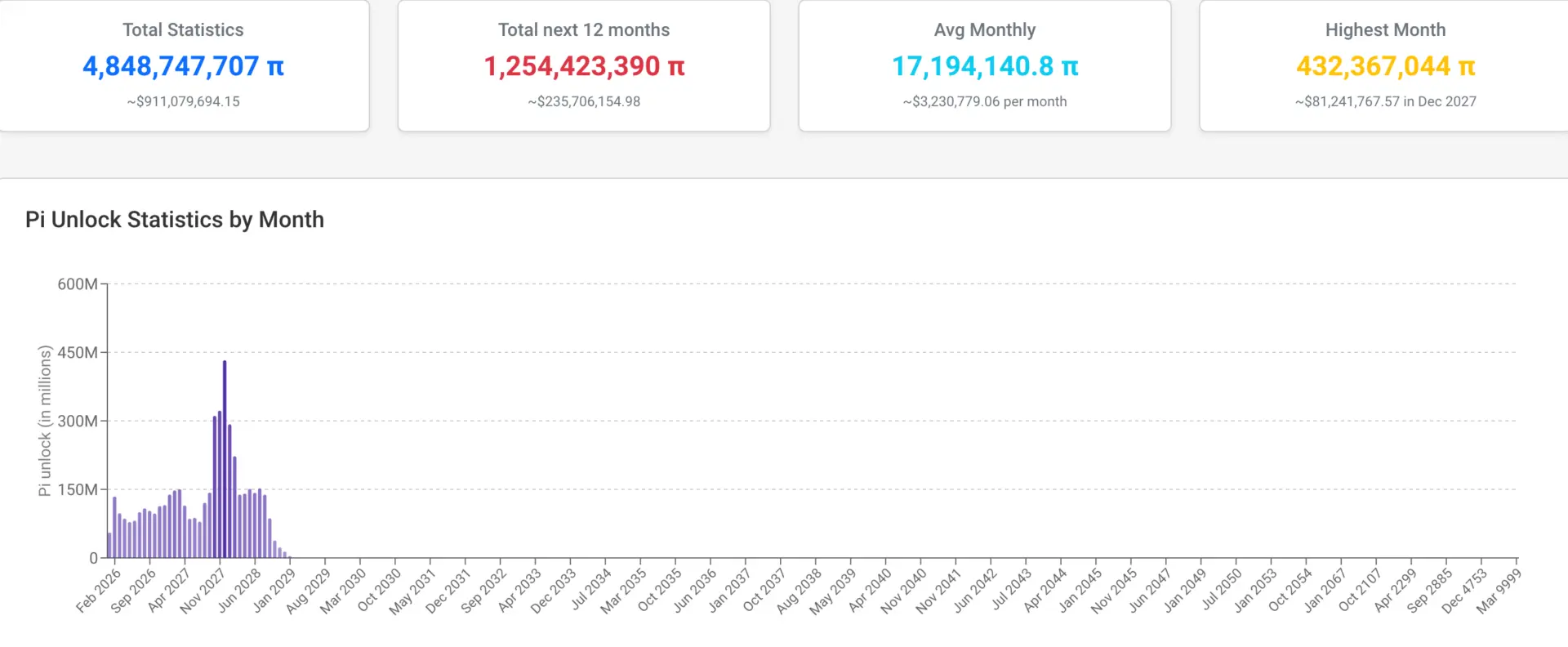
(Source: PiScan)
Due to ongoing supply increases, Pi’s price has plummeted this week. Data from PiScan shows that token unlocks have caused the circulating supply of Pi to keep rising. Over the remaining days of this month, more than 57 million tokens will be unlocked, and 134 million in February. Over the next 12 months, more than 1.25 billion tokens will be unlocked, averaging 104 million per month.
Data from CoinMarketCap shows that Pi’s maximum supply is 10 billion tokens, with a circulating supply of 8.38 billion. This means over 9.16 billion tokens will be unlocked in the future. Increased supply combined with declining demand generally leads to price drops, according to basic economics.
In the next 12 months, unlocking 1.25 billion tokens relative to the current 8.38 billion circulating supply represents about a 15% increase in supply. More importantly, these unlocks are continuous and predictable; market participants know in advance that supply will increase, which itself suppresses buying. Why would rational investors buy today if more and cheaper tokens are coming tomorrow?
Token unlocks are usually held by early miners or team members, whose costs are near zero. For zero-cost holders, any price is pure profit, greatly increasing their motivation to sell. Even if the price drops to $0.10, for holders who obtained tokens for free, it remains a substantial profit. This structural selling pressure is the fundamental reason why Pi’s price struggles to stabilize.
In the longer term, the current circulating supply of 8.38 billion only accounts for 8.38% of the total supply of 10 billion. Even at the current unlock rate, fully releasing all tokens would take decades. This extremely diluted tokenomics design means current holders will face long-term unlocking pressure, severely constraining price upside.
Centralized Flaws of 90 Billion Tokens
Due to core issues including centralization and lack of utility, Pi’s price has also fallen sharply. Pi is one of the most centralized tokens in the crypto industry. The Pi Foundation holds over 90 billion tokens, stored in hundreds of addresses controlled by the foundation. Unlike other cryptocurrencies, Pi holders have no voting rights on proposals.
90 billion tokens out of a total supply of 10 billion means the Pi Foundation controls 90%. This extreme centralization completely contradicts the core principle of decentralization in crypto. In contrast, Bitcoin has no single entity controlling most tokens; Ethereum Foundation’s ETH holdings are less than 1% of total supply; even Binance Coin (BNB), which is somewhat centralized, has a much lower team holding ratio than Pi.
This centralization introduces multiple risks. First, price manipulation risk: entities controlling 90% can easily influence the market price. Second, regulatory risk: highly centralized tokens are more likely to be classified as securities and face strict regulation. Third, trust risk: investors must fully trust the Pi Foundation not to abuse its control, which runs counter to the “trustless” principle of crypto.
More seriously, Pi holders have no voting rights on proposals. In mainstream crypto projects, token holders usually have governance rights, voting on protocol upgrades, fund allocations, and key decisions. For example, Uniswap’s UNI holders can vote on protocol fee distribution; Compound’s COMP holders can vote to modify interest rate models. Pi holders are completely excluded from governance, making Pi more like company stock than a decentralized token.
Ghost Chain Lacks Any Practical Use
Furthermore, unlike tokens like Ethereum and Solana, Pi Network has not realized any practical applications. It is not accepted by any retailers, and its ecosystem has become a “ghost chain.” Ethereum supports thousands of decentralized applications, including DeFi protocols, NFT marketplaces, and gaming platforms, processing millions of transactions daily. Solana attracts many developers with its high speed and low cost, and its ecosystem is thriving.
In contrast, Pi Network’s ecosystem is almost empty. No well-known DeFi protocols are built on Pi, no active NFT markets, no widely used applications. The term “ghost chain” accurately describes its current state: the blockchain is running, but no one is truly using it. Blockchain explorers mainly show token transfers, not smart contract interactions or application activity.
Lack of practical applications means Pi lacks intrinsic value support. Bitcoin’s value comes from its role as a store of value and payment tool; Ethereum’s value stems from its widespread use as a smart contract platform. These are measurable and verifiable utilities. But what is Pi’s value proposition? If merchants do not accept it and it does not support a thriving application ecosystem, what is the point of holding Pi?
Broader crypto market sell-offs are also external factors contributing to Pi’s decline. Bitcoin’s price fell from an intra-year high of $98,000 to $91,000, with total market cap dropping from over $3.3 trillion to $3.08 trillion. Trump announced new tariffs on EU member states, and the CLARITY Act was blocked in the Senate. These macro factors exert pressure on all risk assets.
Related Articles
Pi Network Confirms March 12 DEX Launch, Pi Coin Rallies Over 8% Amid Protocol Upgrades
Pi Network price hits two-week high, protocol upgrade drives 8.5% increase
PI (Pi) increased by 7.51% in the past 24 hours
Pi Network’s v19.9 Mainnet Upgrade Just Changed Everything
Pi Coin Price Prediction As Pi Network Prepares Major Upgrade Ahead Of Pi Day