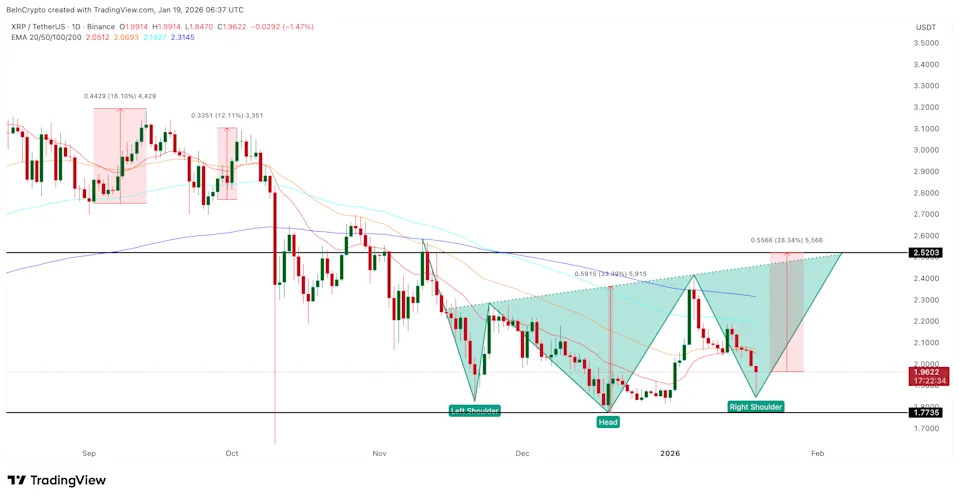
XRP is down 6% this week but has formed an inverse head and shoulders bottom, with a neckline at $2.52. Analysis indicates that XRP needs to first break above the 100-day EMA ($2.24) to trigger a rally; in September, two breakouts led to double-digit gains. Derivatives short positions account for 95% ($520 million), and a breakout could trigger a short squeeze.
Inverse Head and Shoulders Pattern Indicates 33% Reversal Opportunity
(Source: Trading View)
This week, XRP was one of the weaker among larger-cap tokens. Over the past seven days, the price declined about 6%, putting short-term market sentiment under pressure. However, the recent correction may not be the end of this rally. Chart and on-chain data show XRP is at a critical juncture; whether it can replicate the pattern from four months ago will determine its fate.
XRP appears to be forming an inverse head and shoulders pattern on the daily chart. This pattern typically signals a trend reversal, but only after reclaiming key levels. Currently, the neckline is near $2.52, about 28% above the current price. To open the upward path, XRP must first recover the 100-day EMA, the sky blue line.
EMA assigns higher weight to recent prices, making it more responsive to trend changes than simple moving averages. Historically, this level has been a key decision point for XRP. In September, reclaiming the 100-day EMA led to about a 12% rally. Earlier that month, a similar reclaim resulted in a 16% increase.
So far, XRP has failed to hold above the short-term EMAs (20-day and 50-day), and on January 14, it was rejected near the 100-day EMA again. Nonetheless, the latest sell-off produced a long lower wick, indicating buyers absorbed the downward pressure quickly. This reaction suggests demand remains, and the bullish structure is still valid, provided it can ultimately reclaim the EMA barrier.
Key Price Levels for XRP Inverse Head and Shoulders
Left Shoulder: Formed at previous low, representing initial bottoming attempt
Head: Lowest point, indicating maximum selling pressure release
Right Shoulder: Current zone, a second bottom formation symmetrical to the left shoulder
Neckline: $2.52, a confirmed breakout level
Target Price: $3.36 (33% above the neckline)
The validity of this technical pattern depends on volume. Typically, volume should decrease during the formation of the right shoulder, indicating waning selling pressure. A breakout above the neckline should be accompanied by a significant increase in volume to confirm validity. Based on current XRP price action, volume characteristics largely align with textbook inverse head and shoulders.
Key levels are clear. XRP needs to close above $2.24 to confirm strength and re-establish above the 100-day moving average. Afterwards, it could break through the $2.48–$2.52 zone, activating the pattern. If this occurs, a 33% upside potential is again on the table. On the downside, a drop to $1.84 would weaken the current bullish setup, and falling below $1.77 would invalidate the pattern entirely.
Whales and Long-term Holders Position Early
(Source: Santiment)
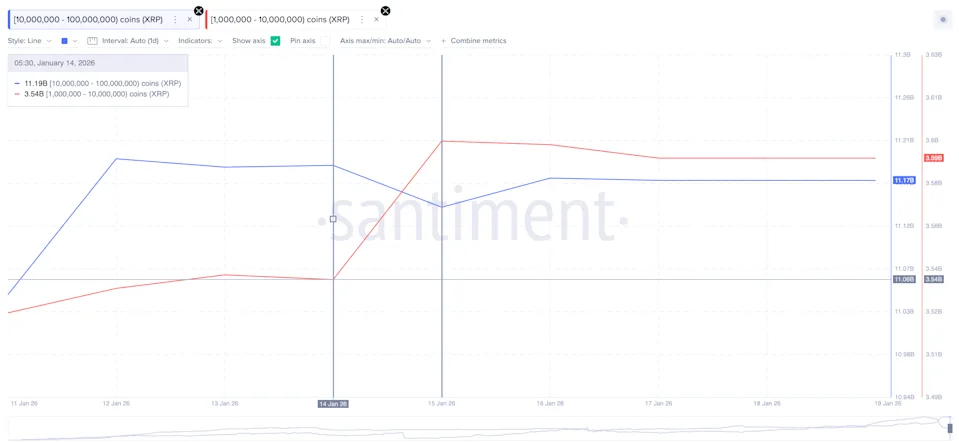
On-chain data reveal early accumulation beneath the surface. Whales holding 10 million to 100 million XRP increased their holdings from about 11.14 billion to 11.17 billion tokens, worth roughly $600 million at current prices. Smaller whales holding 1 million to 10 million XRP became more active, increasing their holdings from about 3.54 billion to 3.59 billion XRP, approaching $1 billion. This accumulation began around January 14, ahead of broader holder accumulation.
Although they sold some tokens during the price correction starting January 15, the net holdings since January 14 remain positive. This behavior indicates whales are not blindly buying but strategically adjusting positions based on volatility. They take profits during rebounds and add on dips—classic professional trading behavior.
Long-term holders follow whales. Since January 16, net holdings among long-term holders have turned definitively positive. This indicator tracks wallets holding XRP for about 155 days or longer, serving as a useful measure of conviction-based investors rather than short-term traders. On January 16, this group held about 222.3 million XRP; by January 18, holdings increased to approximately 234.9 million XRP—an addition of about 11.69 million XRP in just two days, a 5.2% increase.
Timing is crucial. Whales began positioning during the early correction, while long-term holders entered after January 16. This staggered accumulation suggests deliberate buying rather than emotional bottom-fishing. Capital flow analysis shows smart money (whales) leading, followed by conviction investors (long-term holders). This sequence often signals a successful bottom and potential trend reversal.
While the accumulation is substantial, spot buying alone may not be enough to drive a 33% rally. These holdings provide a support base, but a significant upward move often requires catalysts from derivatives markets. Currently, XRP faces this scenario: spot accumulation is complete, waiting for a breakout of key technical levels to trigger derivatives market amplification.
[XRP] Derivatives Short Squeeze Could Be Catalyst for Upside
(Source: Gate)
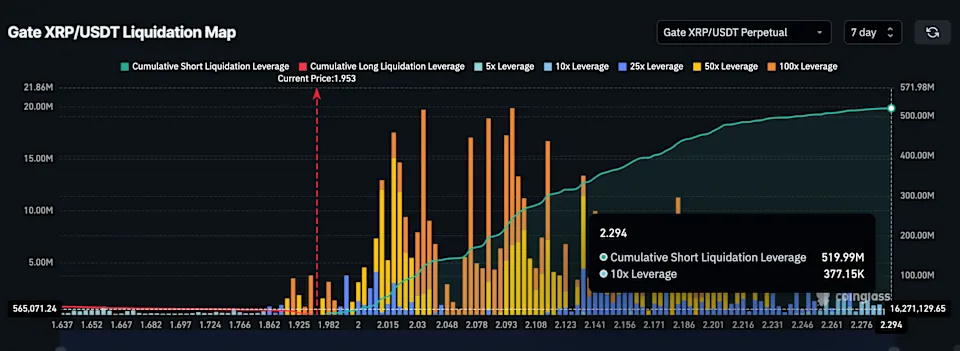
Derivatives positions add a critical twist. In XRP perpetual markets, short liquidation leverage approaches $520 million, while long leverage is near $22 million. This means over 95% of open interest is short. Such imbalance can fuel volatility. A slight rally could trigger a short squeeze; once key levels are broken, prices could surge rapidly.
The short squeeze mechanism works like this: as prices rise, short positions start to lose. To avoid larger losses or forced liquidation, short traders buy XRP to cover. This forced buying pushes prices higher, triggering more short liquidations, creating a self-reinforcing upward spiral. With short interest at around 95%, this squeeze effect can be significantly amplified.
$520 million in short liquidation leverage implies that, assuming an average leverage of 10x, about $52 million in actual collateral supports the $520 million short positions. A 10% price increase would threaten liquidation of these positions. Large-scale liquidations could generate $520 million in forced buy orders, a substantial impact given XRP’s daily volume of roughly $2–3 billion.
In contrast, long leverage is only about $22 million, so even a price decline would generate limited forced selling. This asymmetric structure favors upside risk-reward: upside potential is magnified by short squeeze, while downside risk is limited by light long leverage.
However, whether this opportunity materializes depends entirely on breaking through key technical levels. The levels are clear. XRP needs to close above $2.24 to confirm strength and re-establish above the 100-day MA. Then, it could break through the $2.48–$2.52 zone, activating the pattern. If this occurs, a 33% rally is again on the table, with the short squeeze potentially pushing gains even higher.
Support Breaks Will Destroy Bullish Structure
The downside is that a drop to $1.84 would weaken the current bullish pattern, and falling below $1.77 would invalidate it entirely. XRP has not yet broken down, but if it replays September’s move, this rally could still be initiated.
Why are $1.84 and $1.77 so critical? From a pattern perspective, $1.84 is near the bottom of the right shoulder; a break below would mean the right shoulder failed, invalidating the inverse head and shoulders. $1.77 is a key support in the head region; a breakdown would imply a retest of previous lows, requiring a new accumulation phase.
Volume distribution shows heavy historical trading around these levels, indicating important support zones. Many investors’ cost bases are in these ranges, motivating defensive positions on dips. However, if these supports are broken convincingly, panic selling could accelerate, pushing prices lower.
For traders, current XRP price action offers a clear operational framework. Conservative approach: wait for a confirmed close above $2.24, set stops below $2.10, and target a breakout above $2.52 for a move toward $3.36. Aggressive approach: open small positions near current levels, add on dips toward $1.84, with stops below $1.77, targeting $2.52 and $3.36.
From risk-reward standpoint, entering near $2.00 with stops at $1.77 offers about an 11.5% risk, with a potential 68% reward at $3.36, nearly a 1:6 risk-reward ratio—an excellent setup in technical trading. Of course, this depends on pattern validity and successful breakout; if pattern fails, prompt stops are necessary.


