Bitcoin remains steady at $93,000 on Monday, after overnight sell-offs dipped to $91,800. Trump threatens to impose tariffs on eight European countries, mainly due to the Greenland dispute. Starting February 1, tariffs will be 10%, rising to 25% in June. Ethereum drops 3.7%, altcoins decline 5-10%, gold surges to a new high of $4,690. Bitfinex indicates resistance between $93,000 and $110,000.
Trump Greenland Tariff Threat Sparks Market Sell-Off
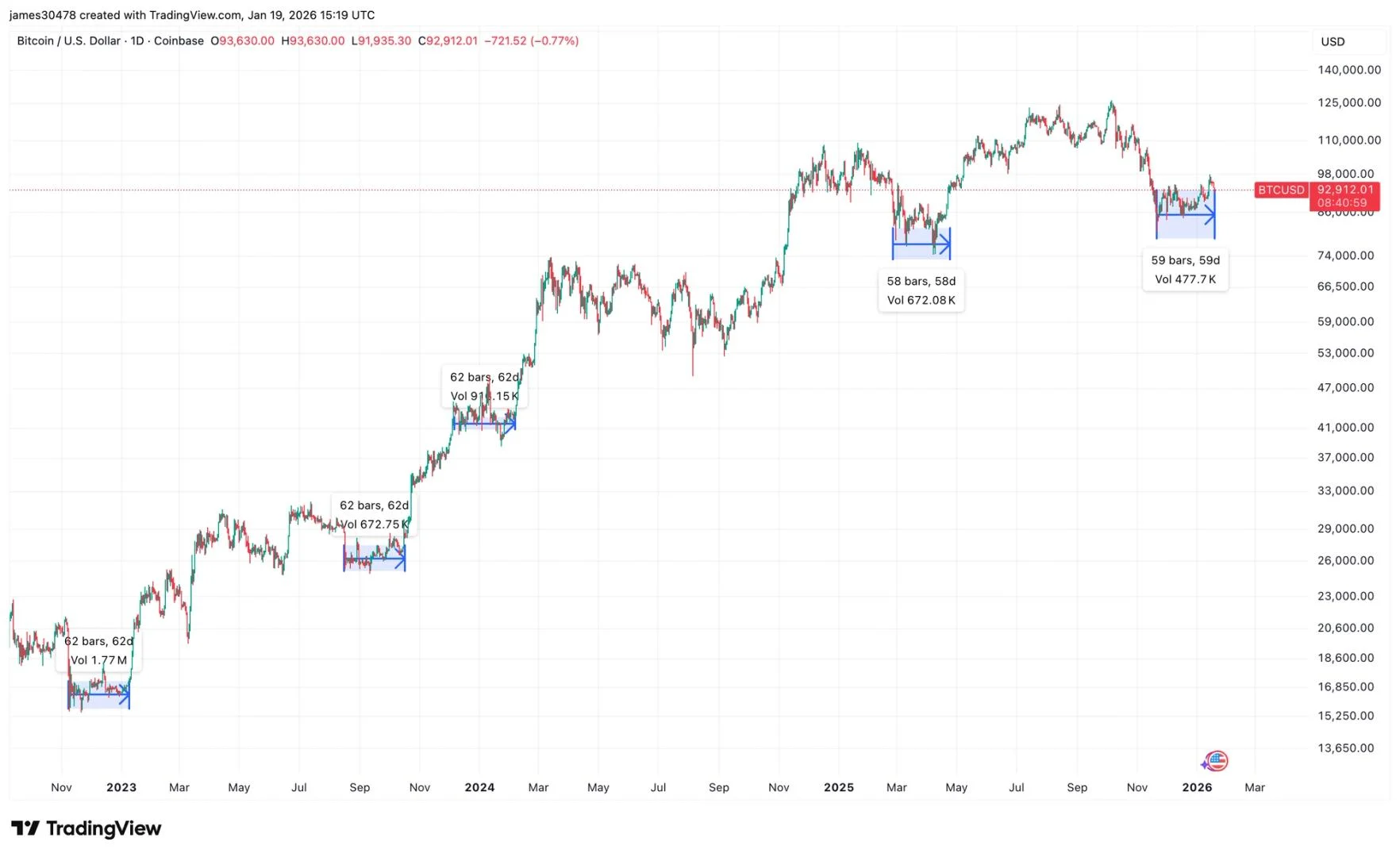
(Source: Trading View)
Why did Bitcoin fall today? The core reason is U.S. President Trump reigniting trade tensions. On January 17, local time, Trump announced on social platform “Truth Social” that starting February 1, 2026, Denmark, Norway, Sweden, France, Germany, the UK, the Netherlands, and Finland will face a 10% tariff on all goods exported to the U.S. From June 1, 2026, tariffs will increase to 25%. Trump stated that this tariff measure will continue until an agreement is reached to “completely and thoroughly purchase Greenland.”
This decline in Bitcoin is due to Trump’s threat to impose new tariffs on Denmark and other European countries over the Greenland dispute. Due to the U.S. market being closed for holidays, trading liquidity was low, and Bitcoin recovered some ground but still fell 2% that day. Ethereum declined 3.7%, barely staying above $3,200. Altcoins performed worse, with SOL, DOGE, ADA, LINK, and AVAX down 5-6%, and SUI plunging over 10%.
Bloomberg reports that Trump’s move has raised concerns about possible retaliatory measures from Europe, potentially leading to a large-scale trade war. This risk aversion has boosted safe-haven demand for precious metals. On January 18, eight European countries issued a joint statement warning that tariff threats could damage transatlantic relations and risk triggering a vicious cycle. They will “coordinate and unite” to respond.
Trump Tariff Timeline
Starting February 1: 10% tariffs on European eight countries
Starting June 1: Tariffs increase to 25%
Condition: Until Greenland purchase agreement is reached
Scope: Denmark, Norway, Sweden, France, Germany, the UK, the Netherlands, Finland
Bloomberg reports that European leaders will hold emergency meetings in the coming days to discuss possible responses. Sources say member countries are considering various retaliatory options, including imposing retaliatory tariffs on U.S. goods worth €93 billion ($108 billion). Other options under discussion include activating a powerful mechanism called the “Counter-Coercion Tool.”
Gold Surges to New High, Bitcoin’s Safe-Haven Role Fails
Meanwhile, gold prices surged again to nearly $4,700 per ounce, setting a new record amid ongoing geopolitical turmoil, with its appeal as a safe-haven asset continuing to strengthen. Over the past 12 months, gold has risen over 70%. Spot gold closed Monday up $74.77, or 1.63%, at $4,670.97 per ounce; intraday, it hit a high of $4,690.92, a historic high.
Why did Bitcoin fall today while gold soared? This divergence reveals a key issue: in geopolitical crises, Bitcoin’s status as a safe-haven asset is not recognized by the market. Traditionally, when global tensions escalate, funds flow into gold, U.S. Treasuries, and other safe assets. Although some supporters call Bitcoin “digital gold,” in actual safe-haven tests, it performs opposite to gold.
This difference stems from market perceptions of the two assets. Gold has thousands of years of history as a safe asset and is viewed as the “last resort currency” in any crisis. Bitcoin, despite its decentralization and censorship resistance, is still regarded as a risk asset rather than a safe haven. During panic, investors sell stocks, cryptocurrencies, and other risk assets, buying gold and Treasuries instead.
Gold’s 70% annual increase contrasts sharply with Bitcoin’s decline today. Over the past year, gold soared from about $2,750 per ounce to $4,670, driven mainly by geopolitical uncertainty and central bank gold-buying surges. In contrast, although Bitcoin has performed strongly at times, it chose to decline during critical safe-haven moments, weakening its narrative as a safe asset.
Kraken Warns of Increased Volatility During Davos
Kraken Vice President Matt Howells-Barby said that the overnight correction reinforced the overall weak trend in the crypto market. He noted that since the crash on October 10, “cryptocurrencies have exhibited asymmetric downside risk,” and “the market punishes negative news far more than it rewards positive catalysts.” He added that earlier this week, Bitcoin approached a key upside level, but geopolitical news quickly halted the rally.
The technical explanation for Bitcoin’s decline today is market fragility. However, Howells-Barby said the correction was relatively small (about 3.5%), indicating traders may be preparing for Trump’s possible tariff reduction threats, a pattern called “TACO” (Trump Always Cowers Out), similar to last year’s threats of tariffs on China and other countries.
Regardless of how this new tariff threat develops, with political and business leaders gathering in Davos for the World Economic Forum, “cryptocurrency markets could see significant volatility in the coming days, and any comments hinting at further escalation or de-escalation of EU-U.S. tariff wars will influence it.”
Long-Term Holders’ Selling Eases but Resistance Remains Heavy
At the same time, Bitfinex analysts noted that selling pressure from long-term Bitcoin holders has eased, dropping from a peak of over 100,000 BTC per week to about 12,800 BTC per week. This is a positive sign indicating that panic among long-term holders is subsiding. However, Bitfinex warns that BTC currently faces strong resistance from dense supply zones between $93,000 and $110,000, where previous rallies have stalled and may again limit upward movement.
They stated, “For a more sustained rally, the market structure needs to shift to a scenario where expiring supply exceeds long-term holder spending.” Historically, this configuration last appeared from August 2022 to September 2023, and from March 2024 to July 2025, both periods followed by stronger, more sustained Bitcoin rallies. They added, “This shift will push up long-term supply, indicating renewed market confidence and easing seller pressure.”
The reason for Bitcoin’s decline today involves both short-term geopolitical catalysts and medium-term technical resistance. Trump’s tariff threats triggered immediate sell-offs, while the long-term supply zone between $93,000 and $110,000 continues to exert upward pressure.


