In 2025, bitcoin reserves on exchanges fell sharply, signaling a shift toward long‑term custody by institutions, though experts warn this metric is no longer a reliable price indicator.
The Great Exchange Exodus: A Shift to Long-Term Custody
In 2025, bitcoin underwent a series of fundamental shifts, transitioning from a speculative risk-on asset into a core pillar of the global financial system. While the price reached a historic peak of approximately $126,000 before stabilizing in the $80,000 to $90,000 range, the year’s defining narrative was a profound transformation in market structure.
The passage of the GENIUS Act in the United States and the adoption of the Strategy “playbook” established bitcoin as a corporate treasury standard. Concurrently, bitcoin exchange-traded funds (ETFs) evolved from simple entry-level vehicles into sophisticated financial instruments—a maturation that significantly dampened the cryptocurrency’s historical volatility. However, one dynamic that has garnered less attention is the diminishing impact of declining exchange reserves.
Read more: The Death of the 4-Year Cycle: Experts on Bitcoin’s New Macro Reality
Market data reveals that between Jan. 1, 2025, and Jan. 7, 2026, total bitcoin reserves across global exchanges plummeted from 2.93 million BTC to 2.48 million BTC. Crucially, this exodus persisted even during periods of downward price pressure, suggesting a departure from traditional “panic-selling” behavior.
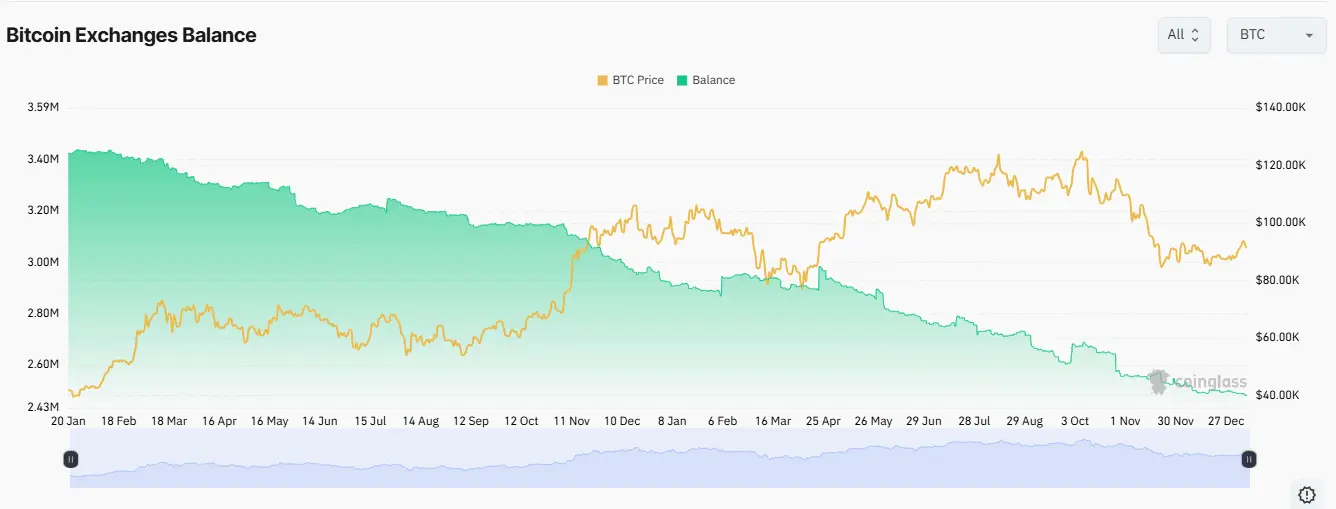
Instead, the trend indicates that large-scale buyers, including ETFs and corporate treasuries, are aggressively moving liquidity into cold storage for long-term custody. For over a decade, the “supply on exchanges” metric served as a reliable bellwether for bullish sentiment; the logic was simple: fewer coins available for sale meant a lower threshold for price appreciation.
This correlation remained the industry standard through the first half of 2025, but the narrative fractured following the Oct. 10 flash crash. For the next 60 days, the market witnessed a rare and confounding decoupling: exchange balances and BTC prices spiraled downward in tandem.
Redefining Liquidity Metrics
While bitcoin recovered as 2025 drew to a close, exchange balances continued their descent. It was the re-emergence of this “supply sink” that reignited excitement, yet many experts warn that this metric alone is no longer a reliable predictor of a bitcoin uptrend.
Martins Benkitis, co-founder and CEO of Gravity Team, suggests that traditional exchange balance tracking is becoming obsolete.
“I question whether this has a direct impact on price, as BTC custody is naturally evolving,” Benkitis said. “Traders, particularly institutions, are increasingly utilizing off-exchange custody. Furthermore, custodians now work closely with exchanges to allow off-exchange assets to be used as collateral. Consequently, liquidity is a more vital metric to monitor than simple exchange balances.”
Iva Wisher, founder and CEO of MIDL, views this shift as a sign of institutional “growing pains.” Wisher describes the current state of bitcoin less in terms of valuation and more in terms of maturity.
“A growing share of supply is settling into long-term ownership,” Wisher said. “The market is moving away from constant churn toward a stable holding base. In this environment, price is shaped less by short-term mood swings and more by a fundamental reality: how much of the asset is actually available for trade.”
The ‘New Normal’ of Volatility
Both experts agree that while the market is maturing, thinner liquidity on exchanges creates a more expressive environment. Benkitis asserts that thinner order books increase “upside convexity,” meaning even small buy flows can move prices aggressively.
Wisher views this as a “constructive” evolution. “Moves look faster, but the market is reacting to real demand instead of being diluted by low-conviction trading,” he said.
When asked at what threshold the decline might trigger a “ liquidity crisis” for market makers, Benkitis maintained that exchange balances do not tell the full story without a broader analysis of cold wallets held by third-party custodians. For Wisher, the true signal is behavioral.
“When engagement holds up even under stress, it’s the sign of a market that is finally growing up,” Wisher said.
FAQ 💡
- What changed for bitcoin in 2025? It shifted from a speculative asset to a global financial pillar.
- Why are exchange reserves falling? Institutions and ETFs moved BTC into long‑term cold storage.
- Does this affect price signals? Experts say liquidity now matters more than simple exchange balances.
- How is volatility evolving? Thinner order books make price moves sharper but tied to real demand.
Disclaimer: The information on this page may come from third parties and does not represent the views or opinions of Gate. The content displayed on this page is for reference only and does not constitute any financial, investment, or legal advice. Gate does not guarantee the accuracy or completeness of the information and shall not be liable for any losses arising from the use of this information. Virtual asset investments carry high risks and are subject to significant price volatility. You may lose all of your invested principal. Please fully understand the relevant risks and make prudent decisions based on your own financial situation and risk tolerance. For details, please refer to
Disclaimer.
Related Articles
Strategy’s Bitcoin-Backed STRC Outperforms Tech Stocks on Risk-Adjusted Returns
Strategy Inc.’s bitcoin-backed preferred equity STRC crossed a notable milestone this week after Chairman Michael Saylor announced the instrument had delivered one of the strongest risk-adjusted performance metrics in the market.
Saylor Promotes STRC as Digital Credit With Sharpe Ratio Over 3
Str
Coinpedia2m ago
ETH/BTC Market Outlook – Analyzing the Potential for a 0.0265 Support Retest
Crypto Market is currently experiencing extreme volatility and the need for a strategic reassessment as investors evaluate the various results of different assets in relation to each other, such as the ETH/BTC pair,
BlockChainReporter27m ago
BTC 15-minute decline of 0.60%: key support broken, combined with leverage deleveraging triggering short-term selling pressure
2026-03-11 17:30 to 2026-03-11 17:45 (UTC), BTC's 15-minute return decreased by -0.60%, with prices fluctuating between 70515.2 and 71317.0 USDT, with an amplitude of 1.13%. Trading volume significantly increased compared to the previous period, with selling pressure dominating, short-term market volatility intensifying, and market attention heating up.
The main driver of this anomaly was BTC losing the key support zone at $68,000-$68,200, triggering algorithmic trading sell-offs and stop-loss orders to be released in concentration, leading to a short-term decline. Meanwhile,
GateNews44m ago
BTC Breaks Through 71,000 USDT
Gate News bot message, Gate market display, BTC breaks through 71,000 USDT, current price 71,003.9 USDT.
CryptoRadar1h ago
BTC breaks through $71,000, with an intraday increase of 1.09%
Gate News Report, March 11, BTC breaks through $71,000, with a daily increase of 1.09%.
GateNews1h ago


