ZEC protocol price has suffered a sharp 20% decline in the past 24 hours, falling to approximately $395 as the Electric Coin Company (ECC)—the primary steward of Zcash—announced the entire team’s collective resignation amid escalating governance disputes with the nonprofit Bootstrap organization.
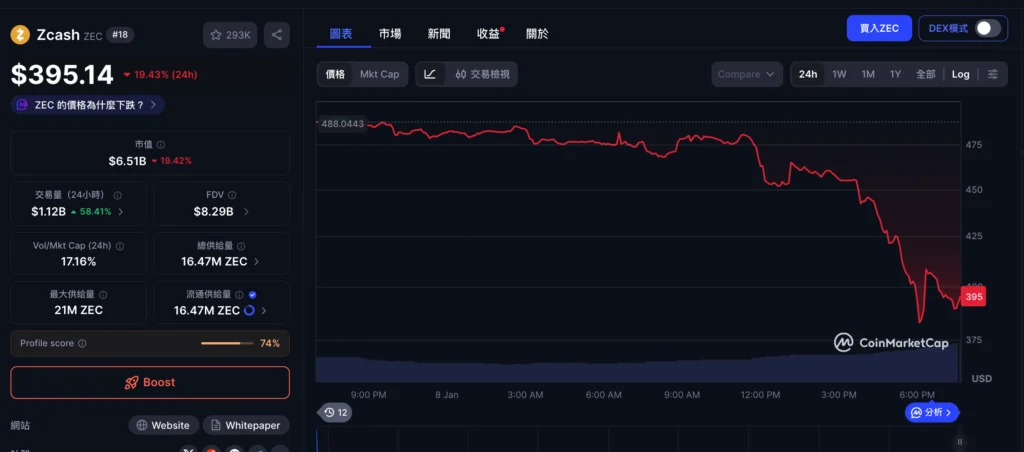
(Sources: CoinMarketCap)
This dramatic ZEC protocol price drop follows a governance breakdown that threatens the project’s development trajectory despite the network’s decentralized and open-source nature remaining intact. This analyst insight examines the events behind the ZEC protocol price collapse, the underlying conflict, implications for protocol sustainability, and the outlook for Zcash moving forward as of January 9, 2026.
Governance Conflict Triggers Full ECC Team Departure
ECC CEO Josh Swihart revealed on X that the entire team resigned on January 8, 2026, citing “malicious governance behavior” from a majority of the Bootstrap board—including Zaki Manian, Christina Garman, Alan Fairless, and Michelle Lai (collectively ZCAM)—that created an irreconcilable conflict with Zcash’s core mission of building unstoppable privacy money.
Swihart emphasized that the team is forming a new company to continue its work, stating: “We are the same team with the same mission—building unstoppable privacy money.”
- Resignation Scope: Complete ECC team exit.
- Conflict Trigger: Alleged misalignment with Zcash’s privacy-focused principles.
- New Entity: Formation of a successor organization to carry forward development.
- Bootstrap Defense: Former ECC CEO Zooko Wilcox publicly supported the board members, citing their integrity.
Immediate Impact on ZEC Protocol Price
The announcement triggered a rapid sell-off, with ZEC protocol price dropping nearly 20% from pre-announcement levels. The token had previously rallied strongly in November 2025, reaching ~$723 amid broader privacy coin momentum, but the governance crisis has erased significant gains.
- 24-Hour Decline: ~20% to ~$395.
- Recent High: ~$723 in November 2025.
- Market Reaction: Sharp volume spike on major exchanges.
- Volatility Context: Reflects uncertainty over future development.
Open-Source Nature Provides Resilience to ZEC Protocol Price Drop
Zcash’s open-source protocol ensures continued operation independent of ECC. Nodes, miners, and validators can maintain the network, and any entity—including the new team—can submit code changes or maintain forks.
This structural decentralization limits immediate protocol-level risks but raises questions about long-term maintenance, innovation, and community coordination.
- Protocol Continuity: No single entity controls Zcash code.
- Development Risk: Loss of primary contributors may slow upgrades.
- Community Role: Increased reliance on independent developers.
- Historical Precedent: Other open-source projects have survived team departures.
Strategic and Governance Implications
The conflict highlights tensions between nonprofit governance bodies and core development teams in decentralized protocols. Bootstrap’s board majority (ZCAM) now faces scrutiny, while ECC’s departure signals a potential fork or competing effort.
Swihart’s emphasis on continuing the privacy mission suggests fragmentation risks, though the protocol’s open nature provides a safety net.
- Governance Lessons: Need for clearer alignment mechanisms.
- Development Continuity: New entity may accelerate or diverge from roadmap.
- Community Response: Early reactions mixed—some support ECC, others await clarity.
Outlook for ZEC Protocol Price and Ecosystem
The ZEC protocol price drop reflects short-term uncertainty, but the network’s decentralized resilience and privacy focus provide long-term foundations. Potential catalysts include:
- Successful transition to new development entity.
- Community-driven governance reforms.
- Renewed privacy coin narrative amid regulatory scrutiny.
Risks remain if development momentum stalls or competing forks emerge.
In summary, the dramatic ZEC protocol price decline follows ECC’s full team exit amid governance disputes with Bootstrap, highlighting classic tensions in decentralized projects. While the open-source ZEC protocol remains operational and secure, the loss of primary contributors introduces short-term uncertainty and development risks. The formation of a new entity offers hope for continuity, but community coordination and governance clarity will determine Zcash’s trajectory in 2026. Monitor official ECC and Bootstrap announcements, community channels, and on-chain activity for further developments—always reference primary sources and regulated platforms when evaluating cryptocurrency investments.
Disclaimer: The information on this page may come from third parties and does not represent the views or opinions of Gate. The content displayed on this page is for reference only and does not constitute any financial, investment, or legal advice. Gate does not guarantee the accuracy or completeness of the information and shall not be liable for any losses arising from the use of this information. Virtual asset investments carry high risks and are subject to significant price volatility. You may lose all of your invested principal. Please fully understand the relevant risks and make prudent decisions based on your own financial situation and risk tolerance. For details, please refer to
Disclaimer.
Related Articles
USDC Rises Against the Trend: Trading Volume Surpasses USDT for the First Time, Leading Holdings in Five Countries
Mizuho Financial Group research shows that USDC's adjusted trading volume will reach $2.2 trillion in 2026, surpassing USDT's $1.3 trillion for the first time, demonstrating its growth in the stablecoin market. USDC performs better in regulated markets, while USDT maintains dominance in emerging markets, reflecting geographic differentiation in the stablecoin market. This phenomenon is closely related to the different regulatory strategies adopted by both.
MarketWhisper3m ago
Why Did Bitcoin Rise Today? Weekly Close Reclaims 70K, Crypto Czar Sends Anti-War Signal
Bitcoin closed last week above $70,000, marking its highest level since March. White House advisor Sacks' anti-war statement drove a market rebound, demonstrating the importance of cryptocurrency in the geopolitical environment. Technical analysis shows Bitcoin holding steady at key support levels, with potential for further gains toward $75,000 to $80,000. Markets remain vigilant about geopolitical risks, which could impact near-term movements.
MarketWhisper14m ago
Today the cryptocurrency fear and greed index rose to 23, with the market in a state of extreme panic.
Gate News, on March 16, according to Alternative.me data, the cryptocurrency fear and greed index rose to 23 today, compared to 15 yesterday, with the market in an "extreme panic state".
GateNews18m ago
White House Advisor David Sacks Calls for US Withdrawal from Iran War to Protect Technology and Crypto
AI advisor David Sacks calls for the U.S. to withdraw from the Iran conflict, citing risks to technology and cryptocurrency sectors. His comments follow increased tensions and targeted threats against U.S. tech firms, causing market fluctuations.
TapChiBitcoin25m ago
Robert Kiyosaki Cites Warren Buffett Cash Strategy While Loading up on Bitcoin Ahead of 'Giant Crash'
Robert Kiyosaki warns a “giant crash” is accelerating as Warren Buffett piles up cash for turmoil, while he urgently shifts millions into bitcoin, gold, silver, and oil in preparation for what he believes could be the biggest market collapse in history.
Robert Kiyosaki Doubles Down on Bitcoin
Coinpedia26m ago


