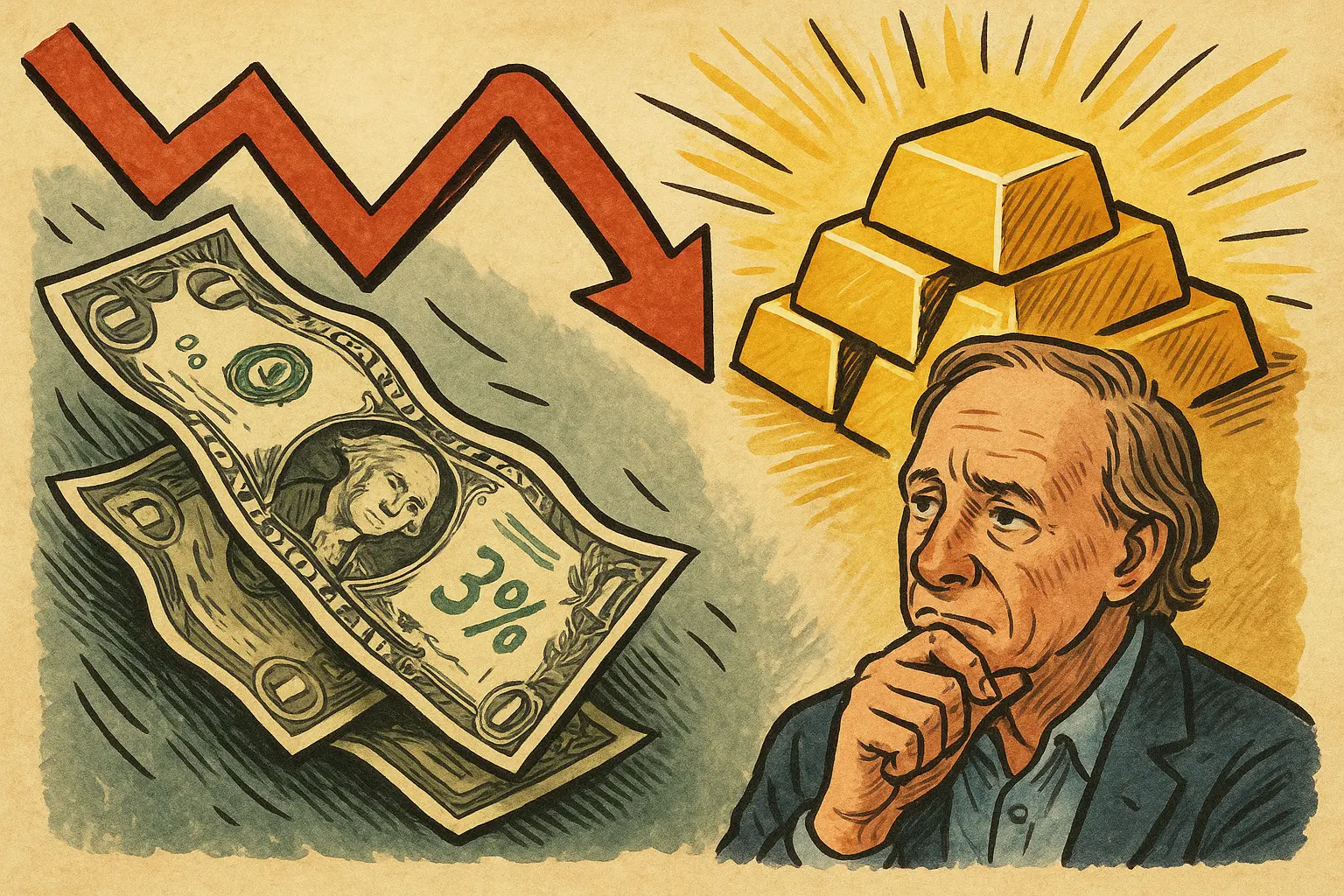
Ray Dalio, founder of Bridgewater Associates, points out that the biggest story of 2025 is the devaluation of the US dollar and the rise of gold. The dollar has depreciated 39% against gold, while gold has risen 65%, far surpassing the S&P 18%. From a gold perspective, the S&P has effectively fallen 28%. Non-US stock markets outperformed, with Europe leading by 23%. Dalio warns that valuations are expensive, and stock risk premiums have fallen to the 10th percentile.
The Shocking Truth of 39% Dollar Devaluation
As a systematic global macro investor, Dalio reflects on market mechanisms at the end of 2025. He believes that most people think US stocks, especially those related to artificial intelligence, are the best investments for 2025, but this view overlooks more important facts.
In 2025, the USD depreciated 0.3% against the Japanese Yen, 4% against the Chinese Yuan, 12% against the Euro, 13% against the Swiss Franc, and 39% against gold (the second-largest reserve currency and the only major non-fiat currency). In other words, all fiat currencies are depreciating, and the biggest market story and volatility come from the weakest fiat currency depreciating the most, while the strongest “hard currency” performs the best.
The top-performing major investment in 2025 was gold, with a USD-denominated return of 65%, outperforming the S&P 500’s USD return of 18% by 47%. In other words, from a gold perspective, the S&P 500 has effectively declined 28%. This data overturns the superficial impression of a US stock bull market and reveals the actual wealth loss masked by currency depreciation.
When a domestic currency depreciates, it reduces the country’s wealth and purchasing power, making domestic goods and services cheaper in foreign currencies, while foreign goods and services become more expensive in the domestic currency. These changes influence inflation rates and who buys what from whom, but the effects usually have a certain lag.
S&P 500 Returns from Different Currency Perspectives
USD Investors: 18%
JPY Investors: 17%
CNY Investors: 13%
EUR Investors: Only 4%
CHF Investors: Only 3%
Gold Investors: -28%
The Wealth Shift: Non-US Stock Markets Outperform Across the Board
Despite US stocks performing strongly in USD terms, their performance is much weaker when valued in strong currencies, lagging significantly behind stock markets in other countries. Clearly, investors prefer non-US stocks over US stocks; similarly, they are more inclined to invest in non-US bonds rather than US bonds or USD cash.
Specifically, European stocks outperformed US stocks by 23%, Chinese stocks by 21%, UK stocks by 19%, and Japanese stocks by 10%. Overall, emerging market stocks performed even better, with a return of 34%, while emerging market USD-denominated debt returned 14%, and local currency debt in emerging markets returned 18%.
In other words, capital flows, asset values, and wealth transfer have shifted significantly from the US to non-US markets. This trend may lead to more asset rebalancing and diversification. Dalio points out that this phenomenon is mainly driven by fiscal and monetary stimulus policies, productivity improvements, and a substantial transfer of asset allocation from the US market.
The Trump administration’s foreign policy has caused concern and retreat among some foreign investors, as fears of sanctions and conflicts intensify. Investors are more inclined to diversify their portfolios and buy gold, which is reflected in the markets. Its policies have also exacerbated wealth and income inequality, as the “wealthy class” (the top 10% of capital owners) hold more stock wealth, and their income growth is more pronounced.
Debt Crisis and the Political Bomb of the 2026 Midterm Elections
Regarding bonds (debt assets), since bonds are essentially promises to deliver currency, their real value declines when the currency depreciates, even if nominal prices may rise. In 2025, the US 10-year Treasury yield was 9% in USD (about half from yield, half from price appreciation), also 9% in JPY, 5% in CNY, but -4% in EUR and CHF, and -34% in gold.
Cash investments performed even worse than bonds. This also explains why foreign investors are reluctant to hold USD bonds and cash (unless hedged against exchange rates). Although the current bond market’s supply and demand imbalance has not yet become a serious problem, nearly $10 trillion of debt will need refinancing in the future.
Dalio warns that since the top 10% of capitalists do not see inflation as a problem, while the majority (the bottom 60%) are overwhelmed by inflation, the issue of currency value (affordability) could become the primary political issue next year. This may lead to the Republican Party losing House seats in the midterms and set the stage for chaos in 2027, while also foreshadowing a highly confrontational 2028 presidential election.
Today, one-party rule has become rare because parties find it difficult to fulfill their promises. It is increasingly evident that a large-scale confrontation between the far-right led by President Trump and the far-left is brewing. On January 1, Bernie Sanders and AOC joined forces to support the “democratic socialism” movement against billionaires. This battle over wealth and money could have profound impacts on markets and the economy.
Disclaimer: The information on this page may come from third parties and does not represent the views or opinions of Gate. The content displayed on this page is for reference only and does not constitute any financial, investment, or legal advice. Gate does not guarantee the accuracy or completeness of the information and shall not be liable for any losses arising from the use of this information. Virtual asset investments carry high risks and are subject to significant price volatility. You may lose all of your invested principal. Please fully understand the relevant risks and make prudent decisions based on your own financial situation and risk tolerance. For details, please refer to
Disclaimer.
Related Articles
Analyst says Bitcoin is still in a deep bear market zone, with BTC quickly retreating after rebounding to $74,000.
Bitcoin recently experienced a brief rebound to $74,000, but analysts believe this is only a temporary correction within the bear market. Market indicators still show that it remains in a deep bear market, and although some on-chain data suggest capital is flowing back, market momentum is unstable and may remain volatile in the short term.
GateNews4m ago
Economist Lyn Alden: Bitcoin's performance in the next two to three years may surpass gold
Macroeconomist Lyn Alden stated in a podcast that Bitcoin could surpass gold in the next two to three years due to overly optimistic sentiment in the gold market. She pointed out that Bitcoin is undervalued and mentioned the oscillating relationship between the two, with the current Bitcoin price around $71,164, down 44% from its all-time high.
GateNews34m ago
Bitunix Analyst: Margin reduction combined with oil price shocks shifts market pricing towards "higher interest rates for a longer period"
CME lowers precious metals futures margin requirements, signaling increased market liquidity. The Middle East conflict has driven up energy prices, leading to a reassessment of inflation risks. The interest rate market pricing has shifted, with easing expectations cooling down, and funds focusing on U.S. non-farm payroll data, affecting economic and liquidity trends. The crypto market is also impacted, with short-term volatility rising.
GateNews1h ago
Culper Research shorted ETH, BitMine: Ethereum has entered a death spiral, Fusaka upgrade fee collapsed by 90%
Short-selling firm Culper Research publicly shorted Ethereum (ETH) and BitMine (BMNR), accusing the Ethereum Fusaka upgrade of causing transaction fees to plummet by 90%. The firm warned that the risk of a "death spiral" is increasing and questioned the sustainability of Ethereum's economic model. Culper cited Vitalik's recent sale of 20,000 ETH, indicating the founder's negative outlook on the current situation, and challenged the interpretation of active address growth, suggesting it may be the result of address poisoning attacks.
動區BlockTempo2h ago
Bittensor (TAO) Tests Crucial $180 Level Amid Renewed AI + Crypto Interest
Michaël van de Poppe's insights on TAO hint at a key resistance level at $180 that could lead to higher prices if surpassed. The token's tie to Bittensor and the AI-crypto narrative keeps it in focus as traders monitor its performance and volume for potential gains.
BlockChainReporter3h ago
HBAR Faces Renewed Pressure as $0.09 Support Weakens
Key Insights:
HBAR price repeatedly failed to clear value area high resistance, reinforcing overhead supply and weakening bullish momentum within the current range structure.
The $0.09 high timeframe support now defines short term direction as price rotates lower inside a clearly
CryptoFrontNews3h ago


