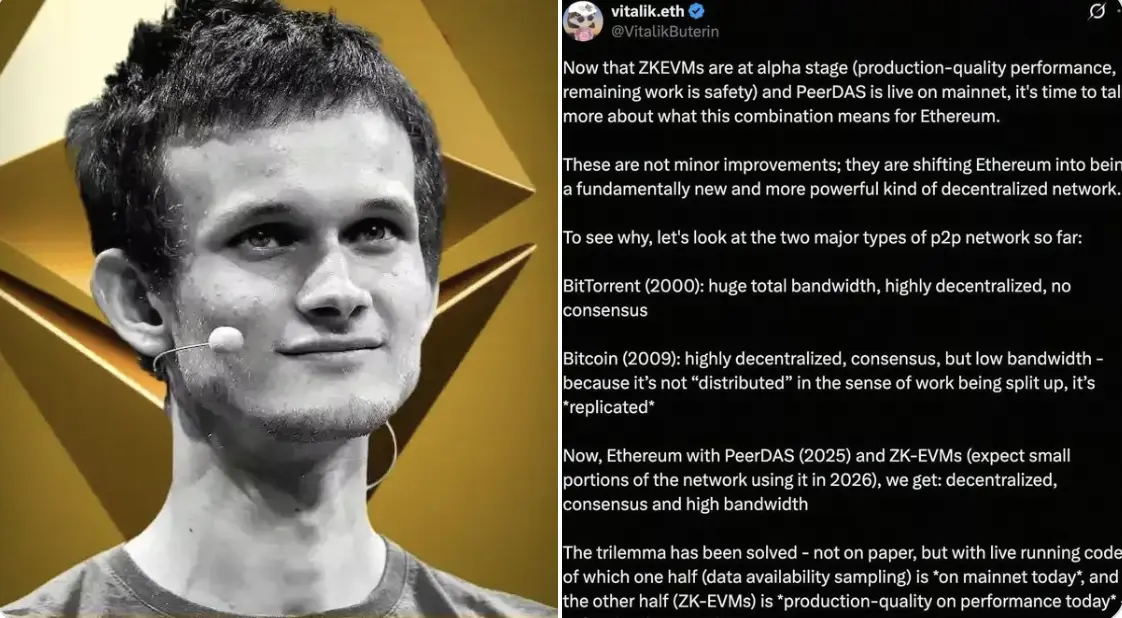
Vitalik Buterin calls for Ethereum to recommit to its foundational principles as 2026 begins, emphasizing a return to the network’s original “world computer” ambition amid impressive 2025 technical gains.
(Sources: X)
In a reflective New Year’s message, the Ethereum co-founder highlighted substantial infrastructure progress while urging the community to prioritize long-term decentralization over fleeting market trends. This analyst insight explores Vitalik Buterin’s calls for Ethereum to recommit to durable, censorship-resistant systems, analyzing key achievements, warnings, and the path ahead in blockchain evolution as of January 7, 2026.
Ethereum’s Major Technical Achievements in 2025
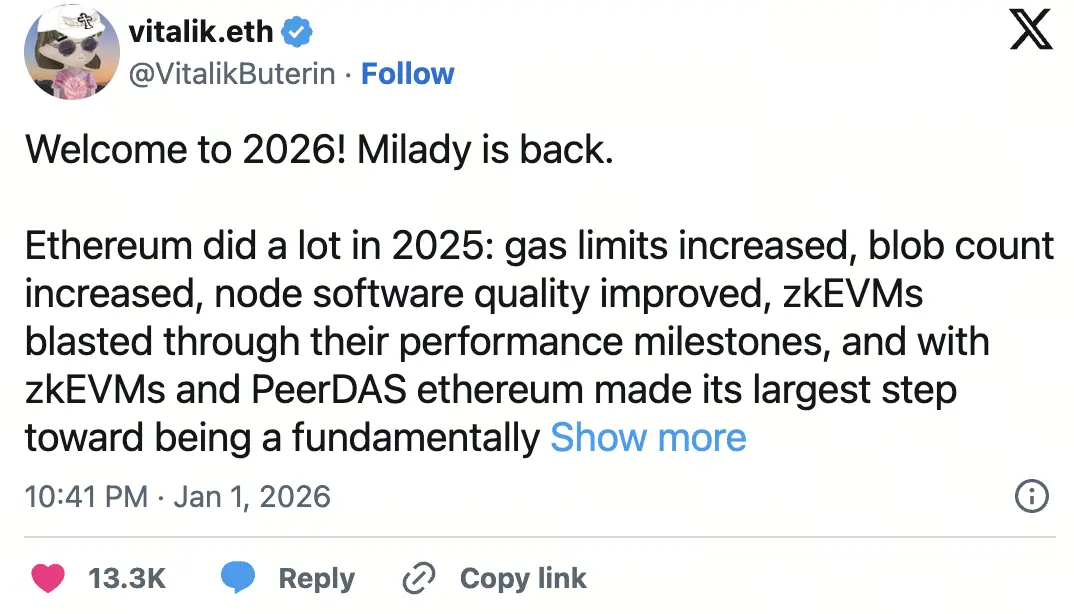
Vitalik Buterin calls for Ethereum to recommit by first acknowledging the network’s strong 2025 performance, where gas limits rose to boost throughput and blob expansions enhanced rollup data availability. Node software improvements reduced hardware barriers and sync issues, fostering greater global participation. zkEVM breakthroughs marked critical scaling milestones, while PeerDAS integration represented a transformative step in data sampling efficiency. These upgrades collectively positioned Ethereum closer to scalable, decentralized computing without centralization trade-offs.
- Gas and Blob Enhancements: Higher limits and expanded counts lowered costs for layer-2 solutions.
- Node Reliability: Better client diversity and lower requirements strengthened network resilience.
- zkEVM Progress: Performance leaps enabled production-ready zero-knowledge proofs.
- PeerDAS Impact: Combined with zkEVMs, created Ethereum’s biggest structural advance in years.
(Sources: X)
Vitalik Buterin’s Warning Against Short-Term Distractions
As Vitalik Buterin calls for Ethereum to recommit to core goals, he cautioned against pursuing transient hype like tokenized real-world assets or political memecoins that divert from sustainable development. Such trends risk inflating metrics artificially rather than building robust infrastructure. Buterin stressed resisting “next meta” cycles driven by viral narratives over foundational work. This perspective reinforces Ethereum’s role as neutral blockchain technology, not a vehicle for short-lived speculation.
- Identified Distractions: Tokenized dollars and political-themed coins as examples of fleeting focus.
- Risks Highlighted: Prioritizing hype erodes long-term decentralization efforts.
- Core Emphasis: Avoid trend-chasing to maintain blockchain integrity.
- Community Call: Vitalik Buterin calls for Ethereum to recommit by focusing on enduring value.
Reaffirming Ethereum as a Decentralized “World Computer”
Vitalik Buterin calls for Ethereum to recommit to its vision of a global, fraud-proof platform where applications resist censorship and third-party interference. Central to this is the “walk-away test,” ensuring systems function independently even if developers vanish. Ethereum positions itself against centralized subscription models, offering user-controlled, persistent alternatives. This mission extends blockchain utility to identity, governance, and broader digital infrastructure.
- World Computer Concept: A shared, neutral platform for trust-minimized applications.
- Walk-Away Test: Benchmark for true decentralization and resilience.
- Anti-Centralization Stance: Rebellion against modern tech giants’ control.
- Broader Applications: Beyond DeFi to civilizational tools requiring permanence.
Balancing Usability and Decentralization in 2026
Vitalik Buterin calls for Ethereum to recommit by advancing usability without sacrificing decentralization, through protocol optimizations like client diversity and node efficiency. At the application layer, intuitive interfaces, privacy features, and fault-tolerant designs are essential. Progress must occur in parallel across layers to enable global adoption. As of early 2026, ongoing upgrades aim to reduce centralization risks while improving non-technical user access.
- Protocol-Level Focus: Node optimization and efficiency gains.
- Application-Level Needs: Better UX, default privacy, and independence from centralized services.
- Parallel Advancement: Usability and decentralization must evolve together.
- Adoption Goal: Make Ethereum accessible worldwide without compromises.
Why Vitalik Buterin Calls for Ethereum to Recommit Matters Now
Vitalik Buterin calls for Ethereum to recommit amid maturing blockchain landscapes, where tools like rollups, zkEVMs, and data sharding provide powerful foundations. In 2026, success hinges on applying these for neutral, resilient systems beyond finance. This recommitment counters growing centralization pressures in technology. Ethereum’s trajectory could define decentralized computing’s future viability.
In summary, Vitalik Buterin calls for Ethereum to recommit to its “world computer” ethos by building on 2025’s technical wins and resisting distractions for lasting impact. The network’s tools are ready, but focused execution is crucial. For deeper understanding, explore Ethereum’s official roadmap resources or community discussions on decentralization best practices, always using secure, compliant tools when engaging with blockchain ecosystems.
Disclaimer: The information on this page may come from third parties and does not represent the views or opinions of Gate. The content displayed on this page is for reference only and does not constitute any financial, investment, or legal advice. Gate does not guarantee the accuracy or completeness of the information and shall not be liable for any losses arising from the use of this information. Virtual asset investments carry high risks and are subject to significant price volatility. You may lose all of your invested principal. Please fully understand the relevant risks and make prudent decisions based on your own financial situation and risk tolerance. For details, please refer to
Disclaimer.
Related Articles
Vitalik: In the application layer and the external interfaces of Ethereum, we should be brave enough to thoroughly reconstruct various concepts.
Vitalik Buterin stated on Farcaster that Ethereum needs a more open and bold mindset, especially at the application layer, emphasizing that core features should be non-negotiable. He highlighted the importance of rethinking concepts and technical directions, suggesting that applications should be redesigned from new perspectives to drive Ethereum's development and growth.
GateNews5m ago
Data: If ETH breaks through $2,175, the total liquidation strength of long positions on mainstream CEXs will reach $694 million.
ChainCatcher reports that, according to Coinglass data, if ETH breaks through $2,175, the total liquidation strength of long positions on major CEXs will reach $694 million. Conversely, if ETH drops below $1,975, the total liquidation strength of short positions on major CEXs will reach $452 million.
GateNews16m ago
Dormant Ethereum ICO Wallet Activates After 10.6 Years, Moves 100.27 ETH
Gate News bot message, a dormant Ethereum ICO wallet became active after 10.6 years and transferred 100.27 ETH ($212K) to a new wallet.
The participant invested only $125 to purchase 401.1 ETH during the ICO. The holding is now valued at $834K, representing an estimated 6,687x return on the initial
GateNews27m ago
Vitalik: Prediction markets help us understand the world and the near future
BlockBeats News, on March 6, Ethereum founder Vitalik Buterin stated that prediction markets help us better understand the world and the near future. I hope prediction market projects can further optimize in this direction, especially with more conditional markets.
BlockBeats has launched a prediction market section where users can subscribe to exclusive updates.
GateNews55m ago
Data: In the past 24 hours, the entire network has liquidated $274 million, with long positions liquidated at $189 million and short positions at $85.9469 million.
ChainCatcher reports that, according to Coinglass data, the total liquidations across the entire network in the past 24 hours amounted to $274 million, with long positions liquidated at $189 million and short positions at $85.9469 million. Among these, Bitcoin long positions were liquidated at $72.5955 million, Bitcoin short positions at $31.1138 million, Ethereum long positions at $38.5414 million, and Ethereum short positions at $24.8499 million.
GateNews4h ago


