
In 2025, silver surged by 165%, and gold increased by 66%, marking the best performance since 1979. Gold hit 91 new highs within 27 months, nearly breaking records every week. Experts point out that this is a structural re-pricing of global capital shifting toward hard assets. Goldman Sachs states that the market remains in the “early stages of a super cycle that could last ten years.”
The Era of Fiscal Dominance Driving Hard Asset Revaluation
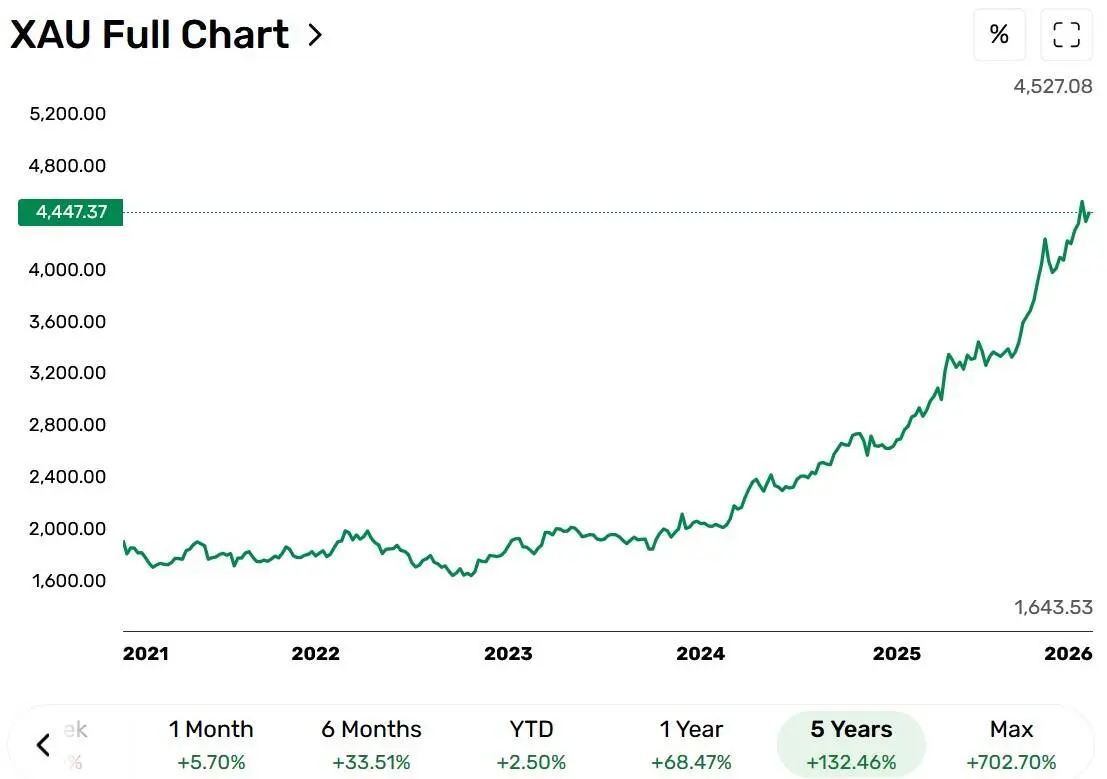
The factors driving the rise in hard asset prices are far more profound and lasting than inflation itself. The world is entering a low-interest-rate but fiscally unstable environment, with government debt continuing to climb and policy flexibility diminishing. Real yields remain under pressure, purchasing power erodes, and capital is steadily shifting from financial assets to tangible assets.
Fiscal dominance has become a prominent feature of the global economy. Debt servicing costs constrain policymakers, making inflation, currency devaluation, and financial repression increasingly unavoidable. Hard assets benefit directly: they are priced in depreciating currencies but represent limited, real-world inputs. Lars Hansen, Director of the Gold Silver Club Research, states: “This is not a bubble burst; it is a typical example of global re-pricing. When confidence in the paper asset system weakens, capital begins to shift toward physical assets.”
The momentum of gold’s rise is particularly noteworthy. Since October 2023, gold prices have climbed from $1,800 per ounce, reaching 91 new all-time highs in just 27 months. Over the past two and a half years, gold has been setting records almost weekly. Such a meteoric rise has never been seen in modern market history. Silver stands out as the best-performing commodity of 2025, with a 165% increase, closing at a record high of $83.62 per ounce. Platinum follows closely, with gains exceeding 140%, driven by long-term supply shortages and rising investor demand.
Geopolitical Fragmentation Accelerates Resource Nationalism
Geopolitical fragmentation has intensified the structural revaluation of hard assets. Globalization has given way to a multipolar system characterized by trade barriers, resource nationalism, and strategic reserves. Energy, food, and critical materials are now national security issues. Supply chains are being rebuilt, costs are rising, and long-term equilibrium prices are increasing accordingly.
This shift is especially evident in metal markets. Major resource powers like China and Russia are strengthening export controls on critical minerals, while Europe and the US are actively promoting supply chain localization. This de-globalization trend means the reliance on low-cost production models is disappearing, replaced by “security premiums”—even at higher costs—to ensure supply stability. For hard asset investors, this structural change will support higher price floors.
Four Drivers of the 2026 Hard Asset Super Cycle
Monetization of Fiscal Deficits: Global government debt-to-GDP ratios hit new highs, with central banks forced to suppress real interest rates, leading to continuous depreciation of fiat currencies.
Geopolitical Fragmentation: Trade barriers and resource nationalism drive supply chain rebuilding, structurally increasing costs.
Industrial Demand Revolution: AI, electrification, and defense spending are fueling explosive demand for copper, silver, aluminum, nickel, and other metals.
Institutional Allocation Shift: Sovereign wealth funds and family offices are upgrading their hard asset allocations from tactical hedges to strategic positions.
The Industrial Demand Revolution Reshapes Hard Asset Values
At the same time, industrial demand is undergoing a structural transformation. Accelerating developments in AI, electrification, automation, and defense spending are driving sustained demand for copper, aluminum, silver, and nickel. As capital expenditure shifts from financial engineering to physical infrastructure, hard assets are moving from the periphery to the core of investment portfolios.
Take silver as an example: over 50% of its demand comes from industrial applications, from solar panels to 5G base stations, from electric vehicles to AI data centers. Silver’s conductivity and thermal properties make it an irreplaceable critical material. The 165% surge in silver in 2025 is not speculative hype but a true reflection of supply and demand fundamentals. The story of copper is similar; the global electrification wave could double copper demand over the next decade, but new mine development cycles take 10 to 15 years, and supply gaps will continue to widen.
Institutional Capital Flows into Hard Asset Allocations
Institutional behavior also confirms this shift. Sovereign wealth funds, hedge funds, and family offices are no longer viewing hard assets as tactical hedges but increasingly as strategic holdings—this change will alter market structures and support higher prices in the coming years.
Wall Street also echoes this view. Goldman Sachs recently told clients, “The outlook for the commodity markets in 2026 is more optimistic than ever,” and stated that the market remains in “the beginning of a super cycle that could last many years, even up to ten.” Major institutions have reached similar conclusions in their outlooks for 2026.
Skeptics argue that the opportunity for easy profits is gone. But data shows the opposite is true. In 2025, the commodities market not only hit new highs but also accelerated growth, with broader participation. Historically, this pattern signals the early stage of a super cycle in hard assets, not its end. Analysts at the Gold Silver Club have believed since early 2021 that commodities are entering a new super cycle. Five years later, this view is further validated. Hansen notes: “Super cycles do not end after five years; they mature when supply finally catches up with demand—and we are still far from that stage.”
Overall, various factors influencing 2026 suggest the world will be more divided, resource-scarce, and more dependent on material inputs than at any time in decades. Hard assets are no longer optional but essential. Hansen states: “This is not a prediction; it is a statement of fact. 2026 will be remembered as the Year of Hard Assets.”
Historical experience shows that during periods of structural re-pricing, rewards go not to the hesitant but to those who early position, maintain discipline, and act before consensus fully forms.
Disclaimer: The information on this page may come from third parties and does not represent the views or opinions of Gate. The content displayed on this page is for reference only and does not constitute any financial, investment, or legal advice. Gate does not guarantee the accuracy or completeness of the information and shall not be liable for any losses arising from the use of this information. Virtual asset investments carry high risks and are subject to significant price volatility. You may lose all of your invested principal. Please fully understand the relevant risks and make prudent decisions based on your own financial situation and risk tolerance. For details, please refer to
Disclaimer.
Related Articles
Bitmine promoted to the NYSE Main Board! Tom Lee: U.S. stocks may be at a bottom, and selling pressure on Ether could ease
Bitmine has officially moved from the NYSE American board to the main board in the U.S., marking an important milestone for the company. Despite a sharp drop in its share price, it has still increased its share repurchase program to $4 billion. The company holds a large amount of Ether (ETH), and expects that a rebound in the crypto market will help improve its assets and share price performance.
CryptoCity19m ago
Bitcoin Reclaims $76,000 as US March PPI Misses Forecasts
Bitcoin surged past $76,000 following lower-than-expected US Producer Price Index data for March 2026, which indicated a 4% year-over-year increase. The rise reflects strong market support despite declining leveraged positions.
GateNews3h ago
BTC 15-minute rise of 0.64%: a technical breakout of key resistance combined with weak liquidity amplifies volatility
2026-04-14 15:30 to 15:45 (UTC), BTC saw short-term fluctuations within the 74,795.5 to 75,319.3 USDT range, with a return of +0.64% and a range of 0.70%. During this period, market attention warmed up, volatility intensified, trading volume rose slightly compared with the previous hour, and short-term buy orders pushed the price upward quickly.
The main driver of this unusual move was BTC’s short-term technical breakout above the 74,000 USDT key resistance, which generated a long signal and triggered rapid responses from quantitative and programmatic buy orders. At the same time, because the order book depth has been rising since 2025
GateNews3h ago
ETH rose 1.06% in 15 minutes: global political stimulation and a coordinated boost to risk appetite and on-chain activity together drove the move
From 15:30 to 15:45 (UTC) on 2026-04-14, the ETH price range was 2340.75 to 2367.0 USDT. Within 15 minutes, the return rate reached +1.06%, and the amplitude was 1.12%. Market volatility intensified, and on-chain and social attention rose in tandem. Short-term trading activity increased significantly, and investor sentiment shifted to optimism.
The main driving force behind this market move is the direct impact of an international political event on risk appetite. The United States announced a blockade of the Strait of Hormuz in the Middle East region related to the White House, creating a stark contrast with peace signals reportedly coming from Iran, and it triggered uncertainty and panic sentiment in the market.
GateNews3h ago
Bitmine gets promoted to the NYSE main board! Tom Lee: US stocks may be at a bottom, with selling pressure on Ether easing
Bitmine has officially moved from the NYSE American board to the main board, marking an important milestone for the company. Despite a sharp decline in its stock price, it has still increased the share repurchase plan to $4 billion. The company holds a large amount of Ether, and it expects that a rebound in the crypto market will help enhance its assets and stock price performance.
CryptoCity3h ago
Bitcoin Reclaims $75,000 for Second Time Since US-Iran Conflict, Up 7% in 24 Hours
Bitcoin surged to $75,000 amid rising U.S.-Iran tensions, adding $98 billion to its market cap and causing $500 million in liquidations. Technical analysts suggest that holding support above $67,000 could lead to an increase toward $80,000, despite highlighting $50,000 as a critical level if support fails.
GateNews3h ago


