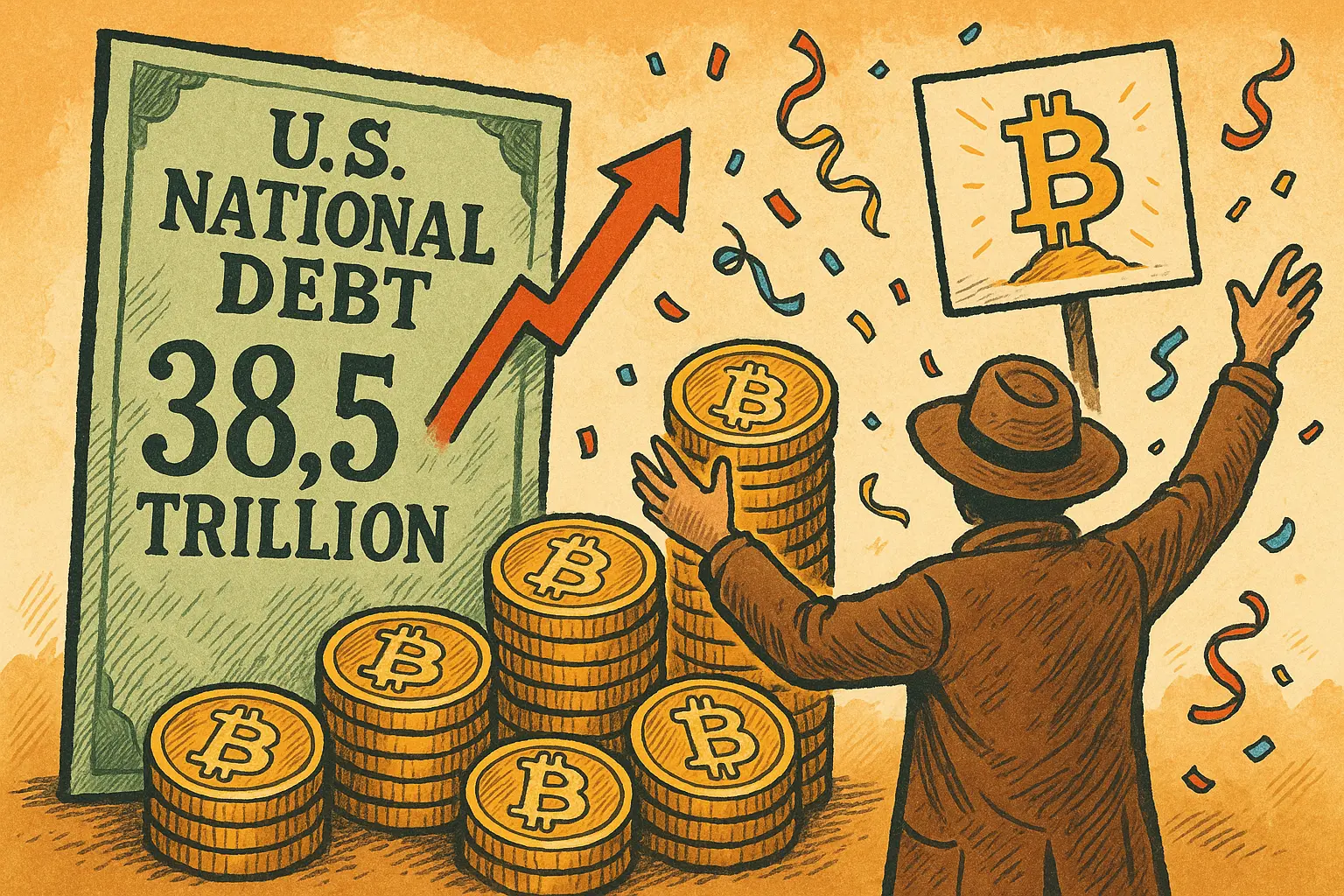
U.S. public debt broke through $38.5 trillion on Saturday, coinciding with the 16th anniversary of Bitcoin’s “Genesis Day.” On January 3, 2009, Satoshi Nakamoto mined the Genesis Block and embedded the headline from The Times: “Chancellor on brink of second bailout for banks.” Sixteen years later, U.S. public debt soared to a new all-time high, validating Nakamoto’s early warning about the out-of-control fiat currency system.
The Hidden Prophetic Code in Satoshi Nakamoto’s Genesis Block
On January 3, 2009, the world was still reeling from the aftermath of the 2008 financial crisis, with governments worldwide frantically printing money to rescue their economies. Nakamoto’s choice to mine the first Bitcoin block on this day was no coincidence. He permanently embedded the headline “Chancellor on brink of second bailout for banks” into the blockchain, serving as the official proof of Bitcoin’s birth and a silent indictment of the fiat currency system.
This headline refers to the UK government’s second round of bank rescue plans in response to the financial crisis. At that time, global central banks were jointly implementing quantitative easing, unlimitedly printing money to save the economy. By embedding this news, Nakamoto expressed a profound critique of central banks’ arbitrary expansion of money supply and the resulting dilution of purchasing power. One of Bitcoin’s core principles is to prevent any inflation through its fixed supply cap of 21 million coins.
Tether CEO Paolo Ardoino congratulated on Genesis Day: “Happy Genesis Block Day, Bitcoin.” Bitcoin investment firm OranjeBTC’s Strategy Director Sam Callahan also extended similar wishes. Every year, the Bitcoin community revisits Nakamoto’s original intent, viewing Genesis Block as the starting point of the decentralized financial revolution.
Stunning Data on the Out-of-Control Spiral of U.S. Public Debt
According to real-time data from the U.S. National Debt Clock, U.S. public debt is expanding at an astonishing rate. Congressional data shows that by 2025, the U.S. government will be adding about $60 billion in debt daily, meaning the total national debt will increase by $2.2 trillion in one year. This runaway speed is unprecedented in history.
Three Key Indicators of the Out-of-Control U.S. Public Debt
Historical comparisons are shocking: according to the U.S. House Budget Committee, it took over 200 years for U.S. public debt to surpass $1 trillion in October 1981. Now, from $37 trillion to $38.5 trillion, it only takes a few months, exposing the complete collapse of fiscal discipline.
Continuous Expansion of Money Supply: Data from the Federal Reserve Bank of St. Louis shows that the M2 money supply (a broad measure of U.S. dollar circulation) has reached $22.4 trillion and continues to grow. The printing presses keep running, diluting the purchasing power of every dollar.
Debt Interest Consuming the Budget: As interest rates rise, the U.S. government pays over the defense budget annually in debt interest, becoming the largest item in fiscal expenditure. This vicious cycle means the government must borrow more to pay off old debt interest.
Market analyst James Lavish sharply commented: “Lying, deceiving, stealing, endlessly printing. This is the usual trick of fiat currency, which weakens the currency until people’s confidence ultimately collapses.” This critique directly points to the core flaw of the fiat system: the lack of supply constraints leading to moral hazard.
Bitcoin’s Fixed Supply and Its Logic to Fight Inflation
Inflation of the fiat currency supply erodes its purchasing power, reducing its value relative to limited goods and services. When U.S. public debt skyrocketed from $1 trillion to $38.5 trillion, the dollar’s purchasing power had shrunk by over 90%. The money needed to buy a house in 1981 now might only cover the down payment.
Nakamoto addressed this issue by setting a fixed maximum supply of 21 million coins. Bitcoin is produced according to a stable issuance schedule, with the block reward halving approximately every four years (every 210,000 blocks). This “halving mechanism” ensures that new supply gradually decreases and ultimately stops around 2140. This design makes Bitcoin deflationary over time, theoretically increasing its relative purchasing power against goods and services.
Bitcoin’s supply curve is fully transparent and immutable; no one can create new coins out of thin air. This sharply contrasts with the fiat system, where supply is entirely subject to central bank decisions, susceptible to political pressure and short-term interests. History is littered with currency collapses caused by government abuse of printing rights—from the hyperinflation of the Weimar Republic to Zimbabwe’s complete failure.
The CEO of the largest compliant crypto exchange in the U.S. once stated that Bitcoin “in a strange way” helps solidify the dollar’s reserve currency status. This seemingly paradoxical view actually reveals a deeper logic: Bitcoin’s existence forces the fiat system to be more cautious, as the public now has an exit option. When confidence in fiat currency wanes, people can shift their wealth into Bitcoin, creating a competitive pressure that somewhat restrains central banks’ reckless issuance.
The Philosophical Duel Between $38.5 Trillion Debt and 21 Million Bitcoins
The U.S. public debt surpassing $38.5 trillion and Bitcoin’s Genesis Day occurring on the same day symbolize a fundamental opposition between two monetary philosophies. The fiat system is built on unlimited credit expansion, allowing governments to push current problems onto future generations through money printing. Bitcoin, on the other hand, embodies absolute scarcity, with its supply cap unchangeable by anyone.
Critics argue that Bitcoin’s fixed supply could lead to a deflationary spiral, suppressing economic activity. But supporters counter that moderate deflation encourages savings and rational investment, while inflation promotes overconsumption and speculation. Nakamoto’s design is essentially a social experiment: how will an economy evolve when people hold a currency that cannot depreciate?
Sixteen years later, the experiment is still ongoing. U.S. public debt has surged from $10 trillion to $38.5 trillion, while Bitcoin has risen from virtually worthless to $91,000. Data may be providing the answer.
Disclaimer: The information on this page may come from third parties and does not represent the views or opinions of Gate. The content displayed on this page is for reference only and does not constitute any financial, investment, or legal advice. Gate does not guarantee the accuracy or completeness of the information and shall not be liable for any losses arising from the use of this information. Virtual asset investments carry high risks and are subject to significant price volatility. You may lose all of your invested principal. Please fully understand the relevant risks and make prudent decisions based on your own financial situation and risk tolerance. For details, please refer to
Disclaimer.


