On-Chain Data Analysis Company CryptoQuant Issues Warning: Due to a clear weakening in Bitcoin demand momentum, cryptocurrencies may have entered a bear market, and the subsequent downside risks should not be ignored.
Recently, CryptoQuant released a report stating: “The growth in (Bitcoin) demand has significantly slowed, indicating that the market is entering a bear market. Since 2023, Bitcoin has experienced three waves of spot demand surges, driven by the US spot ETF listing, the US presidential election, and Bitcoin reserve companies.”
However, since early October 2025, this demand growth has fallen below the long-term trend line, indicating that the new buying interest in this cycle has largely been absorbed by the market, causing Bitcoin to lose a key support level.
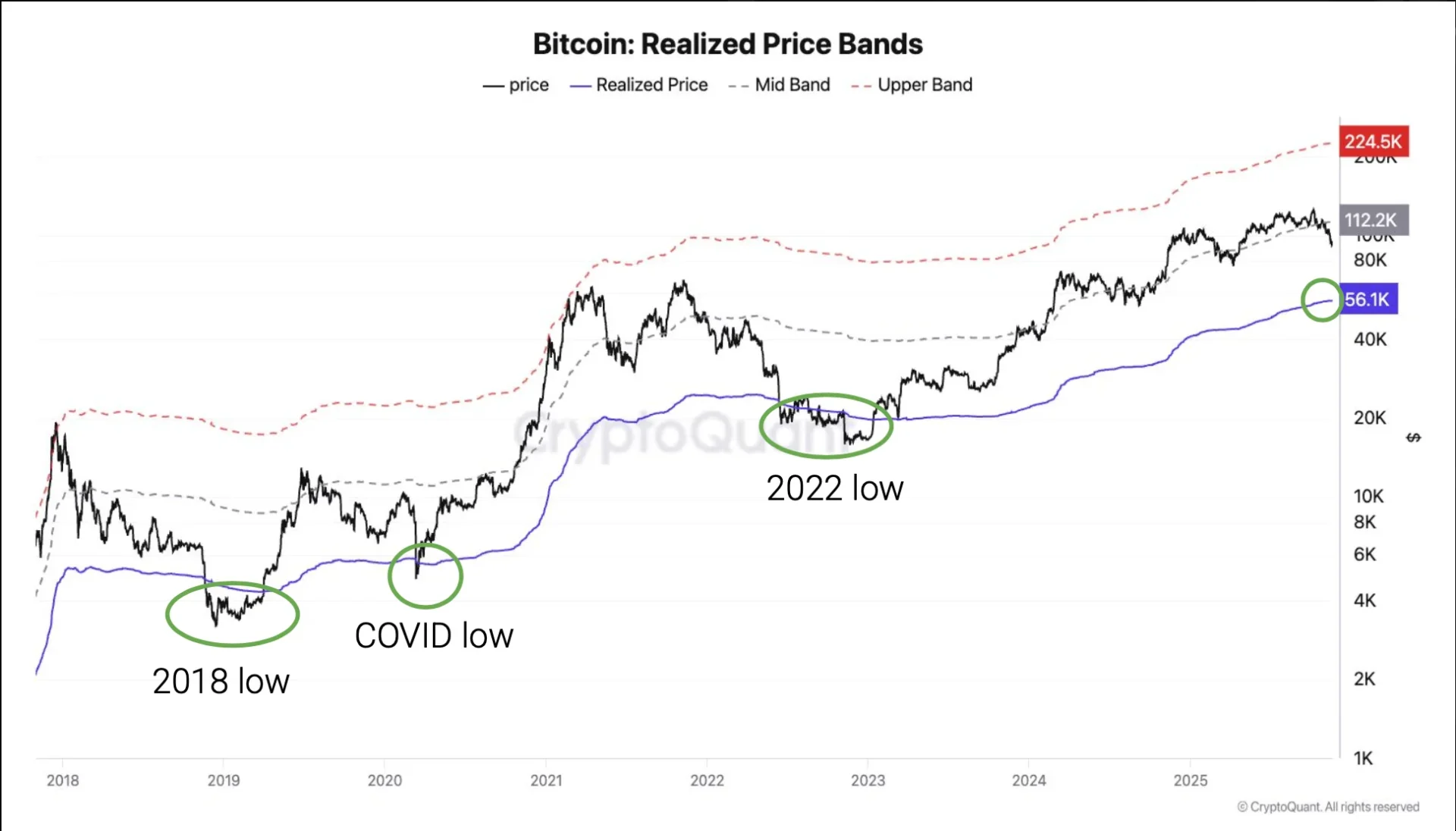
Based on the current weak trend, CryptoQuant believes that the downside risk for Bitcoin is gradually emerging. “$70,000” is the first important support zone. If the market cannot re-ignite bullish momentum, a further decline to $56,000 cannot be ruled out. The report states:
From historical experience, Bitcoin’s bear market bottom often aligns with the “Realized Price” (reflecting the average cost basis of all holders), which is currently around $56,000.
If this level is truly tested, it would mean Bitcoin has fallen approximately 55% from its all-time high, potentially making it the smallest retracement in a bear market to date.
The medium-term support level for Bitcoin is around $70,000.
 Regarding the timing concerns of the market, CryptoQuant’s Head of Research Julio Moreno revealed: “A correction to $70,000 may occur within the next 3 to 6 months; as for the deeper drop to $56,000, if it happens, it could be in the second half of 2026.”
He further added that this bear market actually began in mid-November this year, following the largest liquidation event in cryptocurrency history on October 10.
3 Major Data Confirm: Capital is Withdrawing
CryptoQuant listed three key data points supporting the view that “the bear market has arrived”:
1. ETF Turning into Net Seller: In Q4 2025, US Bitcoin spot ETFs shifted to a “net outflow” status, reducing holdings by approximately 24,000 BTC, contrasting sharply with the strong buying activity of the same period last year.
2. Whales Pull Back: Addresses holding 100 to 1,000 BTC (including ETFs and institutions) are growing at a rate below trend lines, a sign of demand deterioration similar to late 2021, just before the 2022 major bear market.
3. Derivatives Cooling Off: The funding rates of perpetual contracts (calculated as a 365-day moving average) have fallen to the lowest levels since December 2023. Declining funding rates typically indicate reduced leverage appetite among bulls, a classic bear market feature. Additionally, the price has broken below the 365-day moving average, which is often regarded as a bull-bear dividing line in technical analysis.
CryptoQuant also presents a provocative view: “The core engine driving Bitcoin’s 4-year cycle is ‘demand cycles,’ not ‘halving events.’” When demand peaks and begins to decline, regardless of supply-side dynamics, a bear market often ensues.
It is noteworthy that CryptoQuant’s bearish tone sharply contrasts with recent Wall Street major firms’ perspectives, and the market remains highly contested between bulls and bears:
Regarding the timing concerns of the market, CryptoQuant’s Head of Research Julio Moreno revealed: “A correction to $70,000 may occur within the next 3 to 6 months; as for the deeper drop to $56,000, if it happens, it could be in the second half of 2026.”
He further added that this bear market actually began in mid-November this year, following the largest liquidation event in cryptocurrency history on October 10.
3 Major Data Confirm: Capital is Withdrawing
CryptoQuant listed three key data points supporting the view that “the bear market has arrived”:
1. ETF Turning into Net Seller: In Q4 2025, US Bitcoin spot ETFs shifted to a “net outflow” status, reducing holdings by approximately 24,000 BTC, contrasting sharply with the strong buying activity of the same period last year.
2. Whales Pull Back: Addresses holding 100 to 1,000 BTC (including ETFs and institutions) are growing at a rate below trend lines, a sign of demand deterioration similar to late 2021, just before the 2022 major bear market.
3. Derivatives Cooling Off: The funding rates of perpetual contracts (calculated as a 365-day moving average) have fallen to the lowest levels since December 2023. Declining funding rates typically indicate reduced leverage appetite among bulls, a classic bear market feature. Additionally, the price has broken below the 365-day moving average, which is often regarded as a bull-bear dividing line in technical analysis.
CryptoQuant also presents a provocative view: “The core engine driving Bitcoin’s 4-year cycle is ‘demand cycles,’ not ‘halving events.’” When demand peaks and begins to decline, regardless of supply-side dynamics, a bear market often ensues.
It is noteworthy that CryptoQuant’s bearish tone sharply contrasts with recent Wall Street major firms’ perspectives, and the market remains highly contested between bulls and bears:
Disclaimer: The information on this page may come from third parties and does not represent the views or opinions of Gate. The content displayed on this page is for reference only and does not constitute any financial, investment, or legal advice. Gate does not guarantee the accuracy or completeness of the information and shall not be liable for any losses arising from the use of this information. Virtual asset investments carry high risks and are subject to significant price volatility. You may lose all of your invested principal. Please fully understand the relevant risks and make prudent decisions based on your own financial situation and risk tolerance. For details, please refer to
Disclaimer.
Related Articles
Sonic Price May Experience Technical Reversal: RSI Bullish Divergence Emerges, $0.03 Becomes a Key Support Level
Sonic token recently found support at $0.03, and the RSI shows a bullish divergence, indicating weakening downside momentum. If the support remains effective, the price could rebound to $0.04. Both technical and fundamental analyses show positive signals, but if the key support is broken, bears may regain control.
GateNews37m ago
Ethereum funding rate turns negative! ETF outflows, staking yields are lower than stablecoins
Ethereum perpetual contract funding rates turn negative, indicating increased demand for shorts and a clear market bearish sentiment. Institutional demand remains weak, partly due to relatively low staking yields and a lack of sustained capital inflows. On-chain data and technical developments have failed to boost confidence, but Ethereum's DeFi ecosystem still maintains a strong moat. It is necessary to observe a rebound in funding rates and improvements in transaction fee revenue to determine the future market trend.
MarketWhisper45m ago
Bitcoin stabilizes above $70,000, IEA may release the largest-ever crude oil reserves, global risk asset sentiment improves
Bitcoin recently broke through $70,000 again, influenced by changes in the energy market. Its price once reached $71,612 before falling back to $70,036. The market sentiment is related to discussions with the International Energy Agency about releasing strategic oil reserves, and the decline in Brent crude oil prices is seen as a signal to reduce inflation pressure. The market is focused on the Federal Reserve policy meeting, with expectations that if oil prices remain below $90, it will create room for interest rate cuts.
GateNews49m ago
Bitcoin derivatives market turns bullish, traders bet on BTC surging past $80,000
Bitcoin market sentiment is improving, with more traders expecting the price to break above $80,000 in the coming months. The options market signals a bullish bias. Currently, Bitcoin is trading near $70,000, and analysts believe that if the bullish sentiment continues, a new directional move may emerge in the future.
GateNews51m ago
XRP Ledger daily trading volume soars to 2.7 million transactions, RWA enthusiasm heats up, but XRP price remains trapped in the $1.34—$1.44 range
XRP price has recently been volatile, staying between $1.34 and $1.44. However, XRP Ledger transaction activity has increased, with a daily trading volume of 2.7 million transactions, mainly driven by real-world asset tokenization projects. Analysts point out that the market is in a consolidation phase, with a focus on the stability of the $1.34-$1.35 support level. If this support holds, a breakout above $1.44 could be possible.
GateNews53m ago
Ethereum network activity reaches a new all-time high, but ETH price has fallen 30% over 6 months, ranking third in fee revenue.
Ethereum network activity reaches a new all-time high, with multiple indicators showing a significant increase in daily active addresses and smart contract calls. However, ETH price has fallen about 30% over the past six months, indicating a net capital outflow. Analysis suggests that capital flows have a greater impact on price. Despite Ethereum hosting a large amount of stablecoins, its value capture has not kept pace with the growth in network usage.
GateNews1h ago


