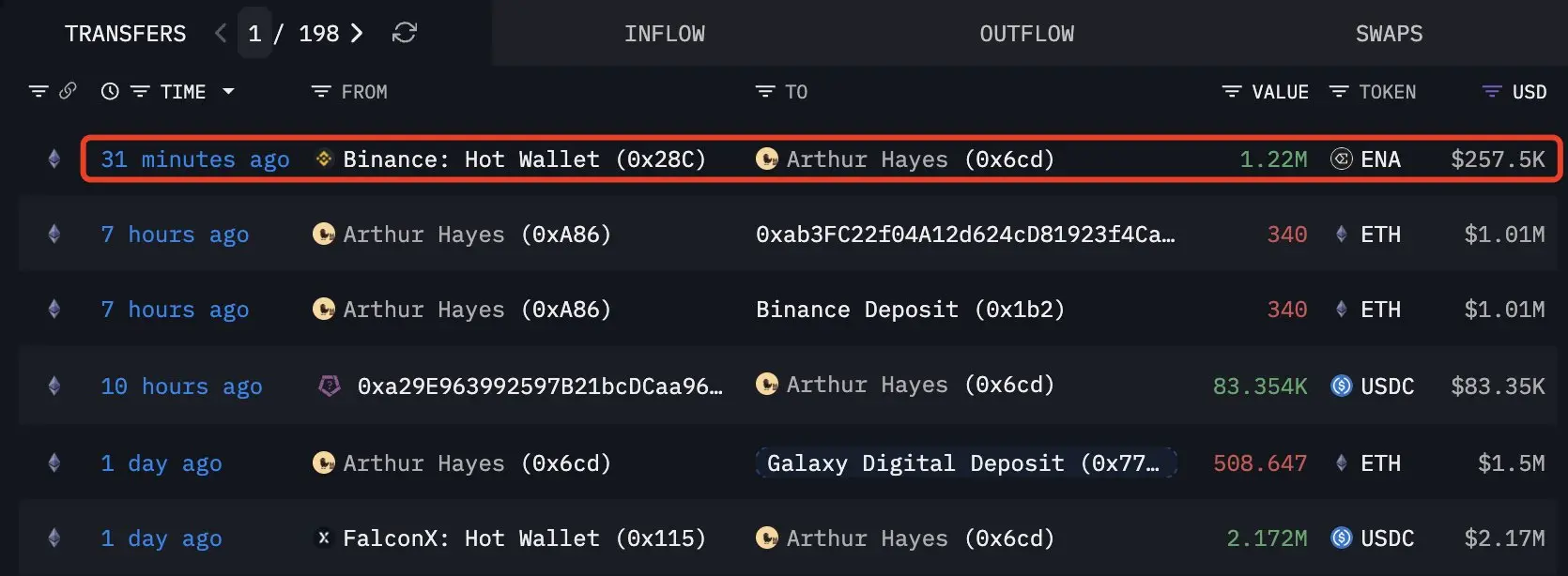
On-chain data shows that legendary trader Arthur Hayes has shifted over $3 million from Ethereum to DeFi tokens, marking a liquidity-driven flow of funds towards yield-focused crypto assets investment opportunities. Hayes' largest investment direction is Ethena (ENA), increasing his position by approximately 1.22 million ENA in a single trade. He has publicly stated that global liquidity conditions are improving, suggesting that this adjustment is a strategic asset allocation.
Why Arthur Hayes Sold ETH to Re-Stake in DeFi
(Source: Arkham)
Arthur Hayes's investment portfolio is undergoing significant changes, but this does not mean abandoning Ethereum as a long-term asset. On the contrary, this rotation shows that ETH is being used as a financing layer, while funds are being redirected to DeFi sector investment opportunities with higher beta coefficients. Data shared by Lookonchain indicates that this is not a symbolic move. Over 1100 ETH have been transferred and redeployed, marking a strategy shift involving millions of dollars of funded support.
The speed and scale of the transactions indicate that this is intentional, rather than a portfolio test or hedging. This interpretation is crucial: Hayes is rotating within the risks of crypto assets, not avoiding them. If he were truly bearish on the crypto market, he should shift to stablecoins or fiat currencies, rather than moving into DeFi tokens. This “sell ETH buy DeFi” operation is actually a dual bullish stance on the crypto market: bullish on the overall market (otherwise he wouldn't hold risk assets), but believing that DeFi will outperform ETH.
Hayes's biggest investment direction is Ethena (ENA), where he increased his holdings by about 1.22 million ENA in a single transaction, bringing his total holdings to over 6 million. Ethena is a synthetic dollar protocol, and its stablecoin USDe maintains its peg through a Delta-neutral strategy (holding ETH spot long + perpetual contract short). The ENA token captures the revenue generated by the protocol, and when the perpetual contract financing rate is positive, the protocol earns the funding rate, and these earnings are distributed to ENA holders.
Analysis of the Three Major Targets of Hayes' Heavy Investment in DeFi
Ethena (ENA): Total holdings exceed 6 million Tokens, betting on the demand for synthetic USD and perpetual contract funding rate returns, suitable for a liquidity-friendly environment.
Pendle (PENDLE): A yield tokenization protocol that allows users to separate and trade future yields. Hayes is optimistic about the explosive growth of the yield trading market.
ether.fi (ETHFI): A liquidity re-staking protocol that provides an additional layer of yield on top of Ethereum staking, benefiting from increased ETH staking rates.
These views align with Hayes' long-standing argument that liquidity-sensitive protocols often perform excellently in the early stages of a loose cycle. Hayes believes that the global liquidity situation is improving, and when central banks begin to cut interest rates and dollar liquidity increases, funds will preferentially flow into DeFi protocols that can provide real returns, rather than merely as a store of value for ETH.
Ethereum's struggle at the resistance level of 3100 USD
(Source: Trading View)
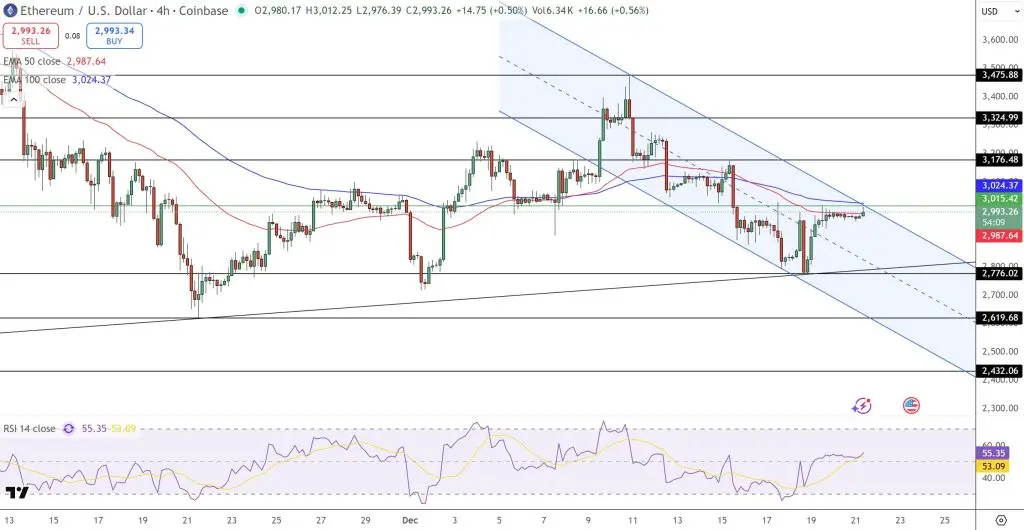
Another focus of today's Ethereum news is the ongoing struggle of the price at key resistance levels. This price rotation also aligns with the current trend of Ethereum. ETH has been trading within a descending channel on the 4-hour chart, repeatedly failing to regain the resistance level between $3100 and $3150. Momentum indicators show the market tending towards stability rather than strengthening, with the RSI lingering in neutral territory and the price consolidating below key moving averages.
In contrast, some DeFi Tokens have broken through short-term downtrend lines or have re-established themselves above key exponential moving averages (EMA), indicating that they have relative strength compared to Ethereum. From a trader's perspective, this divergence supports Hayes' strategy of seeking excess returns in yield-driven assets as Ethereum digests its recent pullback.
The reasons why ETH failed to break through the 3100 USD mark are multifaceted. First, the number of active addresses continues to decline, with the weekly active addresses in December plummeting from 440,000 to 324,000, representing a 26.4% drop in a single month, indicating a shrinkage in network usage demand. Second, there has been a continuous outflow from U.S. ETFs, with hundreds of millions of dollars having flowed out this month, reflecting a lack of institutional confidence. Third, there is a technical breakdown, with the RSI remaining below 50 and the MACD showing a death cross, indicating that downward momentum is dominant.
A deeper reason is the Layer-2 vampiric effect. L2s like Arbitrum, Optimism, and zkSync have siphoned off a large amount of trading activity and Gas fee revenue, weakening ETH's value capture ability. When users trade on L2, the Gas fees paid are much lower than on L1, and most of the profits go to L2 projects rather than ETH holders. This structural issue makes it difficult for ETH to break through resistance levels in the short term.
Hayes's judgment might be: since ETH is difficult to break through in the short term, it is better to shift funds to the DeFi Tokens that have already started to strengthen, and switch back after ETH truly breaks through. This “chasing relative strength” strategy is a common fund management technique used by professional traders.
Liquidity Improvement and Yield Token Strategic Opportunities
Hayes publicly stated on December 20 that the global liquidity situation is improving, which is the core logic behind his position adjustment. The policy orientations of major global central banks are diverging: the U.S. Federal Reserve has paused interest rate cuts, but the market expects a restart in 2026; the European Central Bank is maintaining interest rates but is signaling a dovish stance; and the Bank of Japan has raised interest rates, but actual rates remain negative. This complex policy mix overall still favors liquidity improvement.
In an environment of improved liquidity, yield-generating assets often perform exceptionally well. Ethena's USDe stablecoin offers an annualized return of approximately 10-20% (depending on the perpetual contract funding rate), Pendle allows users to trade future yields and amplify returns, and ether.fi's liquidity re-staking provides dual returns (ETH staking + re-staking rewards). These actual yields far exceed traditional finance's fixed-income products, making them highly attractive in a low-interest-rate environment.
Hayes's strategy is to seek relative excess returns rather than predicting market direction. Ethereum remains structurally very important, but in the short term, capital may favor those protocols that can directly monetize returns, liquidity, and on-chain activity. On-chain evidence eliminates ambiguity; this is not a narrative layout, but rather an early layout of capital before potential liquidity shifts.
What rotation signals should traders pay attention to? First, the strength of DeFi tokens relative to ETH. If ENA, PENDLE, and ETHFI continue to outperform ETH, it indicates that capital rotation is still ongoing. Secondly, whether ETH can break through the 3100 USD mark. If it does, it will change the overall landscape, and capital may flow back to ETH. Thirdly, the global liquidity indicators. If the M2 growth rate accelerates and USD liquidity improves, it will validate Hayes' judgment.
For ordinary investors, Hayes's operations provide a reference but should not be blindly followed. Hayes is a billionaire with a professional team, and his risk tolerance and information acquisition capabilities far exceed those of retail investors. More importantly, when Hayes's operations are made public, the market may have already priced in those expectations. Following the trend could lead to becoming a “bag holder.” A more cautious strategy is to observe the subsequent changes in Hayes's positions, as well as whether DeFi tokens can continue to outperform ETH, before deciding whether to follow suit.
Related Articles
Mainstream CEX and DEX funding rates indicate the market remains broadly bearish, with BTC and ETH both showing negative rates.
Bitcoin's recent volatility has narrowed, and the overall market funding rate is negative, indicating a bearish sentiment. The funding rate is a mechanism to maintain the balance between contract prices and asset prices; a rate below 0.005% suggests a bearish market.
GateNews23m ago
Tokenized RWA grows 309% annually, with Ethereum holding a 57% share dominating the institutional market
The tokenization of real-world assets (RWA) market reached $26.7 billion in March this year, a 309% increase compared to last year. Despite the overall downturn in the crypto market, institutional demand for tokenized assets continues to grow, with Ethereum dominating over 57% of the market share, making it the preferred choice for institutions. Although alternative chains like Solana are developing rapidly, Ethereum's security and ecosystem make its position difficult to challenge. Market growth is mainly driven by improved regulatory environments and the demonstration effect from financial institutions.
MarketWhisper2h ago
BitMine is sweeping up 60,000 ETH! Tom Lee confidently states: "The mini crypto winter" is coming to an end.
Bitmine Immersion Technologies recently purchased 60,976 Ethereum, totaling approximately $120 million, to support the crypto market. Despite facing $7.8 billion in unrealized losses, Chairman Tom Lee remains actively buying, believing the market is close to the bottom. The company plans to stake all its Ethereum, with an estimated annualized return of $259 million, urging investors to seize the bottoming opportunity.
区块客2h ago
Ethereum spot ETF had a net inflow of $57.012 million yesterday, with none of the nine ETFs experiencing net outflows.
As of March 12, Ethereum spot ETFs recorded a total net inflow of $57.012 million on March 11, 2023, in Eastern Time, with all nine ETFs experiencing no net outflows. Among them, the Fidelity ETF had the highest net inflow at $19.1332 million, with a total net inflow of $2.333 billion. Grayscale Ethereum Mini Trust ETF followed, with a single-day net inflow of $19.0788 million and a total net inflow of $1.842 billion. Currently, the total net asset value of Ethereum spot ETFs is $11.85 billion, with a net asset ratio of 4.75%.
GateNews3h ago
Mega Financial states "Banks are more cost-effective than stablecoins," sparking controversy; experimental design is biased
Chairman Dong Rui-bin of Mega Financial Holding's experimental conclusion that bank costs are lower than stablecoins for remittances exceeding $7,000 has sparked widespread criticism in Taiwan's crypto community. Critics pointed out that the experimental design was unfair, incorporating unnecessary exchange costs, making the comparison unequal. Financial researcher Yu Zhe-an analyzed that this may reflect the influence of institutional bias on the research. For users actually using stablecoins, the advantages of banks are not as significant as the experiment suggests.
MarketWhisper3h ago
Institutional Conviction Fuels Bullish Ethereum Outlook Despite Brutal Crypto Selloff
Institutional investors appear unfazed by ethereum’s sharp slide from its 2025 peak, as resilient ETP holdings, rising staking participation, and steady accumulation signal that major capital may still be positioning for a longer-term rebound.
Ethereum Bear Market May Mask Massive Repricing
Coinpedia5h ago


