MicroStrategy (MSTR) disclosed on Monday that between December 8 and 14, it spent approximately $980.3 million to purchase 10,645 Bitcoins, at an average price of $92,098. However, MicroStrategy’s BTC return rate (a core indicator tracking the amount of Bitcoin held per share of MSTR) has turned negative for the first time in years, with a quarterly return of -1%, meaning the amount of Bitcoin held per share is now less than at the end of September.
The Dilution Crisis Behind 670,000 BTC Holdings
As of December 14, MicroStrategy holds 671,268 Bitcoins, valued at about $50.33 billion, with an average cost of $74,972 per Bitcoin. Despite the staggering scale, this recent purchase exposed structural issues in MSTR’s business model. The funds came from selling common stock and issuing multiple series of preferred shares; this week, MSTR and its securities STRF, STRK, and STRD raised nearly $989 million.
The key issue is that the pace of equity dilution has exceeded the rate of Bitcoin accumulation. Since 2020, BTC returns have been positive every year, and since April 2023, quarterly returns have been positive, making this -1% reversal a significant warning. Analysts point out that only when new stock or preferred stock is issued at a price above the company’s Bitcoin net asset value can BTC returns benefit shareholders. When premiums are compressed, dilution becomes uneconomical.
Even more concerning is that MicroStrategy has decided to transfer $1.44 billion into cash reserves rather than investing the funds into Bitcoin. These reserves are intended to pay future dividends related to preferred shares. This large cash reserve not only cannot generate the potential appreciation that Bitcoin offers but also dilutes the Bitcoin exposure per share, directly dragging down BTC returns.
Three Major Warnings of MSTR Valuation Collapse
Net Asset Value Premium Plummets by 224 Percentage Points: Since mid-2023, MicroStrategy’s net asset value (mNAV) has been declining, dropping from over a 240% premium in November 2024 to about 16% currently. This reflects increasing investor reluctance to pay a premium via MSTR for Bitcoin exposure, preferring direct BTC holdings.
Market Cap Falls Below Bitcoin Value: Fundamentally, excluding preferred shares and bonds, MicroStrategy’s market cap is now below its Bitcoin holdings’ value. This inversion has never occurred in previous bull cycles, indicating that the market has lost confidence in MSTR’s value proposition as a “Bitcoin proxy.”
Per-Share Bitcoin Holdings Shrink: The quarterly BTC return rate of -1% means that although the company’s total holdings increased, the actual Bitcoin allocated to each shareholder decreased. This dilution effect is especially deadly when stock prices are weak, as issuing new shares cannot garner enough premium to offset dilution costs.
Technical Indicators Show Downtrend Has Not Reversed
(Source: Trading View)
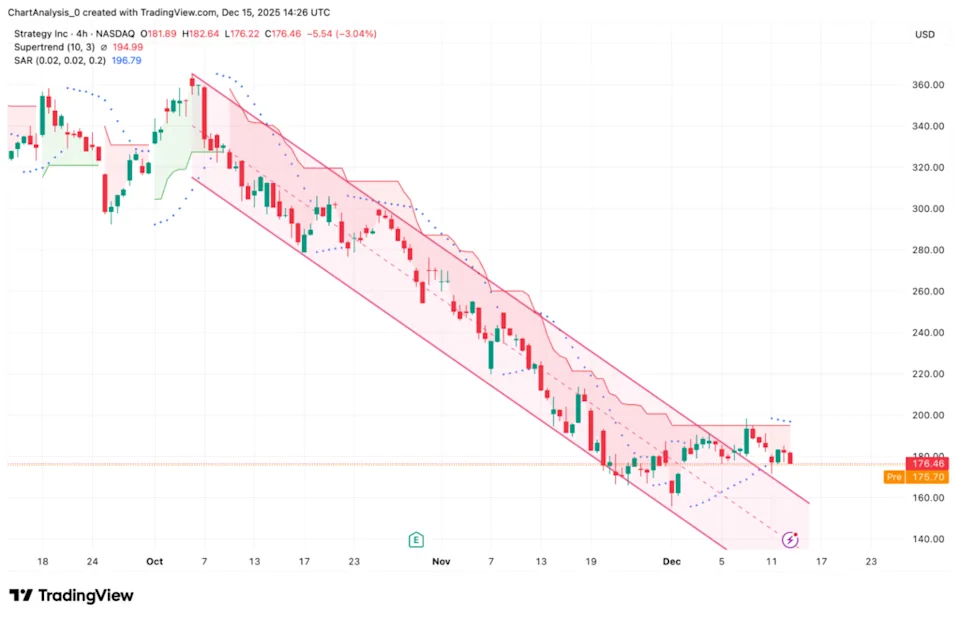
MSTR attempted to break through its descending channel but only briefly surpassed resistance before falling back within the structure, so the attempt failed. This behavior indicates rejection rather than a confirmed trend reversal. The overall structure continues to create lower highs, with sellers actively defending the $190 to $195 zone.
Supertrend and SAR indicators still show a bearish trend, confirming that downward momentum has not reversed. As long as MSTR’s trading price remains below about $195, the downtrend will persist. Short-term support is around $175; if broken, there is a risk of further decline toward $160.
From a broader perspective, the technical weakness of MicroStrategy’s stock price reflects market doubts about the sustainability of its business model. In a sideways or declining Bitcoin market environment, the strategy of continuously buying BTC through equity dilution is showing its limitations. When the mNAV premium compresses to single digits or turns negative, this cycle enters a deadlock: issuing new shares cannot raise enough funds to buy sufficient BTC to offset dilution, leading to further decline in per-share value and further compression of the premium.
MicroStrategy’s Future: Transition or Continued Dilution?
This report further indicates that Bitcoin remains the core asset of MicroStrategy, with its accumulation driven mainly by capital market activities rather than operational cash flow. This highly dependent external financing model works well in a bull market but is extremely fragile in bear or volatile markets. Market data shows that investors currently value MicroStrategy at a 16% enterprise-level premium over its Bitcoin holdings; whether this premium can be maintained will determine MSTR’s future financing capacity.
If the premium further compresses or turns negative, MicroStrategy will face a dilemma: either stop buying BTC and focus on improving operational cash flow (which would diverge from its “Bitcoin bank” strategy), or continue diluting shareholders under uneconomical conditions (which would accelerate stock price decline and premium collapse). Based on the current negative BTC returns and the sharp drop in mNAV premium, the market is already voting with its feet.
For investors holding MSTR, the key issue is no longer how high Bitcoin will go, but whether MicroStrategy’s business model can sustain itself after the premium disappears. If the answer is no, then directly holding BTC or investing in Bitcoin ETFs might be a wiser choice.
Disclaimer: The information on this page may come from third parties and does not represent the views or opinions of Gate. The content displayed on this page is for reference only and does not constitute any financial, investment, or legal advice. Gate does not guarantee the accuracy or completeness of the information and shall not be liable for any losses arising from the use of this information. Virtual asset investments carry high risks and are subject to significant price volatility. You may lose all of your invested principal. Please fully understand the relevant risks and make prudent decisions based on your own financial situation and risk tolerance. For details, please refer to
Disclaimer.
Related Articles
Bitcoin Depot CEO Change: Multiple State Lawsuits Pending, Revenue Expected to Drop 40%
Bitcoin Depot announces that former MoneyGram CEO Alex Holmes has assumed the role of chief executive officer as the company faces enforcement pressure from multiple states. Holmes will focus on operational stability and regulatory reform, with revenue expected to decline 30% to 40% in 2026. Meanwhile, BTM stock has performed poorly, with cumulative losses exceeding 94%.
MarketWhisper15m ago
Here are 9 altcoins that have outperformed Bitcoin recently
Only 9 non-stablecoin tokens are near their all-time high (ATH) more than Bitcoin, indicating that most of the market's losses remain concentrated in other assets.
Currently, Bitcoin is still 43.26% below its ATH. At first glance, this figure seems like a reminder of an incomplete recovery process. However,
TapChiBitcoin18m ago
MetaPlanet Launches Metaplanet Card with 1.6% BTC Cashback Offer
Metaplanet, Asia's largest Bitcoin holder, is launching the "Metaplanet Card," offering 1.6% Bitcoin cashback on transactions. This move enhances daily spending opportunities while boosting shareholder value, leading to a notable rise in their stock.
TapChiBitcoin45m ago
Yesterday, the US Bitcoin spot ETF had net inflows of $7.80 million, while the Ethereum ETF had net outflows of $8.50 million.
BlockBeats News: On March 26, according to Farside monitoring data, US Bitcoin spot ETF had net inflows of $7.8 million yesterday, while Ethereum spot ETF had net outflows of $8.5 million.
BlockBeatNews57m ago
Bitcoin Depot taps ex-MoneyGram CEO amid tightening state scrutiny
Bitcoin Depot has appointed Alex Holmes—already a member of the company’s board—as chief executive and chair, replacing Scott Buchanan who stepped down after less than three months in the top role. The move comes as the crypto ATM operator faces growing regulatory pressure across multiple U.S.
CryptoBreaking1h ago


