Sygnum’s “2025 Asia-Pacific High Net Worth Individuals Report” shows that 87% of high-net-worth individuals in Asia have invested in cryptocurrencies, with an average allocation of 17%. The survey interviewed 270 high-net-worth individuals (with investable assets exceeding $1 million) across ten Asia-Pacific countries (primarily Singapore, but also including Indonesia, South Korea, and Thailand). Sixty percent of respondents said they are prepared to increase their cryptocurrency holdings based on a strong 2-5 year outlook.
From Speculation to Legacy: The Qualitative Shift in Asian Ultra-High-Net-Worth Individuals’ Allocation Logic
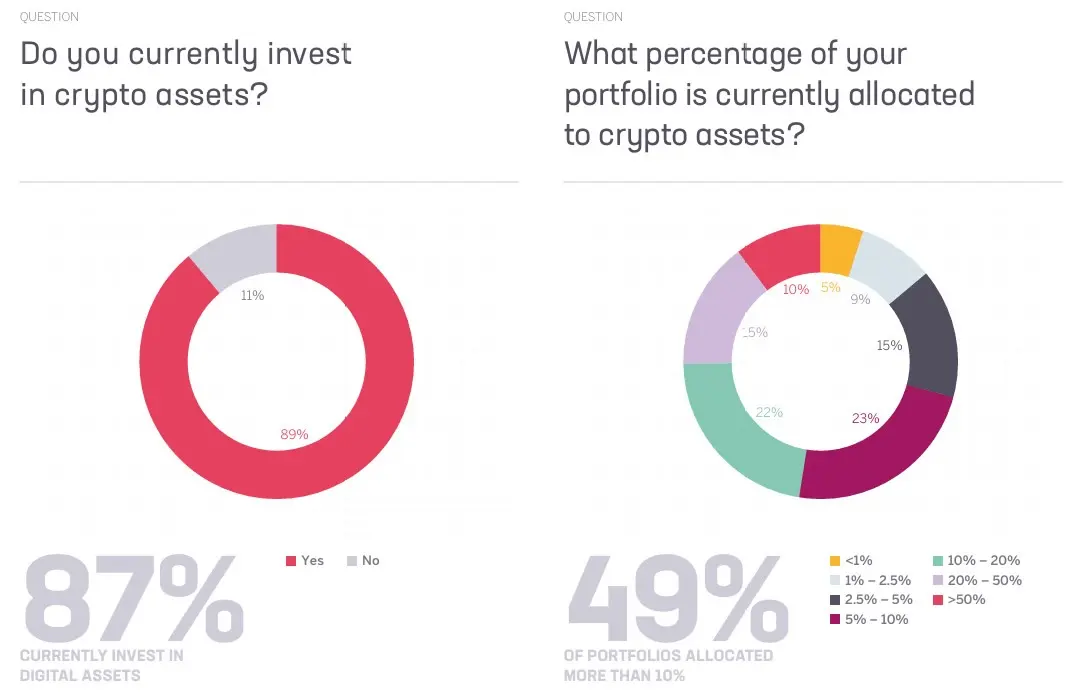
(Source: Sygnum)
The survey reveals that 87% of Asian high-net-worth individuals surveyed already hold cryptocurrencies, with about half of them holding over 10%. The average crypto allocation in their portfolios is around 17%, far exceeding traditional wealth management recommendations for “alternative assets” (usually 5% to 10%). This high allocation marks a fundamental shift, indicating that cryptocurrencies in Asia are moving from peripheral assets to core components of investment portfolios.
More importantly, 90% of the high-net-worth respondents believe digital assets are “important for long-term wealth preservation and estate planning, rather than just speculation.” This cognitive shift is of profound significance. Cryptocurrencies were once seen as high-risk speculative tools, akin to casino chips. But when 90% of Asian wealthy individuals view them as tools for wealth transfer, it signifies that digital assets have passed the test of time and market volatility, and have been incorporated into long-term asset allocation frameworks.
Gerald Goh emphasizes that a 17% portfolio allocation indicates a different mindset from the “get-rich-quick” mentality of 2017. He states: “These are not speculators—they are investors with a 10-20 year investment horizon, considering intergenerational wealth transfer.” This extended time perspective shows that Asian crypto investments are shifting from short-term trading to long-term holding, from single-asset speculation to diversified asset allocation.
Eighty-seven percent of investors said they would demand their private banks or advisors to enhance such services if regulated partners provide cryptocurrency offerings. This demand will drive traditional wealth management firms to fully integrate digital asset services, from product design and risk management to tax planning.
Bitcoin, Ethereum, Solana: Mainstream Protocol Tokens Leading Allocations
The survey shows that 80% of active investors hold blockchain protocol tokens such as Bitcoin, Ethereum, and Solana. Fifty-six percent of respondents cited diversification as the most common reason for investing. This asset choice indicates that Asian cryptocurrency investors prefer infrastructure tokens over meme coins or small altcoins.
The narrative of Bitcoin as “digital gold” is widely accepted among Asian wealthy individuals. Amid concerns about inflation and geopolitical uncertainties, Bitcoin’s capped supply (21 million coins) and decentralized nature make it an ideal hedge against fiat currency devaluation. Ethereum is favored for its smart contract ecosystem and DeFi applications, with many high-net-worth individuals viewing ETH as “the infrastructure of the digital economy.” The inclusion of Solana demonstrates growing acceptance of next-generation high-performance blockchains.
Three Major Drivers of Crypto Investment Among Asian Wealthy
Portfolio Diversification Risk: 56% see crypto as a low-correlation allocation tool alongside traditional assets
Intergenerational Wealth Transfer: Digital assets are easy to transfer across borders and not constrained by physical boundaries, suitable for global families
Regulatory Maturity: Clear frameworks in Singapore and Hong Kong enable institutional participation
Sixty percent of high-net-worth Asians plan to increase their crypto holdings in the future, based on optimistic outlooks over the next two to five years. This medium-term view indicates that investors are not chasing short-term price swings but are confident in the long-term value of blockchain technology. As real-world asset tokenization, central bank digital currencies, and DeFi develop, the infrastructure of the crypto economy continues to improve, providing solid fundamentals for long-term investors.
Singapore and Hong Kong: Regulatory Clarity Driving Institutional Engagement
When asked whether crypto regulation in Asia has become stricter, Gerald Goh believes Asian regulators are more “concrete and cautious” than elsewhere. He notes: “The Monetary Authority of Singapore (MAS) makes very comprehensive decisions. Indeed, they have tightened licensing requirements, increased capital buffers, and limited retail access. But they have also clearly defined custody standards, operational requirements, and investor protections.”
This “restrictive yet constructive” regulatory philosophy creates a stable environment for institutional players. Goh states: “Seemingly restrictive measures are actually strict制度建设 (regulatory infrastructure). The cost is fewer qualified providers, but those that meet standards are truly institutional-grade.” He adds that Hong Kong is also moving along similar lines.
Singapore’s MAS introduced a digital payment token services framework in 2024, requiring exchanges to hold at least 5 million SGD in capital, establish independent customer asset custody, and undergo annual audits. These stringent requirements weed out unqualified small operators but provide trust and credibility for surviving platforms’ institutional clients. Hong Kong’s Monetary Authority also began allowing banks to offer crypto custody services to professional investors and launched a virtual asset trading platform licensing regime in 2024.
This regulatory clarity contrasts with the chaos in Europe and the US. The US SEC’s long-term strategy of enforcement instead of legislation has resulted in regulatory uncertainty. In contrast, Singapore and Hong Kong have proactively established clear rules, enabling companies and investors to understand compliance boundaries. This certainty is a key reason why high-net-worth individuals are willing to allocate significant portions of their assets to cryptocurrencies.
Data from the survey confirms the power of this regulatory effect. In Singapore, the most mature market, high-net-worth individuals have the highest crypto allocations, while in markets with less clear regulation, allocations are more conservative.
Disclaimer: The information on this page may come from third parties and does not represent the views or opinions of Gate. The content displayed on this page is for reference only and does not constitute any financial, investment, or legal advice. Gate does not guarantee the accuracy or completeness of the information and shall not be liable for any losses arising from the use of this information. Virtual asset investments carry high risks and are subject to significant price volatility. You may lose all of your invested principal. Please fully understand the relevant risks and make prudent decisions based on your own financial situation and risk tolerance. For details, please refer to
Disclaimer.
Related Articles
Bitcoin drops to $70,600, Ethereum holds at 2,055. Analysts: Bull market score is only 10; don't put too much faith in this rebound.
Bitcoin has recently continued to hit new lows, currently trading at $70,923, and CryptoQuant has warned that the recent rebound is only a short-term rally in a bear market, with a bull market score of only 10 points. The US stock market has declined across the board, and the crypto market is also under pressure. The future trend depends on whether spot demand turns positive. There are multiple scenarios in the market, including possible sideways consolidation or a drop to the $56,000-$60,000 support zone. Ethereum has shown relative strength in this wave of market movement, but if Bitcoin continues to decline, its support levels will need to be observed.
動區BlockTempo14m ago
Why Ethereum’s Path to $2.5K Could Be Tougher—Here’s Why
Ether faced renewed selling pressure as global markets retreated and traders priced geopolitical risk into risk assets. After a brief move up to $2,200, ETH slipped roughly 6% in the session, as US equities cooled and oil and gas shipments in the Middle East disrupted supply lines. The macro
CryptoBreaking24m ago
Culper Research announces short positions on ETH and related securities, claiming that Fusaka's upgraded token economic model has been damaged
Short-selling firm Culper Research announced that it is shorting Ethereum and related securities, believing that the Fusaka upgrade in 2025 will harm the ETH tokenomics model. The upgrade resulted in a larger-than-expected decrease in Gas fees, and on-chain data shows that the growth in active addresses and transaction volume is driven by low-value transactions. Culper believes Vitalik is aware of this and will continue to sell ETH, expecting ETH prices to decline further.
GateNews26m ago
Vitalik: In the application layer and the external interfaces of Ethereum, we should be brave enough to thoroughly reconstruct various concepts.
Vitalik Buterin stated on Farcaster that Ethereum needs a more open and bold mindset, especially at the application layer, emphasizing that core features should be non-negotiable. He highlighted the importance of rethinking concepts and technical directions, suggesting that applications should be redesigned from new perspectives to drive Ethereum's development and growth.
GateNews47m ago
Data: If ETH breaks through $2,175, the total liquidation strength of long positions on mainstream CEXs will reach $694 million.
ChainCatcher reports that, according to Coinglass data, if ETH breaks through $2,175, the total liquidation strength of long positions on major CEXs will reach $694 million. Conversely, if ETH drops below $1,975, the total liquidation strength of short positions on major CEXs will reach $452 million.
GateNews58m ago


