MicroStrategy Chairman Michael Saylor told Reuters on Wednesday that the company is in discussions with MSCI regarding the decision on whether to exclude it from the index. MSCI stated that it plans to decide by January 15 whether to remove companies whose business model centers on purchasing cryptocurrencies, due to concerns that they resemble investment funds. JPMorgan estimates that if other index providers follow suit, MSCI’s restructuring could lead to $8.8 billion in outflows from MicroStrategy stock.
Saylor Personally Negotiates with MSCI
When asked during the Binance event in Dubai whether MicroStrategy was in talks with MSCI, Chairman Michael Saylor said, “We’re in the process,” adding that he was unsure whether JPMorgan’s outflow figures were accurate. Speaking about the possibility of being excluded from MSCI indexes, he said, “In my view, it won’t have any impact.”
This public display of confidence stands in interesting contrast to the actual act of negotiating. If Saylor truly believed that being delisted would have no impact, there would theoretically be no need for him to personally negotiate with MSCI. This statement appears to be more of a PR strategy, aiming to stabilize investor confidence and prevent panic selling triggered by delisting rumors. From a business management perspective, Saylor is fighting on two fronts: negotiating behind the scenes with MSCI, while simultaneously sending a message to the market that “everything is under control.”
MicroStrategy is currently part of the MSCI USA and MSCI World indexes, which attract investors tracking benchmarks through passive vehicles like ETFs, boosting demand and valuation for its stock. If it is dropped from these major indexes, passive funds tracking these benchmarks will be forced to sell MicroStrategy shares, regardless of individual fund managers’ views.
Last month, JPMorgan wrote in a memo that exclusion clauses would call into question the company’s future costs and its ability to raise equity and debt. This assessment hits the mark: MicroStrategy’s business model heavily relies on continuously issuing stock and bonds to buy Bitcoin. If the stock price plunges due to passive selling pressure, new share issuances will severely dilute existing shareholders, and bond issuance rates will rise sharply.
MSCI Review Criteria and $8.8 Billion Outflow Warning
MSCI is considering excluding any company holding more than half of its total assets in digital assets. This standard directly targets companies like MicroStrategy that allocate the majority of their assets to Bitcoin. According to MSCI’s consultation materials, the feedback window will remain open until January 2026, and the index provider will decide on exclusion by January 15.
According to JPMorgan estimates, if other index providers follow suit, MSCI’s possible restructuring could trigger as much as $8.8 billion in outflows from MicroStrategy stock. How was this number calculated? JPMorgan analyzed the size of global passive funds tracking MSCI indexes, MicroStrategy’s weighting in those indexes, and multiplied it by MicroStrategy’s total market cap. $8.8 billion represents a significant portion of MicroStrategy’s current market value, and outflows of this magnitude could severely depress the stock price in the short term.
Potential Domino Effects of MSCI Delisting
Forced Selling by Passive Funds: ETFs tracking MSCI indexes must sell MicroStrategy shares within a specific timeframe.
Active Funds Follow Suit: Even if active funds aren’t forced to sell, many will adjust their holdings due to benchmark changes.
Stock Price Pressure: Concentrated selling could push the stock price down 20% to 30% in the short term.
Higher Financing Costs: Falling stock prices will increase the cost of new share and bond issuances, affecting Bitcoin purchasing power.
MSCI’s review outlines that if a company’s risk profile is driven more by digital assets than by operating business, index eligibility, classification, or weighting may change. Outcomes may include maintaining the status quo, making adjustments, or removal, with specific details and timing to be announced after the review period ends.
It’s worth noting that MSCI is not the only index provider. S&P Dow Jones, FTSE Russell, and other major index providers are also closely watching the issue. If MSCI acts first to delist MicroStrategy, others will likely follow to maintain methodological consistency. This domino effect could make the $8.8 billion outflow estimate a conservative one.
37% Stock Plunge and $29.5 Billion Financial Swing
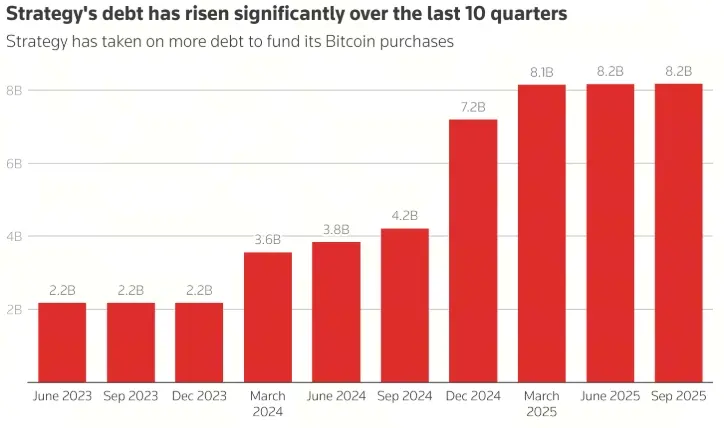
MicroStrategy’s stock has fallen more than 37% this year, far exceeding Bitcoin’s 0.6% drop, indicating that its strategy of selling stock and accumulating debt to buy more crypto assets may be losing investor appeal. Bitcoin posted its largest monthly drop since mid-2021 in November, hitting MicroStrategy hard. On Monday, the company slashed its full-year earnings forecast, projecting a loss of $5.5 billion—a sharp reversal from the $24 billion profit expected just a month prior.
This $29.5 billion financial swing (from $24 billion profit to $5.5 billion loss) is one of the most dramatic financial reversals for a single company in crypto market history. Such a massive correction exposes the inherent vulnerability of MicroStrategy’s business model: when Bitcoin rises, the company enjoys amplified gains; but when Bitcoin falls, losses are similarly magnified, and debt becomes a heavy burden.
MicroStrategy operates as a digital asset vault, using its public company status to accumulate crypto, capitalizing on price swings to profit and allowing cautious investors to gain exposure to higher-risk assets through shares. However, the weaknesses of this model are now becoming apparent in a bear market. Saylor told Reuters, “The stock will be volatile because the company is built on leveraged Bitcoin. If Bitcoin drops 30%, 40%, the stock will fall even more sharply, because the stock is made to fall.”
This self-assessment shows Saylor’s clear understanding of the company’s risk profile. Saylor stated that MicroStrategy’s current leverage ratio is 1.11, and that the company could withstand a 95% drop in Bitcoin’s price. While this resilience sounds strong, it’s important to note that a 95% drop would mean Bitcoin falling from $92,000 to around $4,600; in this extreme case, while MicroStrategy may not go bankrupt in theory, shareholder equity would be nearly wiped out.
Its stunning success has inspired more and more public companies to follow its strategy. But the recent crash may force these companies to sell their holdings, adding further downward pressure on prices. This chain reaction is one of MSCI’s deeper concerns: if more companies emulate MicroStrategy and are included in mainstream indexes, Bitcoin’s volatility will be transmitted directly to traditional stock markets, increasing systemic risk.
Three Scenarios for the January 15 Showdown
Bitcoin is currently trading near $92,000, up about 5% in 24 hours, and market attention is turning to the potential impact of index rule changes in the coming weeks. Both MSCI’s assessment and MicroStrategy’s emergency contingency plans are aligned on the same timeline, jointly determining the place of crypto-intensive companies in mainstream equity benchmarks.
From now until January 15, the market will closely watch three possible scenarios. The optimistic outcome is that MSCI decides to maintain the status quo, taking into account MicroStrategy’s market cap, liquidity, and the results of Saylor’s negotiations, granting a special exemption or grace period. This would let MicroStrategy dodge a bullet, possibly fueling a sharp rebound in its stock price.
The neutral scenario is a partial adjustment, such as reducing MicroStrategy’s weighting in the index or moving it to a special classification. This would cause some selling pressure but not be catastrophic. Such gradual adjustments could be phased in, giving the market time to digest the impact and allowing MicroStrategy to adjust its asset allocation or business model.
The pessimistic scenario is full exclusion, which would trigger $8.8 billion or more in passive selling. If this happens and is accompanied by another Bitcoin decline, MicroStrategy’s stock could crash by over 50% in the short term. Such extreme pressure could truly force MicroStrategy to activate its emergency Bitcoin sale plan, creating a vicious cycle.


