After experiencing a significant fall, the Pi Network price is slowly recovering, reporting at $0.231 on December 1, with a market capitalization of approximately $2.05 billion. Crypto Assets commentators point out a greater possibility: Pi Network could potentially ignite the next major altcoin frenzy, with millions of users who have completed KYC verification eagerly awaiting the upcoming Pi DEX, which is seen as an important catalyst.
Weak trading volume raises concerns: $0.20 support becomes crucial
Despite a slight increase, Pi's 24-hour trading volume has significantly decreased by over 35%, to $23 million. The decline in trading volume indicates that buyers are still present, but lack the confidence to drive prices significantly higher. This contraction in volume is typically a signal of trend weakness in technical analysis, indicating reduced market participation and a wait-and-see attitude among investors.
A daily trading volume of 23 million USD is relatively low for an asset with a market capitalization of 2.05 billion USD, accounting for only about 1.1% of the market cap. In contrast, healthy daily trading volumes for mainstream coins usually represent 3%-5% of the market cap. This low turnover rate indicates that Pi Network holders are either long-term believers unwilling to sell or that there is a lack of new buying interest. In either case, this is not favorable for short-term price increases.
Currently, analysts indicate that Pi needs to hold the support level between $0.243 and $0.244 to maintain its short-term upward momentum. The current price of $0.231 is slightly below this critical support zone, and bulls are making a final defense. If this range holds, Pi may continue to rise slightly to $0.250, and if the market injects new liquidity, it could even reach $0.255.
Pi Network Key Technical Levels
Current Price: 0.231 USD
Key Support: 0.243-0.244 USD (losing this will test 0.20 USD)
Short-term resistance: 0.250 USD
Secondary Resistance: 0.255 USD
Rebound target: 0.27 USD (needs to break through first)
Mid-term target: 0.30-0.35 USD (requires DEX catalysis)
The token may attempt a significant rebound between $0.30 and $0.35. However, if it falls below the support level around $0.27, Pi may drop back to the $0.20 region, erasing recent gains. This technical configuration indicates that Pi Network is at a critical decision moment, and its future trend largely depends on the timing and effectiveness of the DEX launch.
Why Pi DEX Might Become the Catalyst for the Altcoin Craze
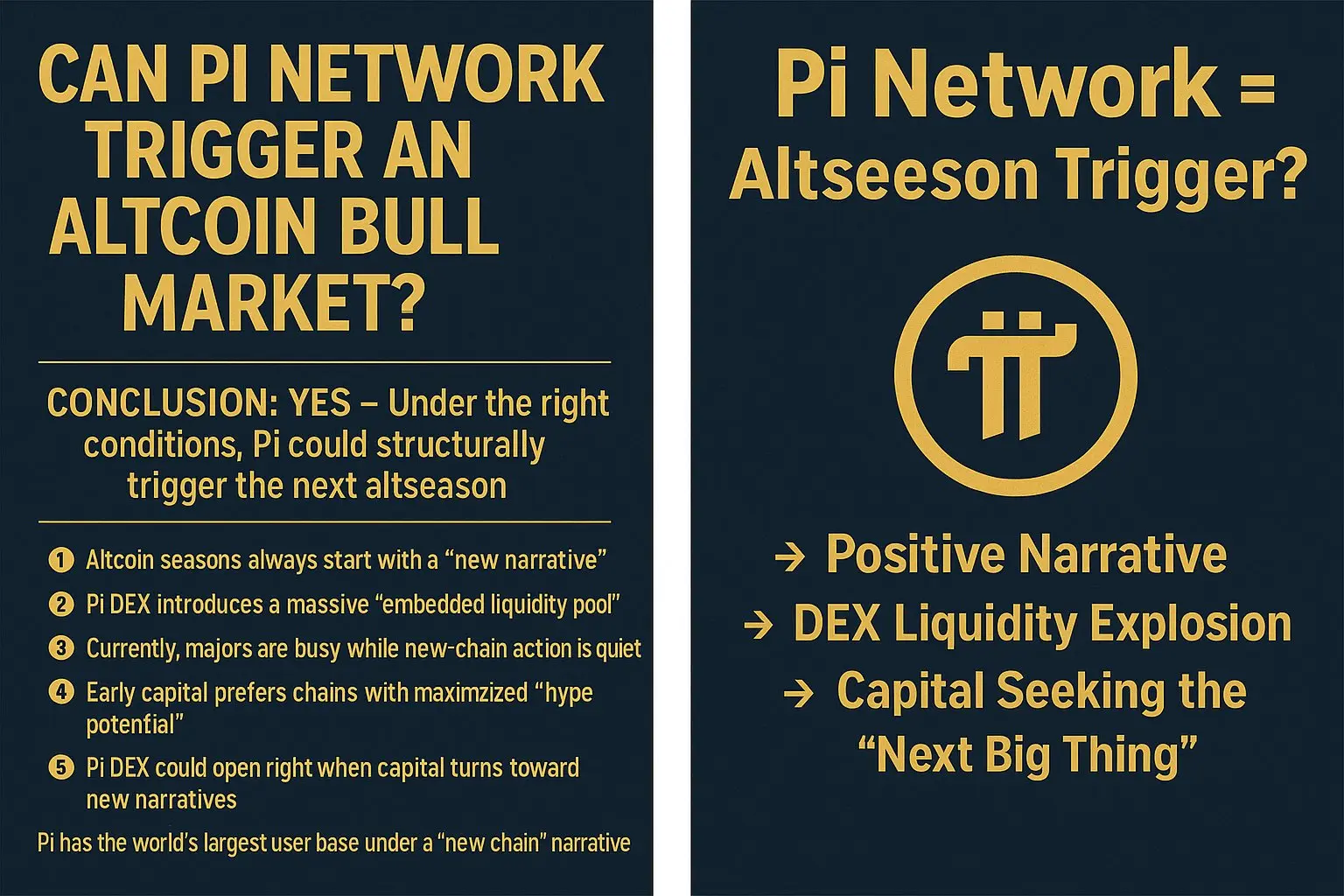
(Source: X)
Cryptocurrency commentators on X pointed out a greater possibility: Pi Network could potentially ignite the next major altcoin boom. Critics believe that a new round of altcoin frenzy is usually triggered by a strong new narrative—and Pi Network is one of the biggest “new chain stories” in the market in recent years. Millions of users who have completed KYC verification are eagerly awaiting the upcoming Pi DEX, which is seen as an important catalyst.
The unique advantage of Pi Network lies in its vast user base. According to official data, millions of users worldwide have downloaded the Pi Network application, with several million having completed KYC verification, becoming qualified mainnet users. Such a user scale is extremely rare in Crypto Assets projects, as most new public chains launch with only tens of thousands to hundreds of thousands of active users.
The launch of Pi DEX will be a key milestone for this ecosystem. Decentralized exchanges not only provide users with a platform to trade Pi tokens, but more importantly, they can attract other projects to issue tokens on the Pi Network, building a complete DeFi ecosystem. They believe that once the decentralized exchange of Pi goes online, it is expected to become a huge liquidity center, thanks to its large user base.
Three Reasons Why Pi DEX is a Catalyst
Large User Base: Millions of KYC users provide natural trading demand and liquidity.
Perfect Timing: When BTC and ETH are consolidating, funds are looking for new growth opportunities.
Novel Narrative: The story of transforming mobile mining into a complete DeFi ecosystem is eye-catching.
When existing mainstream blockchains like Bitcoin and Ethereum become congested or temporarily stagnant, funds often shift towards emerging ecosystems that have strong development momentum or adopt new technologies. Currently, the market is exhibiting these characteristics. The prices of Bitcoin and Ethereum are stabilizing rather than rising, ETF approvals are facing delays, and there is still uncertainty regarding the next upgrade of Ethereum— all these factors may prompt traders to seek new investment opportunities.
The Perfect Storm of New Narratives: A Dual Test of Timing and Execution
Some believe that if Pi launches its DEX amid the current market sentiment seeking new stimuli, it could trigger the next cycle of altcoin bull market. Whether this scenario actually occurs depends on the execution situation, market timing, and buying momentum.
The execution situation is the first key variable. The technical stability, user experience, and liquidity depth of Pi DEX will determine whether it can truly attract users. If the DEX encounters technical failures, transaction delays, or security vulnerabilities after its launch, it will not only fail to create a buzz but may also trigger a crisis of trust. Conversely, if the DEX operates smoothly and provides an excellent trading experience, it will quickly accumulate a good reputation and users.
Market timing is the second key factor. Currently, Bitcoin is consolidating above $90,000, while Ethereum is struggling around $3,000. This stagnation of mainstream coins indeed creates rotation opportunities for alts. Historical data shows that altcoin seasons usually occur after Bitcoin completes its main upward wave and enters a consolidation period, at which point funds begin to look for the next growth point. If Pi DEX launches during this time window, it will attract the maximum market attention.
The buying momentum is the third decisive factor. Although Pi Network has millions of users, it remains uncertain how many of these users are willing to buy Pi tokens with real money. Many users have acquired tokens for free through mobile mining, and they may be more inclined to sell rather than buy. After the DEX is launched, if there is a lack of external buying support, a large number of users who obtained tokens for free may start selling, which could lead to a price crash instead of a surge.
From the current technical perspective and trading volume, Pi Network has not shown signs of triggering a surge in altcoins. A 35% decline in trading volume and prices struggling near key support levels indicate that market confidence remains insufficient. However, this could also be the calm before the storm. If the DEX launches with strong marketing and user incentive programs, the situation could reverse in a short period.
For investors, the altcoin frenzy discourse of Pi Network presents a high-risk, high-reward opportunity. If the discourse proves true, the target from the current $0.2461 to $0.30-$0.35 implies a 20%-42% increase. Should there be further explosion, testing higher price levels cannot be ruled out. However, if the DEX launch receives a tepid response or execution issues arise, the risk of falling below $0.20 is equally real.


