Key takeaways:
- Bitcoin evolves on two clocks: slow, consensus-driven changes at the base layer and fast experimentation at the edges.
- Major upgrades (such as Taproot) arrive through cautious soft forks after long review.
- Rapid shifts such as Lightning payments and Ordinals happen without changing Bitcoin’s core rules, which is why headlines move faster than the L1.
- The “50-year” line is a cue to look at where change occurs, whether in the core protocol or at the edge, before judging whether Bitcoin has truly changed.
On November 10, 2025, Ripple chief technology officer David Schwartz posted a deadpan line on X: “Bitcoin is not the same now as it was 50 years ago.”
The gag works because Bitcoin (BTC) launched in 2009, so the “50 years” is obviously tongue-in-cheek, but it landed because it pointed to a bigger truth about how people talk about Bitcoin’s evolution.
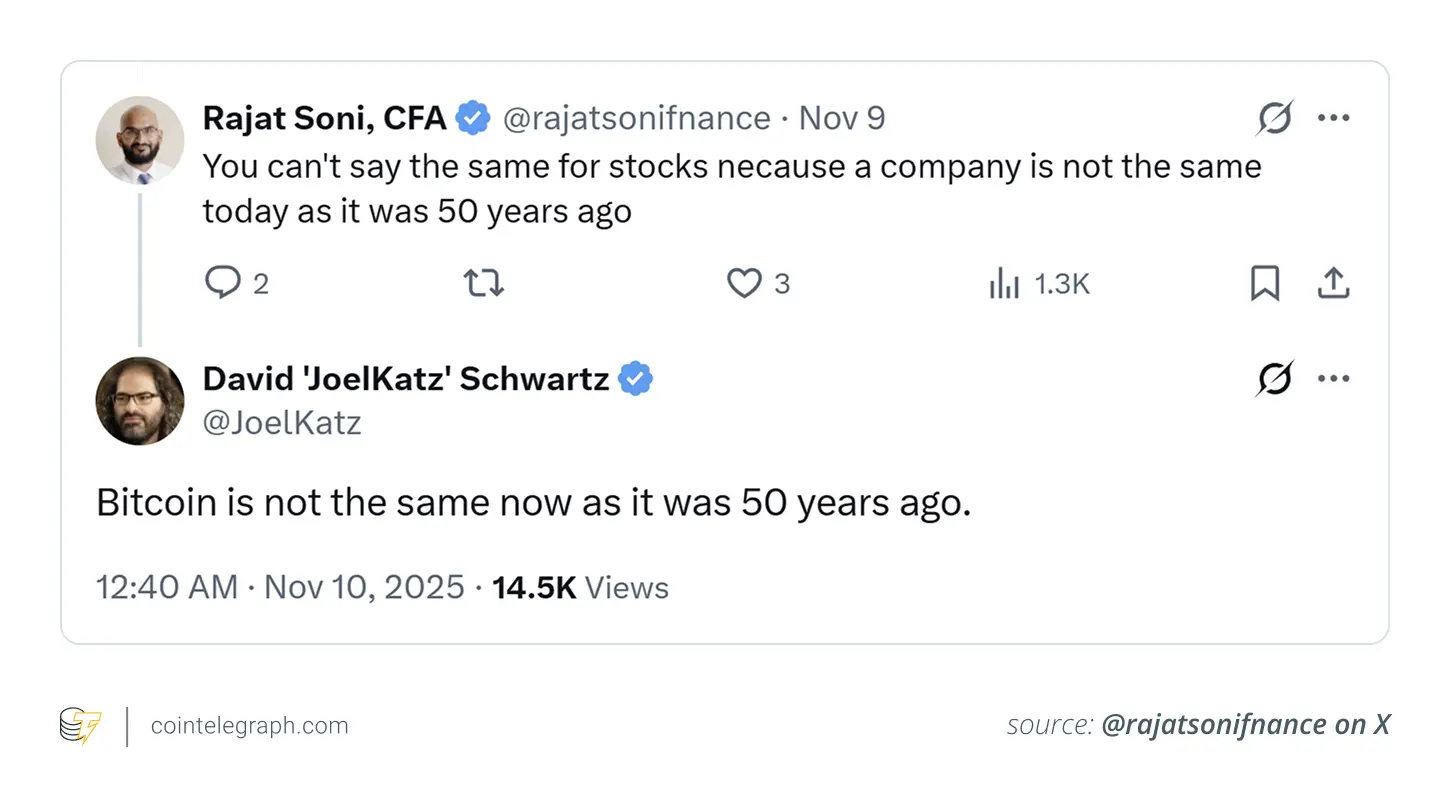 Schwartz’s quip came in a thread arguing that “1 BTC = 1 BTC” and that volatility exists in fiat terms, not in Bitcoin’s own unit of account. This framing often fuels absolutist takes about whether Bitcoin changes at all.
Did you know? Rajat Soni, a critic of XRP (XRP), is a CFA charterholder and a Bitcoin-focused finance commentator active on X.
The joke exposes the timescale confusion
Schwartz’s line works because it highlights a mismatch in how people think about time in crypto.
Headlines make it feel as if Bitcoin changes overnight, but the foundations it stands on were built over decades:
- Public-key cryptography (Diffie-Hellman, 1976)
- Merkle trees (1979)
- Proof-of-work precursors such as Hashcash (1997 and 2002)
- Digital-cash sketches such as Wei Dai’s B-money (1998).
Bitcoin’s 2008 design pulled decades of cryptographic work into a single, operational system. Once a protocol with real value reaches scale, change slows because coordination costs rise sharply. Researchers and builders now refer to this dynamic as “protocol ossification.”
That slow pace can look like nothing is changing at all, but that is not the case. A helpful way to think about it is the Lindy effect, which says that the longer a non-perishable technology has survived, the longer it is likely to survive. This is why long-standing building blocks such as public-key cryptography and hash trees continue to support newer systems. But the Lindy effect is only a heuristic, not a promise. It describes survival, not inevitability.
So, when you zoom out, the joke is a reminder that Bitcoin’s evolution runs on two different tempos: the decades-long lineage of its core ingredients and the faster cycles we see in today’s news.
Did you know? Segregated Witness (Bitcoin Improvement Proposal 141) activated on Aug. 24, 2017, fixing transaction malleability and enabling capacity and Lightning improvements.
What changes at Bitcoin’s core (and how)
At the base layer, Bitcoin does change, but slowly and only with broad agreement.
Most upgrades are soft forks, which tighten the rules that nodes enforce. Soft forks create coordination risk between different versions of the software. To reduce disruption, the community has spent years refining activation methods such as BIP-9 and BIP-8 version bits.
In practice, a change moves from discussion and specification to testing and, if there is clear support, an activation window where miners and economic nodes signal readiness.
Taproot is the clearest recent example. Proposed years earlier and activated in November 2021, it added Schnorr signatures and a new output type that improves efficiency and privacy without breaking existing rules.
The path from idea to activation required extensive review and a miner signaling period before the rules actually switched on. It shows that upgrades do arrive, but only after patient consensus-building.
Today’s debates, such as reenabling “OP_CAT” or introducing “OP_CTV” (BIP-119), follow the same pattern: incremental programmability proposals undergoing public research, risk analysis and social review before any activation can even be considered.
The process is as much about coordination among maintainers, reviewers, miners and users as it is about code.
Did you know? Bitcoin Script is intentionally not Turing-complete, which limits complexity to keep validation predictable and safe for all nodes.
Where rapid change happens
The pace quickens once you move away from Bitcoin’s base layer.
Payment channels move transactions offchain, route them over a mesh and touch the layer 1 only as a backstop. This is why the Lightning Network iterates far faster than consensus changes. Its core mechanics, including hashed timelock contracts and newer approaches, such as point timelock contracts (PTLCs), let value move across intermediaries without trust.
PTLCs replace hash-based secrets with elliptic-curve points, giving channels better privacy, more flexible routing and the ability to split payments across multiple paths. Because these improvements live in implementations rather than the base protocol, they can evolve without a hard consensus vote.
Ordinals and inscriptions show the same fast-edge dynamic from another angle: new behaviors emerging by using existing rules. Casey Rodarmor’s scheme numbers satoshis and attaches data to them through Taproot-era scripting, creating collectibles without altering Bitcoin’s consensus. This is why the phenomenon could explode culturally, while the base protocol remained unchanged.
Both examples highlight the split tempo the joke points to: Layer 2s and client-side systems can add features, UX improvements and even new markets at high speed, while the base layer changes rarely and deliberately. Headlines tend to follow the edge, such as Lightning upgrades or inscription waves, while the chain’s core advances in carefully staged steps.
The deeper lesson
Schwartz’s “50-year Bitcoin” line sticks because it compresses how crypto really evolves into a single joke: a slow, conservative core that rarely changes and a fast, inventive edge that does.
The slow core is by design. Once a monetary protocol has billions at stake, upgrades move only after lengthy review and broad social consensus, a dynamic widely discussed as protocol ossification.
Yet slow is not the same as stuck. Concrete paths for change exist, such as the soft-fork track for new opcodes like “OP_CAT” and “OP_CTV,” which could expand Bitcoin’s transaction programmability. These follow multi-quarter or multi-year timelines rather than news cycles.
Meanwhile, new behavior can explode at the edges without touching consensus. Ordinals and inscriptions did exactly that by numbering satoshis and attaching data using rules already in place.
Forget the years. Think of the remark as a decoder. If a claim about Bitcoin “changing” does not specify where (base layer or edge) and how (consensus upgrade or emergent use), it is missing the point the joke highlighted.
This article does not contain investment advice or recommendations. Every investment and trading move involves risk, and readers should conduct their own research when making a decision.
- #Bitcoin
- #Blockchain
- #Cryptocurrencies
- #Altcoins
- #Business
- #Ripple
- #Bitcoin Price
- #Adoption
- #XRP
- #DeFi
- #How to
Add reaction
![]()


