The Ethereum validator queue continues to grow, with approximately 1.5 million ETH waiting to participate in the staking system, while 2.45 million ETH are in the withdrawal queue of off-chain validators.
The queuing mechanism is designed as a rate-limiting measure to maintain network stability. Ethereum processes activation requests and validator withdrawals at a fixed rate each epoch of approximately 6.4 minutes, helping to prevent sudden shocks that could affect the security model when too many validators join or withdraw at the same time. The current wait time for staking participation can extend to several days depending on the backlog of requests, while the withdrawal process also experiences similar delays as the network processes each request in an orderly manner.
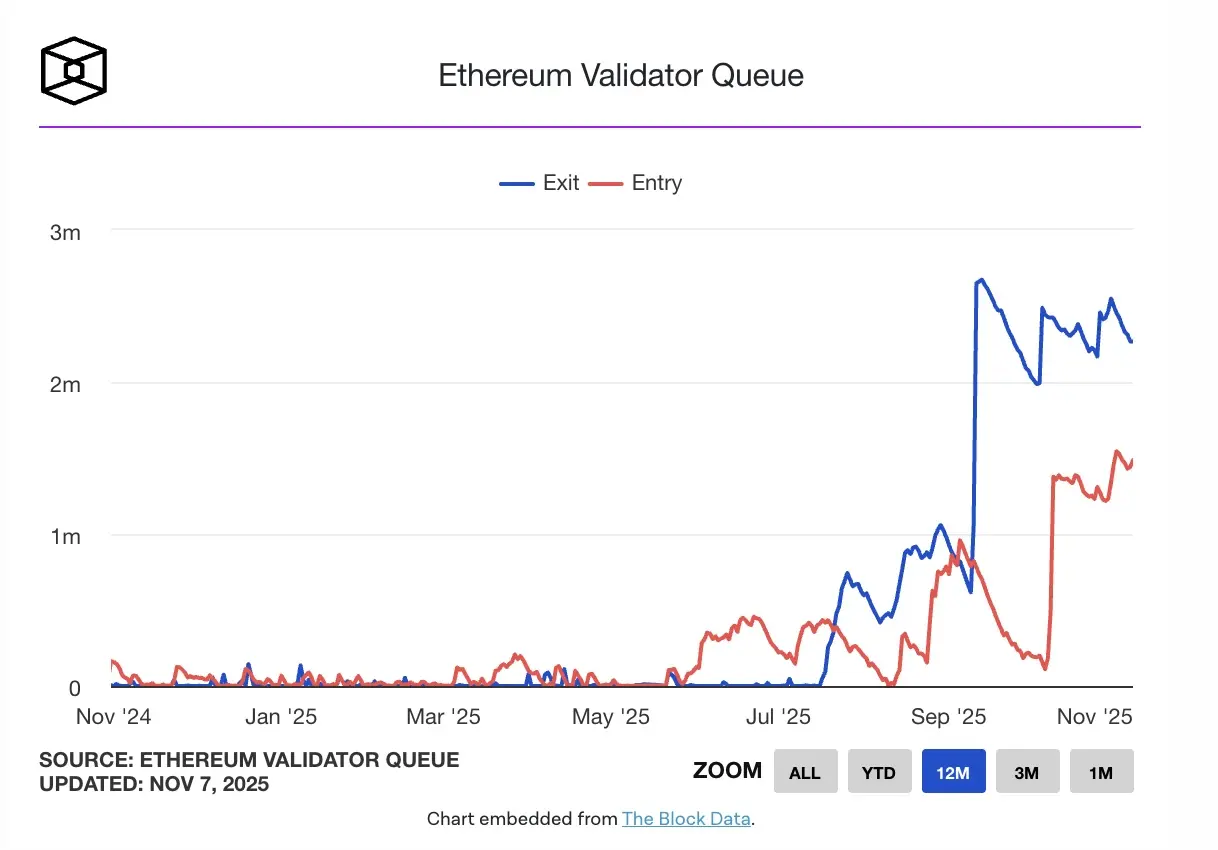 The ETH staking waiting list continues to grow | Source: The BlockDirect staking on the (native staking) demonstrates a deliberate choice compared to liquidity staking products (liquid staking derivatives), even though protocols like Lido and Rocket Pool offer more flexibility with tokens such as stETH and rETH — allowing investors to earn staking rewards while using capital for other purposes.
However, direct staking is attractive to validators who want full control over their infrastructure, avoiding risks from the smart contracts of liquidity staking protocols and eliminating reliance on intermediaries. The minimum requirement of 32 ETH along with the necessary technical know-how creates a certain barrier, but at the same time ensures that only serious, long-term participants are motivated to maintain the network. Locking capital in direct staking also means accepting slow withdrawal times, the risk of being penalized (slashing) when the validator operates incorrectly, and technical risks from the staking mechanism itself.
These factors filter out participants with a long-term vision and strong belief in the future of Ethereum.
Currently, Ethereum has established itself as the main payment infrastructure for large-scale economic activities, with the majority of stablecoin volume being traded directly on the network and many leading DeFi protocols like Aave conducting most lending activities on the mainnet.
As financial institutions become increasingly confident in Ethereum, many investors are willing to commit capital for the long term to both ensure network security and reap returns. The growing waiting list to participate in staking indicates a strong belief that Ethereum will continue to maintain its position as the leading smart contract platform, making the opportunity cost of locking up capital acceptable for investors seeking profits.
Thạch Sanh
Disclaimer: The information on this page may come from third parties and does not represent the views or opinions of Gate. The content displayed on this page is for reference only and does not constitute any financial, investment, or legal advice. Gate does not guarantee the accuracy or completeness of the information and shall not be liable for any losses arising from the use of this information. Virtual asset investments carry high risks and are subject to significant price volatility. You may lose all of your invested principal. Please fully understand the relevant risks and make prudent decisions based on your own financial situation and risk tolerance. For details, please refer to
Disclaimer.
Related Articles
Yesterday, the net outflow of Ethereum spot ETFs in the U.S. was $189.3 million, with BlackRock's ETHA seeing an outflow of $140.2 million.
Gate News Report, March 27: Yesterday (March 26), the net outflow from U.S. Ethereum spot ETFs was $189.3 million. The specifics are as follows: BlackRock ETHA had a net outflow of $140.2 million, Fidelity FETH had a net outflow of $24 million, Bitwise ETHW had a net outflow of $5.1 million, Grayscale ETHE had a net outflow of $13.8 million, and Grayscale Mini ETH had a net outflow of $6.2 million.
GateNews15m ago
Yesterday, Bitcoin spot ETFs saw a net outflow of $171.3 million, while Ethereum ETFs experienced a net outflow of $189.3 million.
BlockBeats news, on March 27, according to Farside Investors monitoring, yesterday the net outflow of Bitcoin spot ETFs in the United States was $171.3 million, including: IBIT net outflow of $41.9 million, FBTC net outflow of $32.8 million, BITB net outflow of $33.1 million, ARKB net outflow of $30.5 million.
Ethereum ETFs had a net outflow of $189.3 million, with ETHA having a net outflow of $140.2 million.
BlockBeatNews23m ago
Vitalik's endorsement still faces rejection, Hegota upgrades and abandons quantum-resistant frame transactions
Ethereum developers decided on March 27th not to prioritize frame transactions for the Hegota upgrade due to their complexity. Frame transactions were originally designed to enhance quantum resistance and provide account abstraction, but developers expressed concerns about their implementation difficulty and impact on upgrade timelines. Although not officially prioritized, frame transactions are still marked as "under consideration," and their technical feasibility will be discussed in the future.
MarketWhisper2h ago
Ethereum Price News: ETH Breaks Above $2,400 as Three Key Indicators Show Signs of Recovery
Ethereum recently experienced a 6% pullback, retesting the $2,050 level, and the market remains cautious about whether it can rebound to $2,400. A breakout requires a revival in decentralized exchange activity, renewed institutional confidence, and futures market premiums returning to a reasonable range. Currently, Ethereum's price has fallen 31%, with weak market demand and limited short-term upward momentum. Investors should monitor on-chain data and capital flows.
GateNews2h ago
Bitcoin and Ethereum account for 80% of the crypto market capitalization.
Bitcoin and Ethereum dominate the cryptocurrency market, holding approximately 67% and 13% of total market capitalization, respectively. This concentration indicates a strong preference for relatively stable assets among investors. Bitcoin is considered "digital gold," while Ethereum leads in decentralized applications and smart contracts. Their price movements significantly influence the overall market trends.
TapChiBitcoin2h ago


