午休看TVL

vip
Age 0.1 Yıl
Peak Tier 0
No content yet
I checked the TVL during my lunch break, and it feels like this recent meme wave has been really lively and a bit noisy... but the noisier it gets, the more I want to slow down. Honestly, when people start narrating the story, their hands tend to get itchy, and by the time they start thinking "Should I cut my losses," it's already half a beat too late.
My current approach is pretty simple: before entering a position, I write down two lines—one for the point I recognize as wrong, and another for the amount of time I’m willing to wait without moving. As long as the price falls below that "I surr
View Original
  • Reward
  • Comment
  • Repost
  • Share
Lunchtime checked out a round of TVL, and the more I look, the more I think stablecoins are really about this: when something goes wrong, it's not the "model" that collapses first, but people panic first. Reserve transparency, to put it simply, is about giving everyone a bit of certainty: whether you can see it at any time, understand it, and tell if there's misappropriation. When information is blurry, the run mentality just grows on its own; on-chain transfers in those few minutes are more honest than any candlestick chart...
By the way, I saw everyone complaining again about validator/miner
View Original
  • Reward
  • Comment
  • Repost
  • Share
The downward trend line is pressing down; if the lows are not broken, it will consolidate sideways; if broken, it will continue downward.
View Original
MarcusCorvinus
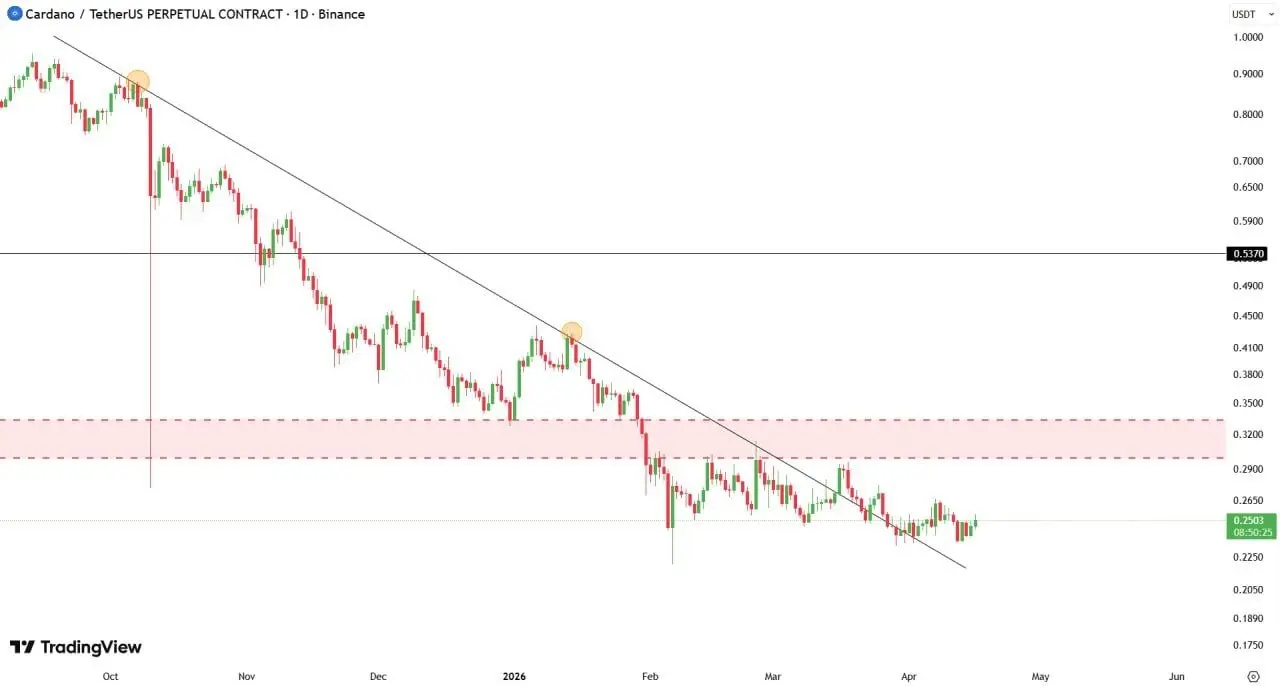
$ADA remains locked in a clean downtrend — structure hasn’t shifted yet.
Lower highs continue to print while price respects the descending trendline.
0.24–0.26 is holding as key support after the prolonged selloff, but pressure is building.
This is a classic compression zone.
A clean reclaim of 0.30–0.32 is required to flip momentum bullish and break the structure.
Until then, the trend favors either sideways grind or further downside.
Momentum is quiet… but not for long.
repost-content-media
  • Reward
  • Comment
  • Repost
  • Share
There are short-term opportunities, but for long-term narrative, we also need to watch BTC and liquidity cues. Be cautiously optimistic.
BTC0,93%
View Original
CryptoSat
Is it mini ALT season before everything going to DESTROY 🤔
  • Reward
  • Comment
  • Repost
  • Share
Don't focus on the ups and downs; the key is the sustained net inflow ability after productization.
View Original
Furan86999
In the past, Wall Street looked at Bitcoin as if it were a “rogue-style” asset—criticizing it out loud, while keeping a close watch on it with their hands. Now, no more pretending—within a month, four major firms have almost simultaneously moved: Morgan Stanley rolled out a spot BTC ETF (MSBT, fee 0.14%), Goldman Sachs filed an application for a Bitcoin Premium Income ETF with the SEC, BlackRock has reapplied for a Bitcoin yield-related ETF (BITA), and Citigroup has stepped in more deeply in the capacity of an authorized participating institution (AP). Meanwhile, the total size of US Bitcoin spot ETFs has surged to $96.5 billion, and BlackRock’s IBIT alone has taken $55 billion, accounting for about 57% of the entire market; on the same day, Goldman Sachs–related actions also saw a net inflow of $411 million.
This batch of signals is actually very straightforward: Wall Street isn’t here to “buy coins by following the trend.” They’re here to standardize Bitcoin, productize it, and bring it into compliance. You can understand it as an “asset identity upgrade”—from what used to be a “non-mainstream asset,” it is being rewrapped as a standard financial product that can be bought, allocated, and used to enhance yield within institutional accounts. For institutions, the significance of ETFs is not about whether prices go up or down, but about a compliant channel + a risk-control framework + a continuous pool of funds: being able to enter the investment-advisory system, fit into a pension logic, and make strategy allocations is the most critical incremental value.#GatePreIPOs首发SpaceX #加密市场回升
  • Reward
  • Comment
  • Repost
  • Share
These days, meme coins are heating up again. Watching the on-chain funds surge wave after wave, it’s quite exciting, but I still stick to my old habit: think about how to get out before I enter. Honestly, stop-loss isn’t about being “right,” it’s about not being dragged along by emotions. Usually, I watch two signals: the pool’s TVL/depth suddenly pulling out, and large addresses starting to move funds to exchanges. When both happen at the same time, I don’t argue with myself anymore—cut in half if needed, keep some face but prioritize survival.
Recently, the staking and shared security setups
View Original
  • Reward
  • Comment
  • Repost
  • Share
24-hour live broadcast? Are you treating candlestick charts like an electrocardiogram?
View Original
TimeProphecyMachine
I want to know if you also have 24-hour live streaming?
repost-content-media
  • Reward
  • Comment
  • Repost
  • Share
Recently, someone has been watching large on-chain transfers and hot and cold wallets on exchanges, shouting "Smart money is coming" every time... I find it quite amusing but also a bit anxious. As for sandwich attacks and arbitrage, honestly, you think you're catching opportunities, but often you're just paying others' fees and slippage, while providing liquidity. I pay attention to whether TVL is rising or falling, but I care more about whether the transaction is "natural" or being manipulated by someone trying to eat at both ends. Now I place orders more cautiously, preferring to split them
View Original
  • Reward
  • Comment
  • Repost
  • Share
During my lunch break, I went back to check a few blockchain game pools again, and it feels like the playbook is pretty much the same: in the early stage, the rewards are pushed really hard, and the output depends entirely on issuing new coins. Players collect and sell at the same time. The TVL looks decent, but the capital flow is actually running out. Put simply, inflation isn’t being picked up by demand, so the pools turn into a “who can run faster” competition. The more subsidies there are, the more hollow it becomes. In the end, once liquidity gets pulled, everything collapses.
Recently,
View Original
  • Reward
  • Comment
  • Repost
  • Share
  • Pin