Trade
Basic
Futures
Futures
Hundreds of contracts settled in USDT or BTC
Options
HOT
Trade European-style vanilla options
Unified Account
Maximize your capital efficiency
Demo Trading
Futures Kickoff
Get prepared for your futures trading
Futures Events
Participate in events to win generous rewards
Demo Trading
Use virtual funds to experience risk-free trading
Earn
Launch
CandyDrop
Collect candies to earn airdrops
Launchpool
Quick staking, earn potential new tokens
HODLer Airdrop
Hold GT and get massive airdrops for free
Launchpad
Be early to the next big token project
Alpha Points
NEW
Trade on-chain assets and enjoy airdrop rewards!
Futures Points
NEW
Earn futures points and claim airdrop rewards
Investment
Simple Earn
Earn interests with idle tokens
Auto-Invest
Auto-invest on a regular basis
Dual Investment
Buy low and sell high to take profits from price fluctuations
Soft Staking
Earn rewards with flexible staking
Crypto Loan
0 Fees
Pledge one crypto to borrow another
Lending Center
One-stop lending hub
VIP Wealth Hub
Customized wealth management empowers your assets growth
Private Wealth Management
Customized asset management to grow your digital assets
Quant Fund
Top asset management team helps you profit without hassle
Staking
Stake cryptos to earn in PoS products
Smart Leverage
NEW
No forced liquidation before maturity, worry-free leveraged gains
GUSD Minting
Use USDT/USDC to mint GUSD for treasury-level yields

More

GateUser-df796f3c

No content yet
GateUser-df796f3c
Perp DEXs have quietly become crypto’s most important landscape.
Not spot DEXs.
Not L2s.
Not memecoins.
Perpetuals.
This isn’t a narrative shift it’s a flow reallocation.
In the last 30 days, hundreds of billions in volume have concentrated across a handful of venues ( defillama, Jan 2026).
@lighter_xyz leads with ~$167.5B in 30D volume.
@HyperliquidX and @AsterDEX follow at ~$150B+.
@edgeX_exchange and @ApeXProtocol form the next tier.
Ranking matters less than density.
Liquidity concentration creates resilience.
Fragmentation leaks fragility.
That’s the real signal.
Perpetual markets aren’t
Not spot DEXs.
Not L2s.
Not memecoins.
Perpetuals.
This isn’t a narrative shift it’s a flow reallocation.
In the last 30 days, hundreds of billions in volume have concentrated across a handful of venues ( defillama, Jan 2026).
@lighter_xyz leads with ~$167.5B in 30D volume.
@HyperliquidX and @AsterDEX follow at ~$150B+.
@edgeX_exchange and @ApeXProtocol form the next tier.
Ranking matters less than density.
Liquidity concentration creates resilience.
Fragmentation leaks fragility.
That’s the real signal.
Perpetual markets aren’t
- Reward
- like
- Comment
- Repost
- Share
Most wallets are still treated as interfaces.
At scale, they are execution systems.
@rainbowdotme is operating in that second category.
1/ The Core Mechanism
Every swap or bridge is an optimization problem:
• Which chain clears with the best effective price?
• Which route minimizes slippage under live gas conditions?
• Which liquidity source actually settles during congestion?
Rainbow’s routing engine does not treat these as isolated decisions. Each execution feeds back into the system.
User intent → route selection → execution outcome → data capture → routing update.
That loop turns the walle
At scale, they are execution systems.
@rainbowdotme is operating in that second category.
1/ The Core Mechanism
Every swap or bridge is an optimization problem:
• Which chain clears with the best effective price?
• Which route minimizes slippage under live gas conditions?
• Which liquidity source actually settles during congestion?
Rainbow’s routing engine does not treat these as isolated decisions. Each execution feeds back into the system.
User intent → route selection → execution outcome → data capture → routing update.
That loop turns the walle

- Reward
- like
- Comment
- Repost
- Share
Perps are cooling while open interest still sits
This is a throughput problem, not a price problem.
2026 opens with a subtle but important signal in derivatives.
Perpetual futures throughput is falling, while open interest remains elevated. That combination rarely resolves quietly.
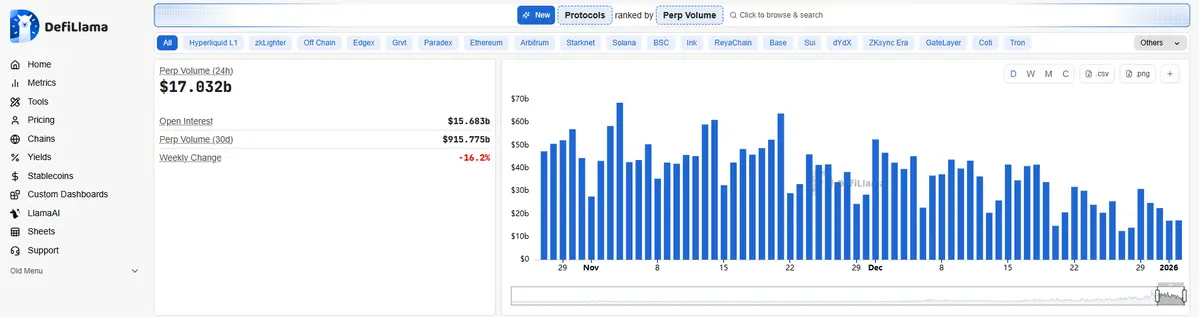
Over the past week, aggregate perp volume has compressed sharply to $17.03B in 24-hour volume, down 16.2% week-over-week, while open interest still sits at $15.6B.
Source: DefiLlama.
This matters because perps are not priced on conviction alone. They are priced on flow capacity. Volume is what allows leverage to rec
This is a throughput problem, not a price problem.
2026 opens with a subtle but important signal in derivatives.
Perpetual futures throughput is falling, while open interest remains elevated. That combination rarely resolves quietly.
Over the past week, aggregate perp volume has compressed sharply to $17.03B in 24-hour volume, down 16.2% week-over-week, while open interest still sits at $15.6B.
Source: DefiLlama.
This matters because perps are not priced on conviction alone. They are priced on flow capacity. Volume is what allows leverage to rec
PERP-4,03%
- Reward
- like
- Comment
- Repost
- Share
One thing I keep coming back to with @Lombard_Finance is how quiet the system feels once you understand it.
You stake $BTC, mint $LBTC, and that $LBTC keeps full Bitcoin exposure while earning yield. Nothing exotic. No forced leverage loops. Just Bitcoin becoming productive on-chain.
As yield accrues, each unit of $LBTC represents more $BTC over time. That subtle mechanic matters. You’re not chasing emissions, you’re compounding Bitcoin itself.
What really stands out is the experience. Traditional Bitcoin leverage feels stressful. Constant liquidation checks, opaque risks, decision-making driv
You stake $BTC, mint $LBTC, and that $LBTC keeps full Bitcoin exposure while earning yield. Nothing exotic. No forced leverage loops. Just Bitcoin becoming productive on-chain.
As yield accrues, each unit of $LBTC represents more $BTC over time. That subtle mechanic matters. You’re not chasing emissions, you’re compounding Bitcoin itself.
What really stands out is the experience. Traditional Bitcoin leverage feels stressful. Constant liquidation checks, opaque risks, decision-making driv
BTC-2,32%

- Reward
- 5
- 3
- Repost
- Share
kblyfb1907 :
:
Merry Christmas ⛄:View More
Prediction markets have already crossed the liquidity threshold. Volume and revenue now print consistently enough that the category no longer needs narrative justification. The next edge is not scale. It is breadth.
Specifically: whether today’s leading venues expand the range of tradeable outcomes, or remain structurally dependent on a small set of loud, episodic cycles.
This distinction is already visible across the current prediction market stack.
— The Problem With Event-Driven Liquidity
Platforms like @Polymarket have proven that onchain prediction markets can attract real liquidity. Elec
Specifically: whether today’s leading venues expand the range of tradeable outcomes, or remain structurally dependent on a small set of loud, episodic cycles.
This distinction is already visible across the current prediction market stack.
— The Problem With Event-Driven Liquidity
Platforms like @Polymarket have proven that onchain prediction markets can attract real liquidity. Elec

- Reward
- like
- Comment
- Repost
- Share
This doesn’t look like $ETH accumulation if you’re watching price.
It does if you’re watching supply.
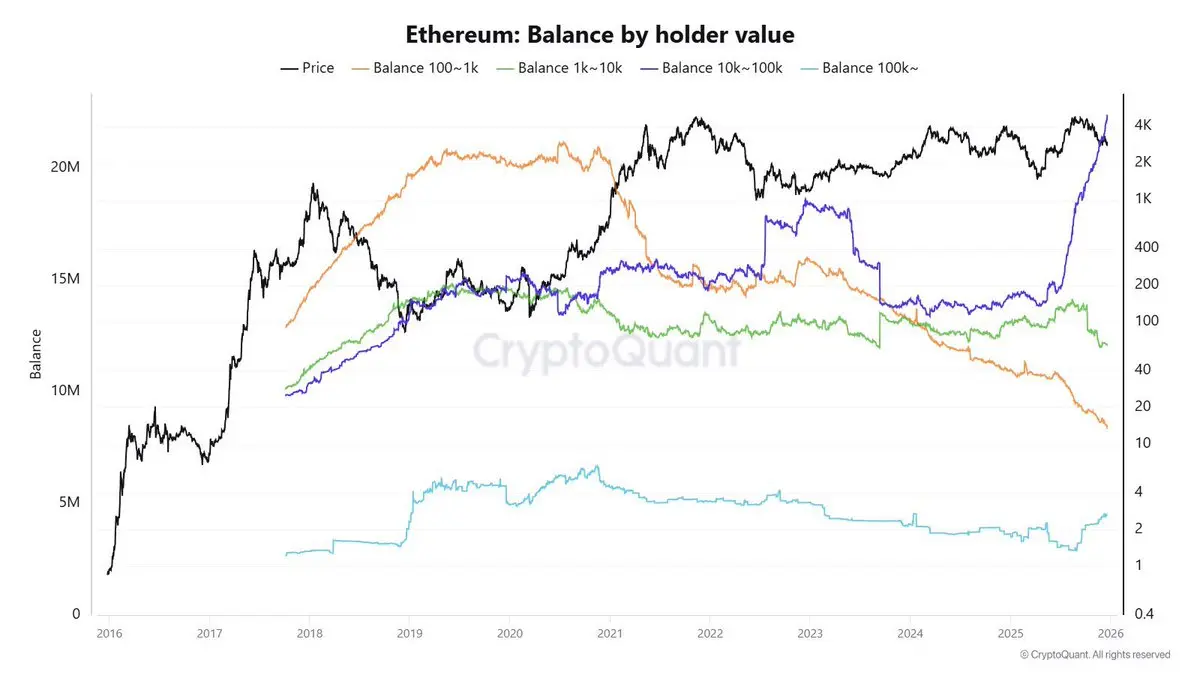
$ETH isn’t attracting aggressive inflows. What’s happening instead is quieter: liquid supply is being absorbed while turnover slows. That’s a different signal.
From a flow perspective, this phase is defined by compression:
- Smaller holders are distributing into strength
- Larger wallets are accumulating without urgency
- Exchange balances continue to drift lower
- Volatility compresses while positioning resets
That combination usually precedes movement, not follows it.
What matters here is el
It does if you’re watching supply.
$ETH isn’t attracting aggressive inflows. What’s happening instead is quieter: liquid supply is being absorbed while turnover slows. That’s a different signal.
From a flow perspective, this phase is defined by compression:
- Smaller holders are distributing into strength
- Larger wallets are accumulating without urgency
- Exchange balances continue to drift lower
- Volatility compresses while positioning resets
That combination usually precedes movement, not follows it.
What matters here is el
ETH-3,29%
- Reward
- like
- Comment
- Repost
- Share
It’s the end of the year, and a structural shift is becoming hard to miss.
Early crypto grew by persuading people.
Late crypto grows by constraining them.
That transition is underway now.
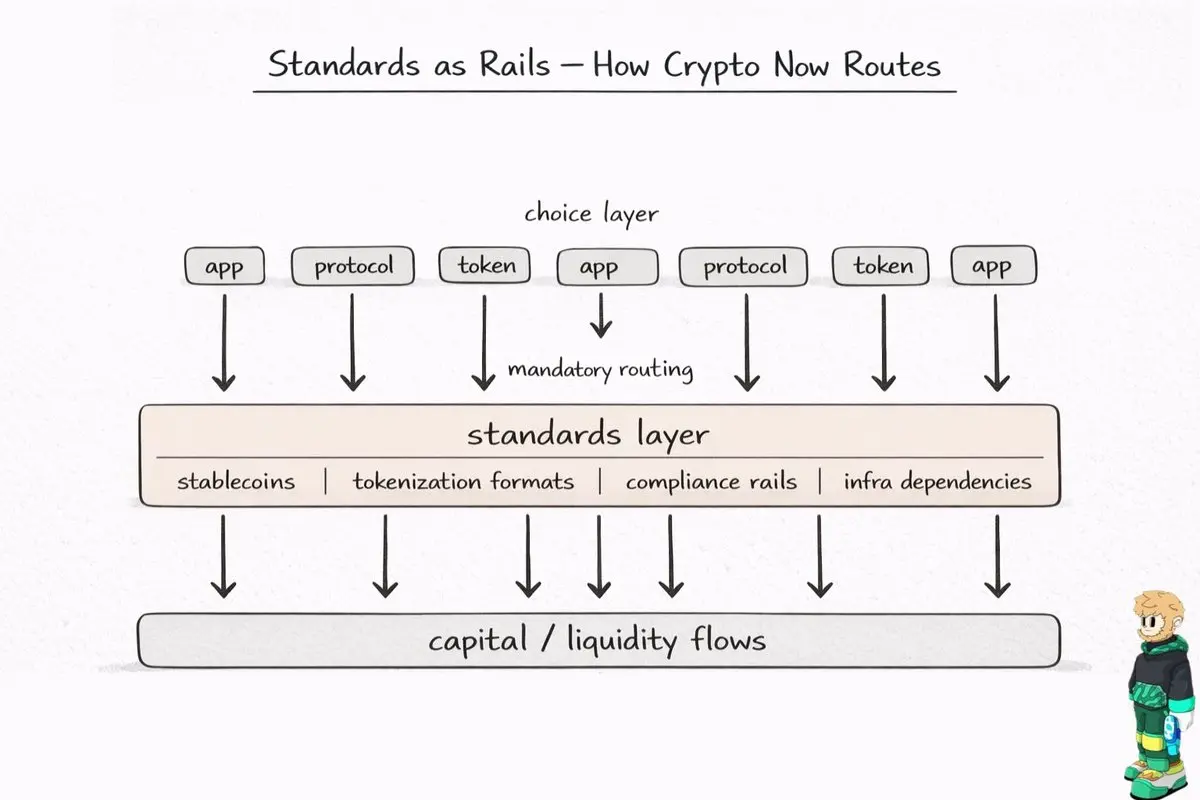
When standards emerge, optionality collapses. Builders stop asking what they can do and start asking what they must integrate with. Capital behaves the same way. It stops chasing originality and starts anchoring to whatever everything else is forced to route through.
You can see it clearly:
-> stablecoins becoming non-negotiable settlement units
-> tokenization frameworks dictating asset structure
-> complian
Early crypto grew by persuading people.
Late crypto grows by constraining them.
That transition is underway now.
When standards emerge, optionality collapses. Builders stop asking what they can do and start asking what they must integrate with. Capital behaves the same way. It stops chasing originality and starts anchoring to whatever everything else is forced to route through.
You can see it clearly:
-> stablecoins becoming non-negotiable settlement units
-> tokenization frameworks dictating asset structure
-> complian
- Reward
- like
- Comment
- Repost
- Share
$BTC.b becoming the primary $BTC standard on @stable is a collateral re-rating event, and it’s being driven by @Lombard_Finance.
This is the first time $BTC leverage on this surface is anchored to:
• validator-secured issuance
• protocol-native minting
• deterministic stablecoin conversion
That trifecta removes what traders usually overpay for in $BTC leverage: uncertain failure modes.
Once collateral loss becomes mathematically bounded instead of issuer-dependent, three risk dynamics reprice:
1️⃣ Liquidation topology simplifies:
Multiple wrappers create feedback spirals across venues. A singl
This is the first time $BTC leverage on this surface is anchored to:
• validator-secured issuance
• protocol-native minting
• deterministic stablecoin conversion
That trifecta removes what traders usually overpay for in $BTC leverage: uncertain failure modes.
Once collateral loss becomes mathematically bounded instead of issuer-dependent, three risk dynamics reprice:
1️⃣ Liquidation topology simplifies:
Multiple wrappers create feedback spirals across venues. A singl
BTC-2,32%

- Reward
- like
- Comment
- Repost
- Share
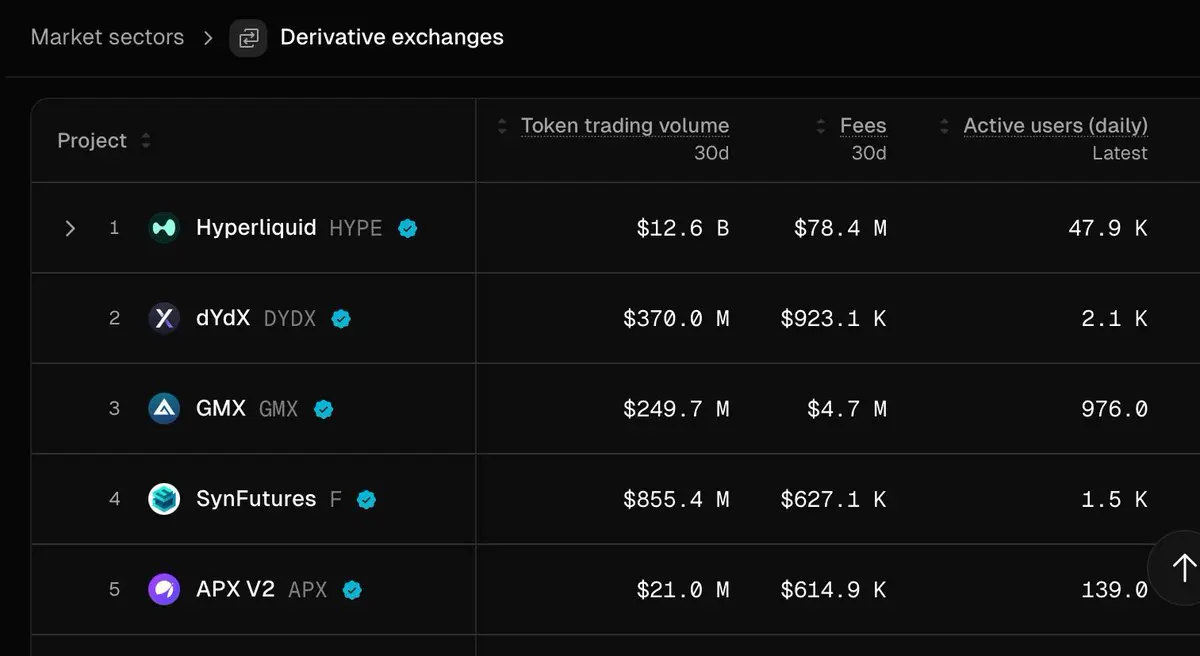
Perps charge more per trade. DEXs make more money.
Over the last 30 days:
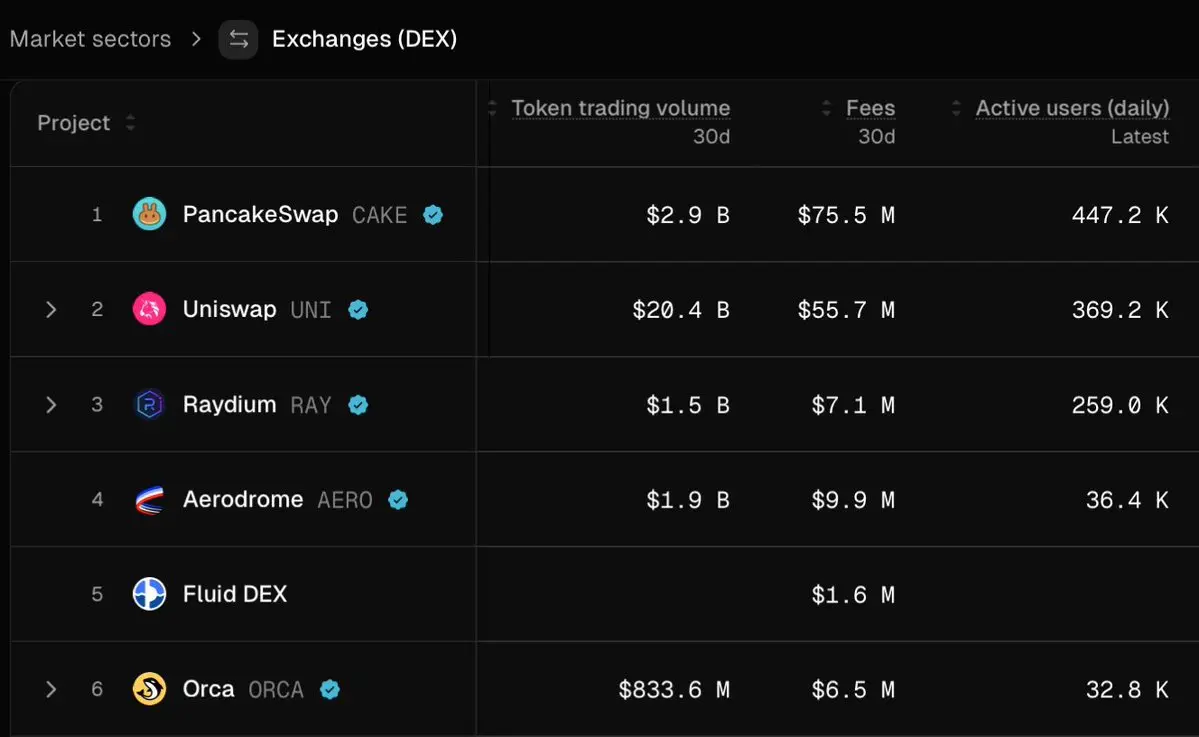
-> Perpetual futures platforms processed $19.1B of trading activity and earned $87.3M in fees.
-> DEXs processed $228.8B of spot trading activity and earned $224.4M in fees.
Perps monetize harder per dollar.
DEXs monetize at far greater scale.
On fee efficiency alone, perps win:
• 0.46% per dollar traded on perps
• 0.10% per dollar traded on DEXs
But on absolute cash flow, DEXs still dominate:
DEXs earn ~2.6× more total fees than perps
That gap is structural.
Perps compete on leverage, rebates, and tight spreads. They mu
Over the last 30 days:
-> Perpetual futures platforms processed $19.1B of trading activity and earned $87.3M in fees.
-> DEXs processed $228.8B of spot trading activity and earned $224.4M in fees.
Perps monetize harder per dollar.
DEXs monetize at far greater scale.
On fee efficiency alone, perps win:
• 0.46% per dollar traded on perps
• 0.10% per dollar traded on DEXs
But on absolute cash flow, DEXs still dominate:
DEXs earn ~2.6× more total fees than perps
That gap is structural.
Perps compete on leverage, rebates, and tight spreads. They mu
- Reward
- like
- Comment
- Repost
- Share
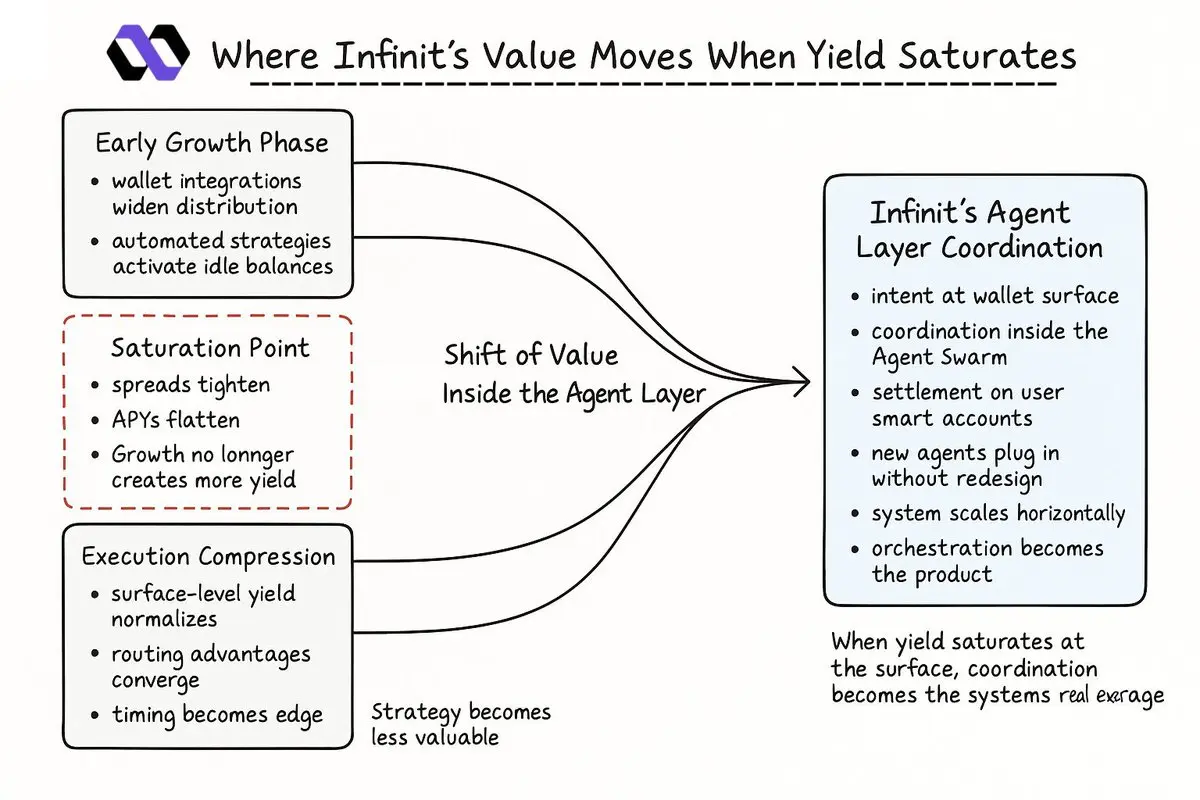
Early adoption for @Infinit_Labs follows a clear arc:
• wallet integrations widen distribution
• automated strategies wake up idle balances
• yield-routing agents capture cross-chain inefficiencies.
In the early phase, every new user helps because the market still has slack.
But that slack eventually disappears. As one-click execution scales, spreads tighten, yields compress, and the system starts to look like any market where too much capital chases the same opportunities. The marginal value of one more wallet falls.
— The Point Where Growth No Longer Helps
This phase is the saturation point:
• wallet integrations widen distribution
• automated strategies wake up idle balances
• yield-routing agents capture cross-chain inefficiencies.
In the early phase, every new user helps because the market still has slack.
But that slack eventually disappears. As one-click execution scales, spreads tighten, yields compress, and the system starts to look like any market where too much capital chases the same opportunities. The marginal value of one more wallet falls.
— The Point Where Growth No Longer Helps
This phase is the saturation point:
IN2,92%
- Reward
- like
- Comment
- Repost
- Share
The misunderstanding around yield is structural.
Most people still see it as something you “pick,” when the real determinant of performance is how efficiently your capital gets where it needs to be.
APR tables suggest simplicity.
The market does not.
Liquidity now lives across L1s, L2s, appchains, intent routers, and timing-sensitive execution surfaces.
That fragmentation breaks the old model where “highest APR” translated into highest returns.
@Infinit_Labs' value comes from understanding why that break happened and building for the environment that replaced it.
When execution becomes the pro
Most people still see it as something you “pick,” when the real determinant of performance is how efficiently your capital gets where it needs to be.
APR tables suggest simplicity.
The market does not.
Liquidity now lives across L1s, L2s, appchains, intent routers, and timing-sensitive execution surfaces.
That fragmentation breaks the old model where “highest APR” translated into highest returns.
@Infinit_Labs' value comes from understanding why that break happened and building for the environment that replaced it.
When execution becomes the pro

- Reward
- like
- Comment
- Repost
- Share
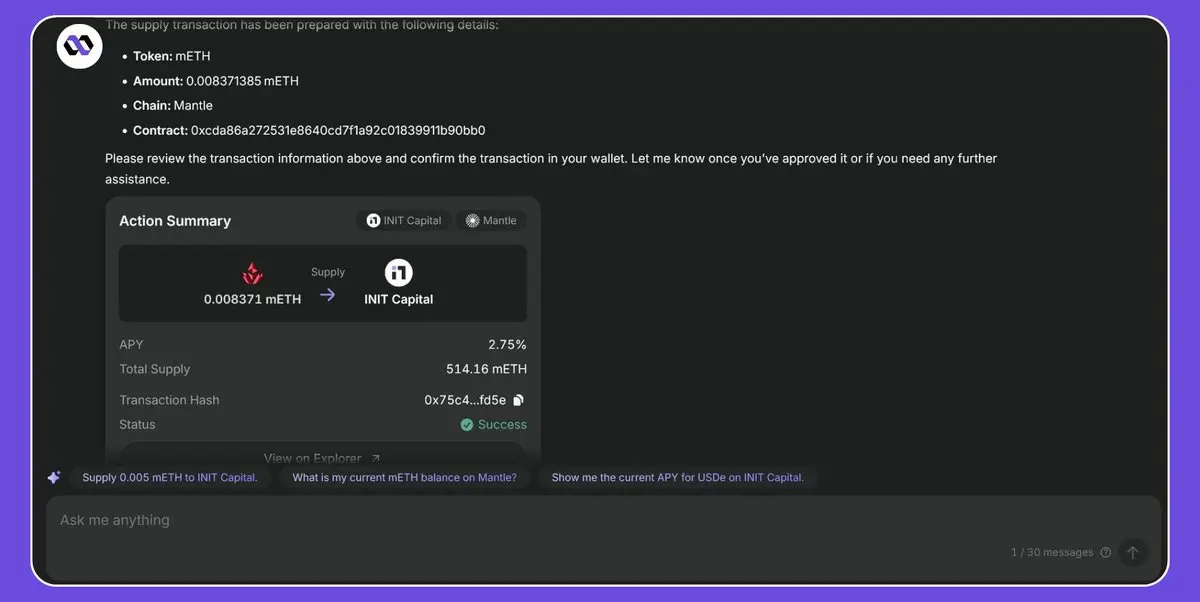
STRATEGY: The Dual-Surface Yield Engine
This strategy uses the two strongest, most stable yield planes on @Mantle_Official that @Infinit_Labs agents can actually execute:
$mETH supply APY and $USDe supply APY inside @InitCapital_.
These two surfaces consistently diverge, because borrower demand pushes $USDe yields up while $mETH stays predictable around 2.7%.
By splitting your position between both, you build a yield engine that captures the higher of the two over time without leverage, LP risk, or restaking.
No loops.
No liquidation risk.
Only the two operations INFINIT supports: Kyber swaps
This strategy uses the two strongest, most stable yield planes on @Mantle_Official that @Infinit_Labs agents can actually execute:
$mETH supply APY and $USDe supply APY inside @InitCapital_.
These two surfaces consistently diverge, because borrower demand pushes $USDe yields up while $mETH stays predictable around 2.7%.
By splitting your position between both, you build a yield engine that captures the higher of the two over time without leverage, LP risk, or restaking.
No loops.
No liquidation risk.
Only the two operations INFINIT supports: Kyber swaps
USDE0,04%
- Reward
- like
- Comment
- Repost
- Share