



#加密市场回升
The claim that the US-Iran naval blockade went into effect on April 14th, or the market reaction to this event, is a key point. According to geopolitical news, situations involving Iran and the US are often highly volatile, and narratives of a sudden "blockade + coordinated cryptocurrency rally" spread faster on social media than confirmed macroeconomic data.
1) If geopolitical tensions escalate (oil route risk / sanctions / maritime incidents)
Typical market impacts:
• Oil: usually rises first (supply-risk premium)
• Gold/precious metals: rise as a "safe haven"
• Cryptocurrencies: mixed
• In the short term: may rise with "liquidity + risk-taking rhetoric"
• or may fall if investors generally avoid risk
Therefore, the key point: cryptocurrencies don't always act as a safe haven during geopolitical shocks; they generally behave like a high-beta risk asset.
2) If the narrative of “agreement/de-escalation” prevails:
If markets believe a compromise is likely:
• Oil: tends to fall (risk premium decreases)
• Gold: generally softens
• Cryptocurrencies and stocks: tend to rise (risk rotation)
However, the strength of the rise depends on:
• How credible the agreement is
• Whether sanctions are actually eased
• Global liquidity conditions (Fed expectations are more important than geopolitics in the long term)
3) “How high can the recovery go?”
In these event-driven movements:
• Cryptocurrency rallies are generally momentum-driven
• Strong moves can last for days or even weeks
• However, they generally retreat unless supported by macro liquidity (interest rates, USD, ETF inflows, etc.)
An important fact:
Geopolitical news often determines the direction, but macro liquidity determines the distance.
So even if DeFi increases by 5% in 24 hours:
• Its sustainability depends not only on headlines, but also on Bitcoin's dominance trends, funding rates, and risk appetite.
4) Allocation Considerations (Oil vs. Crypto vs. Gold)
I can't give personal investment advice, but in general portfolio frameworks:
Conservative/Hedging Approach
• Higher gold/precious metals position (hedging tail risk)
• Moderate oil position (hedging against geopolitical inflation)
• Lower crypto (volatility control)
Balanced Macro Hedging
• Oil: moderate (benefits from shocks but can quickly reverse)
• Gold: stable fundamental hedging
• Crypto: smaller but asymmetric uptrend allocation
Risk-taking/Liquidity-focused Approach
• Higher crypto (beta + momentum)
• Lower gold
• Oil is purely tactical (not long-term holding)
5) The Important Point Most People Miss
These kinds of geopolitical jumps often:
• lead to short-term narrative trades
• but are quickly invalidated by:
• interest rate expectations
• USD strength
• ETF inflows/outflows (For crypto)
• Is it a real supply disruption or just voltage fluctuation?
Factors confirming a sustainable uptrend:
1. Breakout + HOLD (not just a sudden rise)
• Price breaks resistance and stays above it for multiple closes (daily/weekly)
• Retests remain as support (not rejection)
False movements usually:
• Breaks resistance → falls immediately below it
2. Increased volume (critical filter)
• True trend = rising price + rising spot volume
• Uptrends driven solely by futures = usually weak / reversible
3. Derivatives not overheated
A healthy uptrend indicates:
• Funding rates: neutral to slightly positive
• Open positions: gradually increasing (not a vertical jump)
• Overly positive funding = crowded long positions → risk of squeeze
4. Macro alignment (very important in the crypto market right now)
Sustainable uptrends should generally be supported by:
• Liquidity expectations (interest rate cuts / USD easing)
• Stable or declining real returns
• Evolving risk perception
Without macro support → uptrends tend to fade quickly
5. Leadership structure
Strong trends indicate:
• Bitcoin leads → altcoins follow
• Random altcoin rallies don't happen first
6. Volatility squeeze → expansion → continuation
Healthy structure:
• Consolidation → breakout → retest → continuation
B. Signals of a false uptrend (bull trap)
1. "News bounce" without structure
• Sudden geopolitical or headline-driven rise
• No consolidation base
Example pattern:
Vertical candle → Immediate rejection → Breakout of range
2. Weak participation
• Low spot volume
• Mostly driven by leverage (futures)
3. Failed retest (Most important signal)
• Price breaks resistance
• Returns to test resistance
• Fails → goes down again It falls.
This is a classic bull trap trigger.
4. Deviations
• Price forms higher peaks
• RSI/momentum forms lower peaks
Indicates exhaustion
5. Liquidity trap behavior
• Sudden wick above resistance
• Followed by a downward liquidation waterfall
6. Macroeconomic contradiction
Even if cryptocurrencies rise:
• Oil prices rise sharply (inflation risk)
• USD strengthens
• Interest rates rise
Liquidity tightens → rally usually fails
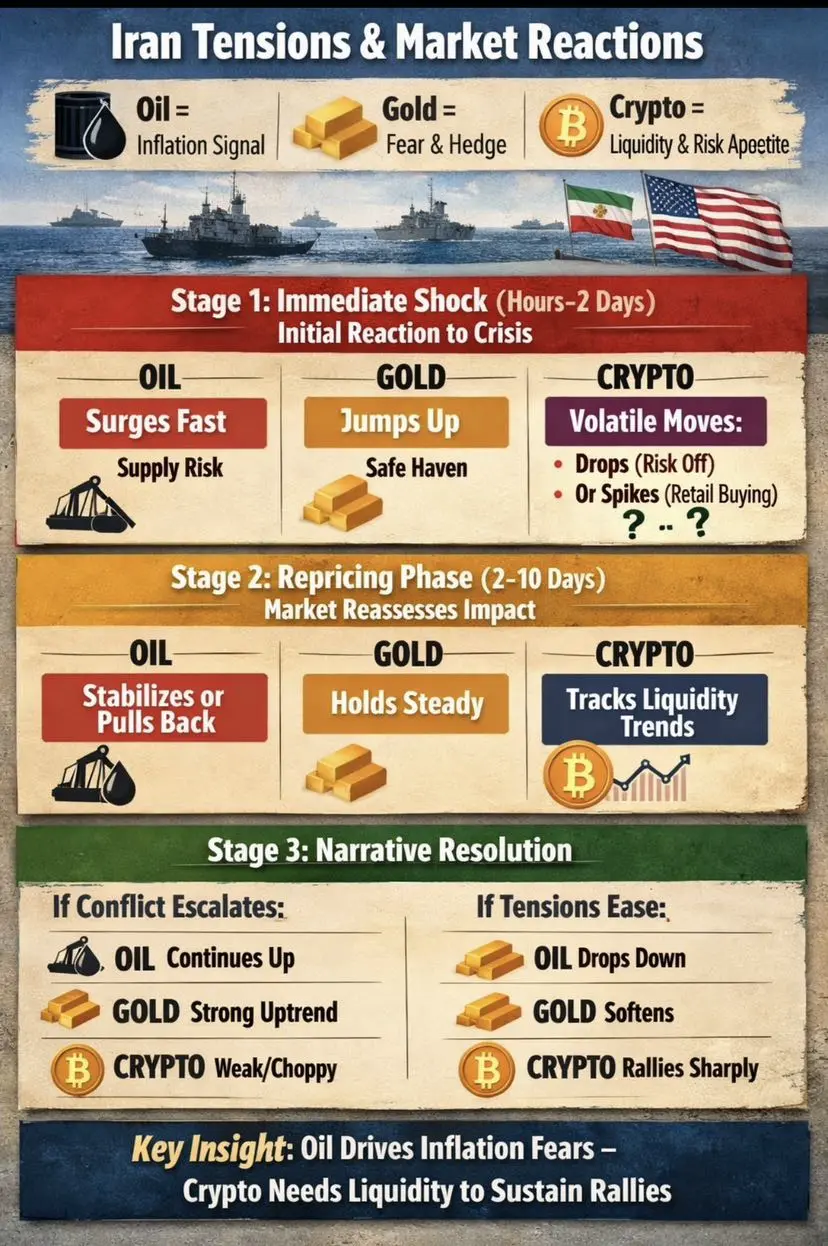
2) Reaction of oil, gold and cryptocurrencies to shocks related to Iran
Stage 1: Immediate shock (hours-2 days)
Oil (first mover)
• Sharp rise due to supply risk (Hormuz/sanctions)
• Reacts fastest because it is physically constrained
Usually the cleanest directional movement
i Gold (safe haven)
• Rises, but sometimes with a delay or is erratic
• Driven by USD strength Can be disrupted
Crypto (Confusing reaction)
Two possible initial moves:
• declines (liquidation + risk aversion)
• OR increases (retail "risk-taking narrative")
Crypto is the least consistent in its initial reaction

Phase 2: Repricing phase (2-10 days)
Markets begin to interpret:
• Will this rise or fall?
• Will oil remain high?
Typical behavior:
• Oil stabilizes or pulls back
• Gold remains in demand but stops following a strong trend
• Cryptocurrencies begin to follow liquidity expectations
Stage 3: Narrative resolution
If tension continues:
• Oil → continuous uptrend
• Gold → strong uptrend
• Cryptocurrencies → generally weak or volatile (liquidity pressure)
If tension decreases / expectations of agreement increase:
• Oil → falls first
• Gold → softens
• Cryptocurrencies → strongest uptrend (risk rotation)
3) Underlying relationship (most important insight)
Consider this:
Oil = inflation signal
• Drives expectations of macro tightening/loosening
Gold = fear + hedging against inflation
• Reacts to uncertainty + USD dynamics
Crypto = liquidity + risk appetite
• Responds LAST to geopolitical developments, and MOST to macro liquidity gives
• If oil remains strong and consistently rising → crypto rallies will be challenged
• If oil stabilizes or falls → crypto rallies may be prolonged
• If gold rises alone → uncertainty does not necessarily mean a crypto rally
• A crypto rally without volume and macro support → likely a false breakout
$BTC $XAUUSD $BONK
The claim that the US-Iran naval blockade went into effect on April 14th, or the market reaction to this event, is a key point. According to geopolitical news, situations involving Iran and the US are often highly volatile, and narratives of a sudden "blockade + coordinated cryptocurrency rally" spread faster on social media than confirmed macroeconomic data.
1) If geopolitical tensions escalate (oil route risk / sanctions / maritime incidents)
Typical market impacts:
• Oil: usually rises first (supply-risk premium)
• Gold/precious metals: rise as a "safe haven"
• Cryptocurrencies: mixed
• In the short term: may rise with "liquidity + risk-taking rhetoric"
• or may fall if investors generally avoid risk
Therefore, the key point: cryptocurrencies don't always act as a safe haven during geopolitical shocks; they generally behave like a high-beta risk asset.
2) If the narrative of “agreement/de-escalation” prevails:
If markets believe a compromise is likely:
• Oil: tends to fall (risk premium decreases)
• Gold: generally softens
• Cryptocurrencies and stocks: tend to rise (risk rotation)
However, the strength of the rise depends on:
• How credible the agreement is
• Whether sanctions are actually eased
• Global liquidity conditions (Fed expectations are more important than geopolitics in the long term)
3) “How high can the recovery go?”
In these event-driven movements:
• Cryptocurrency rallies are generally momentum-driven
• Strong moves can last for days or even weeks
• However, they generally retreat unless supported by macro liquidity (interest rates, USD, ETF inflows, etc.)
An important fact:
Geopolitical news often determines the direction, but macro liquidity determines the distance.
So even if DeFi increases by 5% in 24 hours:
• Its sustainability depends not only on headlines, but also on Bitcoin's dominance trends, funding rates, and risk appetite.
4) Allocation Considerations (Oil vs. Crypto vs. Gold)
I can't give personal investment advice, but in general portfolio frameworks:
Conservative/Hedging Approach
• Higher gold/precious metals position (hedging tail risk)
• Moderate oil position (hedging against geopolitical inflation)
• Lower crypto (volatility control)
Balanced Macro Hedging
• Oil: moderate (benefits from shocks but can quickly reverse)
• Gold: stable fundamental hedging
• Crypto: smaller but asymmetric uptrend allocation
Risk-taking/Liquidity-focused Approach
• Higher crypto (beta + momentum)
• Lower gold
• Oil is purely tactical (not long-term holding)
5) The Important Point Most People Miss
These kinds of geopolitical jumps often:
• lead to short-term narrative trades
• but are quickly invalidated by:
• interest rate expectations
• USD strength
• ETF inflows/outflows (For crypto)
• Is it a real supply disruption or just voltage fluctuation?
Factors confirming a sustainable uptrend:
1. Breakout + HOLD (not just a sudden rise)
• Price breaks resistance and stays above it for multiple closes (daily/weekly)
• Retests remain as support (not rejection)
False movements usually:
• Breaks resistance → falls immediately below it
2. Increased volume (critical filter)
• True trend = rising price + rising spot volume
• Uptrends driven solely by futures = usually weak / reversible
3. Derivatives not overheated
A healthy uptrend indicates:
• Funding rates: neutral to slightly positive
• Open positions: gradually increasing (not a vertical jump)
• Overly positive funding = crowded long positions → risk of squeeze
4. Macro alignment (very important in the crypto market right now)
Sustainable uptrends should generally be supported by:
• Liquidity expectations (interest rate cuts / USD easing)
• Stable or declining real returns
• Evolving risk perception
Without macro support → uptrends tend to fade quickly
5. Leadership structure
Strong trends indicate:
• Bitcoin leads → altcoins follow
• Random altcoin rallies don't happen first
6. Volatility squeeze → expansion → continuation
Healthy structure:
• Consolidation → breakout → retest → continuation
B. Signals of a false uptrend (bull trap)
1. "News bounce" without structure
• Sudden geopolitical or headline-driven rise
• No consolidation base
Example pattern:
Vertical candle → Immediate rejection → Breakout of range
2. Weak participation
• Low spot volume
• Mostly driven by leverage (futures)
3. Failed retest (Most important signal)
• Price breaks resistance
• Returns to test resistance
• Fails → goes down again It falls.
This is a classic bull trap trigger.
4. Deviations
• Price forms higher peaks
• RSI/momentum forms lower peaks
Indicates exhaustion
5. Liquidity trap behavior
• Sudden wick above resistance
• Followed by a downward liquidation waterfall
6. Macroeconomic contradiction
Even if cryptocurrencies rise:
• Oil prices rise sharply (inflation risk)
• USD strengthens
• Interest rates rise
Liquidity tightens → rally usually fails
2) Reaction of oil, gold and cryptocurrencies to shocks related to Iran
Stage 1: Immediate shock (hours-2 days)
Oil (first mover)
• Sharp rise due to supply risk (Hormuz/sanctions)
• Reacts fastest because it is physically constrained
Usually the cleanest directional movement
i Gold (safe haven)
• Rises, but sometimes with a delay or is erratic
• Driven by USD strength Can be disrupted
Crypto (Confusing reaction)
Two possible initial moves:
• declines (liquidation + risk aversion)
• OR increases (retail "risk-taking narrative")
Crypto is the least consistent in its initial reaction

Phase 2: Repricing phase (2-10 days)
Markets begin to interpret:
• Will this rise or fall?
• Will oil remain high?
Typical behavior:
• Oil stabilizes or pulls back
• Gold remains in demand but stops following a strong trend
• Cryptocurrencies begin to follow liquidity expectations
Stage 3: Narrative resolution
If tension continues:
• Oil → continuous uptrend
• Gold → strong uptrend
• Cryptocurrencies → generally weak or volatile (liquidity pressure)
If tension decreases / expectations of agreement increase:
• Oil → falls first
• Gold → softens
• Cryptocurrencies → strongest uptrend (risk rotation)
3) Underlying relationship (most important insight)
Consider this:
Oil = inflation signal
• Drives expectations of macro tightening/loosening
Gold = fear + hedging against inflation
• Reacts to uncertainty + USD dynamics
Crypto = liquidity + risk appetite
• Responds LAST to geopolitical developments, and MOST to macro liquidity gives
• If oil remains strong and consistently rising → crypto rallies will be challenged
• If oil stabilizes or falls → crypto rallies may be prolonged
• If gold rises alone → uncertainty does not necessarily mean a crypto rally
• A crypto rally without volume and macro support → likely a false breakout
$BTC $XAUUSD $BONK