GateUser-a846de00

vip
Age 0.1 Yıl
Peak Tier 0
No content yet
1. "Life is not as easy as flipping the palm, but with the palm we can make our lives much better."
"Life only happens once, and opportunities also appear only once; neither comes twice."
2. "Don't tell people about your plans. Show them your results."
View Original
ChainGuestCorePathvip
The high level of US leveraged loan default rates continues: risk warnings and market transmission logic
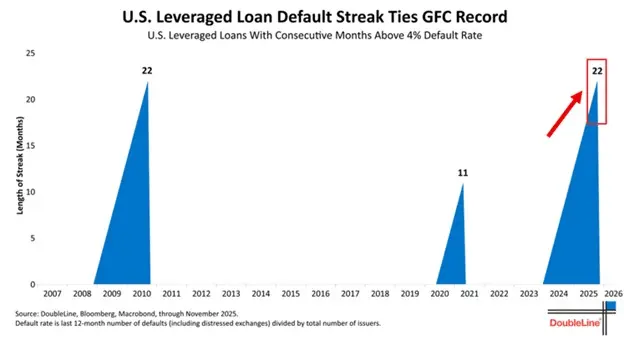
The default rate of US leveraged loans (Leveraged Loans) has exceeded 4% for 22 consecutive months, matching the record set during the 2008-2009 financial crisis, and the trend is still ongoing. From a historical perspective, such high default rates exceeding 4% have only occurred three times: the first two during the financial crisis and the COVID-19 pandemic in 2020. We are currently in the third instance—what is worth noting is that in the first two cases, a recession was triggered. The core concern is not the absolute level of the monthly default rate, but the prolonged duration of the high default state. This indicates that the current credit issues are not caused by a one-time liquidity shock but are the result of sustained pressure from a high-interest-rate environment on corporate cash flows and refinancing capabilities—this long-term stress warning is far more significant than short-term fluctuations. The primary target of leveraged loans is companies with weaker credit profiles and higher debt ratios, which are also the most sensitive to interest rate changes within the entire credit system. When the default rate of such assets remains high for an extended period, it often indicates that companies can no longer achieve self-repair through operational improvements or refinancing, and can only passively deplete existing cash flows, making the trend of credit deterioration difficult to reverse. Unlike the 2008 financial crisis, this round of risk has not initially impacted the banking system but is concentrated in private equity, collateralized loan obligations (CLOs), and non-bank credit systems. The risk has not manifested as a concentrated outbreak but is being released gradually and in a dispersed manner. This also explains why macroeconomic data appears relatively stable on the surface, while credit pressures continue to accumulate—this dispersed risk release pattern delays direct impacts on the macroeconomy but does not eliminate hidden dangers. According to economic cycle laws, credit is always a leading indicator. When the leveraged loan default rate remains high for a long time, corporate investment, mergers and acquisitions, and capital expenditures tend to be suppressed, and this suppression effect will gradually transmit to employment and consumption sectors. Therefore, the current default data does not mean the economy has entered recession, but clearly signals that if high interest rates persist, the probability of economic downturn will continue to rise. In simple terms, if the Federal Reserve does not adjust the high-interest-rate environment, the risk of economic slowdown or even recession will significantly increase. Against this backdrop, market pricing of risk assets will become more stringent, and investment strategies that do not rely on market direction but focus on cash flow stability and structural yields will gain higher market weight. The current popularity of the AI sector is a typical example—its high prosperity drives sales growth, improves financing environment, and expands market space, precisely aligning with the current market’s core demand for “certainty of returns.” In contrast, cryptocurrencies like Bitcoin are more dependent on liquidity support and are less capable of generating stable cash flows, making them more sensitive to liquidity changes and policy adjustments. However, I still believe that Bitcoin has a strong correlation with technology stocks—if not, its price might have already halved.
repost-content-media
  • Reward
  • Comment
  • Repost
  • Share
1. "Life is not as easy as flipping the palm, but with your palm, you can change our lives for the better."
"Life only happens once, and opportunities also only appear once; neither come twice."
2. "Don't tell people about your plans. Show them your results."
3. "Forgiving may not necessarily make us better or even feel better, but it clearly opens the way to goodness."
4. "Because struggle is a sign of your journey toward success."
5. "Take time to do what makes your soul happy."
View Original
post-image
post-image
重生之我是B圈大哥vip
At 2 a.m., my phone wouldn't stop buzzing—Fujian friends bombarding me with voice messages, their voices trembling:
"I put 10,000 USDT in full margin with over 30x leverage, and just a tiny dip, and my account is gone?"
Checking the trading record, my head buzzed—
9500 USDT was directly dumped in, full position, 30x leverage, no stop-loss set.
Over the years, I've realized many traders have a huge misconception about full margin:
Full margin is not a defensive move; using full margin incorrectly can lead to the fastest ruin.
**The real story of liquidation is this: what kills you isn't leverage itself, but pushing your entire capital and life savings too hard.**
Here's a simple calculation:
With 1000 USDT principal, using 900 USDT to open a 10x long position, just a 5% move against you, and your account is wiped out;
Alternatively, with 1000 USDT principal, only risking 100 USDT to open a 10x position, you'd need a 50% move against you to get liquidated—that's the magic of position management.
The problem is never the leverage multiple; it's repeatedly risking your entire life savings.
I can survive half a year without liquidation by following these three strict rules:
**① Single position limit ≤ 20% of total account balance**
**② Maximum single loss set ≤ 3% of total account balance, with stop-loss firmly in place**
**③ During market volatility, stay calm, do not add to winning positions, and keep a stable mindset**
The true purpose of full margin is to help you survive longer, not to let you go all-in and turn things around instantly.
It's a tool to counter market fluctuations, not a gambler's button for a comeback.
Light position testing, strict stop-loss, disciplined execution—missing any of these three means risking your market life.
**The game in crypto isn't about who makes the most money fastest, but who stays at the table the longest.**
If you don't want to be driven by emotions anymore, if you want to avoid buying the top on rebounds and getting caught on dips, join me to learn how to read charts, analyze structures, and grasp the rhythm.
No matter how crazy the market gets, with the right methods, opportunities will always come to you.
repost-content-media
  • Reward
  • Comment
  • Repost
  • Share
1. "Life is not as easy as flipping the palm, but with your palm, you can change our lives for the better."
"Life only happens once, and opportunities also only appear once; neither come twice."
2. "Don't tell people about your plans. Show them your results."
3. "Forgiving may not necessarily make us better or even feel better, but it clearly opens the way to goodness."
4. "Because struggle is a sign of your journey toward success."
5. "Take time to do what makes your soul happy."
View Original
post-image
post-image
  • Reward
  • Comment
  • Repost
  • Share
check
Takanoritakavip
Tokyo Rate Hike + Federal Reserve "Fake Liquidity": Bitcoin's Christmas Rally Faces "Ice and Fire"
Brothers, on the morning of December 15th, when Asian traders just opened their candlestick charts, Bitcoin suddenly "slashed" from $90,000 straight down to $85,616, a 5% drop that caused contract accounts to bleed profusely. Strangely, gold only fell by $1 at the same time, remaining steady as a mountain. Without any major defaults or negative news, the culprit behind this "silent slaughter" was hidden in a decision by the Bank of Japan.
And in the same week, the Federal Reserve was still performing its "constipation-style liquidity injection"—spreading $38 billion in ten days, while reverse repurchase agreements (ONRRP) drained $13.5 billion in a single day. It’s like chugging beer while scratching your throat to induce vomiting—drinking in vain. The two major central banks played a synchronized act, pushing Bitcoin into a dead end of "ice and fire."
I. The Fed’s "Split Personality" Game: Fake Liquidity, Genuine Support
First, let’s talk about the big tricks of the Fed. The government was shut down for three months, with the national debt soaring by $700 billion, and interbank market liquidity dried up to a desert. Small banks faced skyrocketing borrowing costs, real economy loans became as hard as climbing a mountain, and wages for ordinary people shrank for three consecutive months—typical "champagne on top, cigarette butts below."
The Fed loudly claimed "end of QT (quantitative tightening)," but its actions told a different story. On December 22nd, it spread $6.8 billion in a single day, totaling $38 billion over ten days. But brothers, have you noticed? Why is the market so quiet? Because this bunch of kids is playing both sides—left hand injecting liquidity, right hand draining it—via reverse repos (ONRRP), which exceeded $13.5 billion in a single day, more aggressive than the liquidity injection.
Even more sneaky is the "Bank Term Funding Program (BTFP)," which Citigroup strategists directly exposed: "This is just QE in disguise, with the same effect as directly buying government bonds." The water is indeed being released, but not a drop reaches the common people’s fields; it all flows into Wall Street’s swimming pool. The S&P has been rising steadily, gold soared 68% in a year, and on-chain stablecoins ballooned to $230 billion—ammunition is ready, but the trigger isn’t in retail hands.
This "mutual tug-of-war" logic is: the Fed wants to support the financial system from collapsing while controlling inflation expectations; it needs to bail out the big players but fears a flood of dollars washing into small shops on the street. The result? Liquidity precisely irrigates the wealthiest, while the grassroots get nothing.
II. The Bell Rings in Tokyo: Why Did Bitcoin "Seize the Throat" with a Single Sword?
Now, switch the lens back to Tokyo. On December 19th, the Bank of Japan raised interest rates to 0.75%, a 30-year high. This 0.25 percentage point tweak caused Bitcoin to plummet out of the toilet?
Because the "yen arbitrage" beast was awakened.
Over the past thirty years, Japan’s zero interest rate policy created bad habits among global hedge funds: borrow near-free yen → exchange for dollars → buy high-yield assets (US bonds, US stocks, Bitcoin). This "perpetual motion machine" had grown to trillions of dollars. But when the yen hikes interest rates, the game changes instantly:
1. Borrowing costs rise: the once free yen now costs interest, squeezing arbitrage opportunities
2. Yen appreciation pressure: previously borrowed yen to buy dollars, now must reverse—sell assets to buy yen and repay debt
3. Bitcoin becomes the primary "liquidity pool": 24-hour trading, shallow market depth, high leverage—liquidation is the first to be hit
Historical data is shocking: after the BOJ’s rate hike in July 2024, Bitcoin dropped from $65,000 to $50,000 within a week, a 23% crash. In the past three rate hikes, the average retracement exceeded 20%. This 5% decline is just the appetizer.
The most painful part? Gold only fell by $1, but Bitcoin collapsed by 5%. Where is the "digital gold"? Brothers, the times have changed.
III. Bitcoin’s "Image Collapse": From Rebellious Teen to Wall Street Puppet
After the spot ETF approval in January 2024, Bitcoin was officially integrated into Wall Street’s fold. BlackRock and Fidelity embedded Bitcoin into their portfolios, pension funds and hedge funds allocated positions based on traditional risk models.
This brought a deadly shift: Bitcoin transformed from a safe-haven asset into a high-risk Beta tool.
Data speaks:
• Correlation with Nasdaq: from -0.2~0.2 before 2020, soaring to 0.80 in 2025
• Volatility structure: rising and falling with tech stocks, losing immunity to macro events
• Holder structure: whales reducing holdings, small and medium addresses increasing, institutions accumulating during dips
This isn’t panic selling but a "generational shift." Early whales are handing over chips to a new generation of institutions. Bitcoin is shifting from a "rebellious youth fighting fiat" to a "Wall Street liquidity lever."
On-chain data shows that $230 billion in stablecoins are lurking on exchanges, watching closely, but no one dares to move. Because everyone knows: Bitcoin has become the most sensitive and fragile link in the global liquidity chain. The decisions made in Tokyo’s conference room can instantly determine your account balance.
IV. Christmas Rally in Jeopardy: This Year Might Break the "Must Rise" Rule
Since 1969, the Christmas rally (the last 5 days of the year + the first 2 days of the new year) has averaged a 1.3% increase for the S&P, and Bitcoin has been partying for years. But this year, the rules might really break.
A double-kill pattern has formed:
• On the Fed’s side: "Fake liquidity" continues, policy signals are chaotic. As Futu statistics show, when the Fed itself is playing both sides, historical rules often fail.
• On Japan’s side: hints of continued mild hikes in 2026, with pressure to close positions before rate hikes—like a Damocles sword hanging overhead, ready for a 15% correction at any time.
Two scenarios:
Gentle: The Fed buys $40 billion in bonds monthly, just enough to fill the liquidity gap. Risk assets sip porridge, Bitcoin slowly climbs to $93,000, but don’t expect a party.
Aggressive: The Fed floods with $60 billion+ monthly, flooding the gold mountain. Wall Street pops champagne, Bitcoin follows stocks to new highs. But the cost is exploding inflation and credibility collapse, with Japan’s rate hikes doing even more damage.
Crypto players’ view: Most likely heading into a "sickly rally." The fear and greed index is in the extreme fear zone at 25, market sentiment like a village hit by flu, trembling under the blankets. $89,000 is a key resistance; holding above could see $93,000. But if it falls below and Japan hikes again, even $80,000 might not hold.
V. Practical Tips for Brothers
Short-term (late December - early January):
• Light positions for the holidays: Christmas rally uncertainty is high, keep contract positions below 20%
• Watch dual indicators: Fed reverse repo balance + bank reserve ratio—decline in the former and rise in the latter signals gentle QE4
• Set stop-losses: if $89,000 doesn’t hold, cut at $85,000; if it stabilizes, small positions can chase to $93,000
Mid-term (Q1 2026):
• Hedge against BOJ risk: monitor BOJ meetings (March, June), reduce positions one week before hikes
• Stablecoin movements: $230 billion stablecoins are "dry tinder," wait for SEC’s new officials or Biden’s favorable policies to ignite this "Mars"
• Correlation traps: don’t treat Bitcoin as a safe haven anymore; it’s tied to Nasdaq—if US stocks plunge, Bitcoin can’t escape
Long-term:
• QE4 will inevitably land: under recession pressure, the Fed will have to buy government bonds itself—just a matter of time. This is the ultimate good news for Bitcoin, but the path will be extremely tortuous.
Conclusion: Survive the switch between old and new scripts
Brothers, Bitcoin hasn’t done anything wrong; it’s just paying the price during its "institutionalization" process. In the past, we only needed to watch on-chain data; now, we must also keep an eye on Tokyo, Washington, and Wall Street.
This Christmas, instead of betting on ups and downs, think clearly: when the Fed’s fire hoses and pumps are both running, and Tokyo’s rate hikes can instantly evaporate your wealth, are your assets in a swimming pool or in a desert?
History doesn’t repeat simply, but it often echoes startlingly. QE in 2008 birthed Bitcoin; QE3 in 2020 ignited the institutional bull market. Today’s "constipation-style liquidity" is ugly but clear in direction—the underlying logic of the financial system has collapsed, and traditional rules are shattering. Amid the chaos of switching scripts, some stubborn things will be re-priced.
Survive, and you’ll see the next cycle.
Brothers, when do you think the next rate hike by the Bank of Japan will be? Will Bitcoin fall below $80,000? Feel free to leave your judgment in the comments! If you find this analysis reliable, like and share to let more brothers understand this grand chess game! To get real-time on-chain data monitoring and BOJ meeting alerts, remember to follow Crypto Digger and leave a message. We’ll keep digging into the secrets of global central banks next time! #东京加息 #美联储QE4 #比特币身份危机 #圣诞行情预测 #Stablecoin Arsenal
$BTC
  • Reward
  • Comment
  • Repost
  • Share
#Gate2025AnnualReportComing
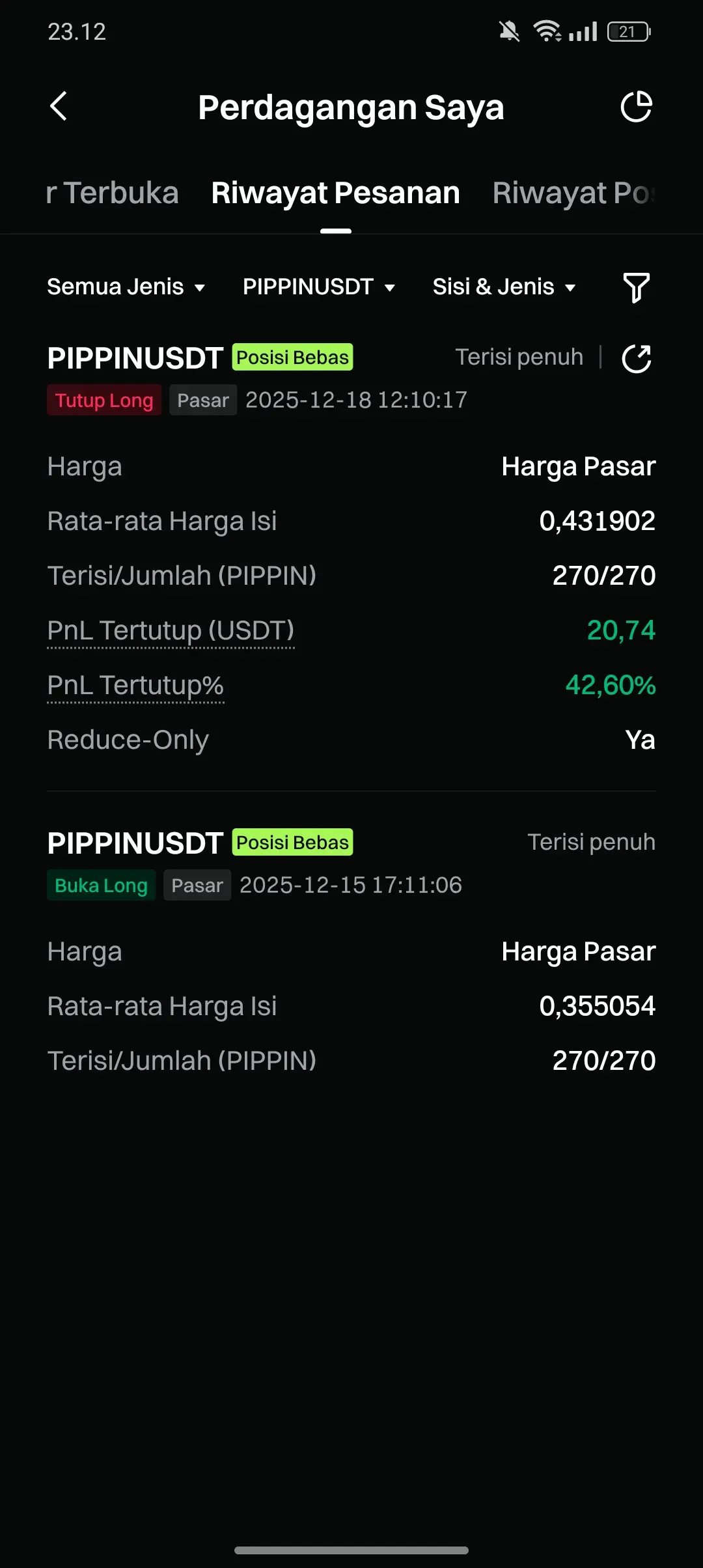
The Gate.io app always provides options; you must be able to analyze and pay attention to data for the best progress.
View Original
post-image
post-image
  • Reward
  • Comment
  • Repost
  • Share
best aplication in the world , thank you gate io , i get free money in apk , very impresif, top perfomance . best of the best top.
post-image
post-image
  • Reward
  • Comment
  • Repost
  • Share
good
ASSAvip
#CryptoMarketWatch
In the last month, the BTC trend looks like a wide sideways movement with a slight decrease in momentum:
the price has hardly changed, volatility has been noticeable, the structure is closer to a correction in the range than to a strong trend.
1. Over the month, BTC has increased by approximately 1.56%, moving within a range of about $84,000–$94,600.
2. The price is currently below the monthly moving averages and just below the daily pivot, the MACD is still negative, and the RSI is around 45.
3. The key balance zone for the month is $87,900–$89,300, a breakout upwards will open the path to $92,000–$95,000, and a breakout downwards to $84,000–$85,000.
analysis for the month
How has BTC moved in the last 30 days
I rely on the daily candles for the last 30 days for [Bitcoin (BTC)]
1. About 1 month ago, BTC was around $86,798.77.
2. The current daily price is around **88,152.67 $**, which gives **+1.56 %** for the month.
3. The range of the last 30 days for swings:
1. Minimum (swing low)around **83,862.25 $**.
2. Maximum (swing high) around **94,601.57 $**.
That is, the market went through almost 10–11 thousand dollars in range, but by the end of the month returned close to the starting values, which is typical for the consolidation phase after strong trending movements.
**What it means:** The month has passed under the sign of volatile sideways movement. In the short term, there is no clear bullish or bearish dominance, but a struggle is taking place within a wide range.

Moving averages and overall trend
On the daily timeframe:
1. Simple Moving Averages (SMA)
1. SMA 7d: 87,572.77 $ ( below the current price ).
2. SMA 30d: 89,494.37 $ ( above the current price ).
3. SMA 200d: 107,880.33 $ ( significantly above the current price ).
2. Exponential Moving Averages (EMA):**
1. EMA 7d:88 157.44 $.
2. EMA 30d: 90,478.57 $.
3. EMA 200d:102 496.65 $.
Interpretation:
1. In the short term, ( BTC is holding near its moving averages, indicating a local balance after recent volatility.
2. The price is below the 30-day SMA and EMA, which supports the scenario of a **corrective or distributional sideways movement**, rather than a fresh impulsive uptrend.
3. A strong divergence of the 200-day moving averages at the top reflects that there was previously a very powerful bullish cycle, and the current month looks more like a pause or structural correction within the larger trend.
What this means is that on a monthly horizon, the structure is closer to a correction in a sideways trend. To resume a confident upward trend, the price must consolidate above 89,500–90,500 and return the price above the 30-day moving averages.

Impulse: MACD and RSI
1. **MACD )daily(:**
1. **MACD line:** −1,454.8.
2. **Signal line:** −1 680.3.
3. **Histogram:** +225.49.
This means that the MACD is still in the negative zone )the medium-term momentum is weakened(, but the histogram is already positive. This indicates that the downward momentum is fading, entering a "deceleration of the decline" phase and a possible formation of a range bottom.
2. RSI )daily(:
1. RSI 7:49.6.
2. RSI 14: 45.42.
3. RSI 21: 43.68.
All values below 50, but far from being oversold. This is a moderately bearish, but not panic mode, typical of a sideways market with a slight downward slope.
**What it means:** the momentum for BTC over the month is more likely weakening than turning into a strong trend. This is convenient for accumulation and inconvenient for aggressive short-term trend strategies that prefer clear movements rather than whipsaws.

Important levels: Fibonacci and pivot
On the daily timeframe, based on the last monthly range:
1. Swing range:
1. Swing high: $94,601.57.
2. Swing low: 83 862.25 $.
2. Fibonacci Levels )retracement(:
1. 23,6 %: 92 067,09 $.
2. 38,2 %: 90 499,15 $.
3. 50,0 %:89 231,91 $.
4. 61,8 %:87 964,67 $.
5. 78,6 %: 86 160,46 $.
3. Main daily pivot:
1. Pivot point:88 966.67 $.
2. The current price is about $88,152.67, which is just below the pivot.
Practical output by levels:
1. The current zone around 88–89 thousand falls right into the "balance zone" between 50% and 61.8% Fibo)89 232 and 87,965 $(. This is often a key decision area where the market converges before a new movement.
2. Above **90,500 $** begins the area of strengthening the bullish scenario and a possible return to 92-95 thousand. ) 23.6% Fibonacci and swing high (.
3. Below 86,100–86,500 $, the risk of a deeper correction to 84–85 thousand and testing the lower part of the range increases.
What does it mean: over the month, the market has formed a wide box range with a center around 88–89 thousand. While BTC is hovering around this zone, the baseline scenario for the next month looks like a continuation of trading within the range until a clear breakout above 90.5–92 thousand or below 86 thousand.
Scenarios for next month regarding the technique
Not as a recommendation, but as a set of conditional scenarios:
1. **Moderately bullish scenario )breakout above the range(:**
1. The price is held above 87.9 thousand )61.8% Fibonacci ( and returns above 89.5–90.5 thousand.
2. RSI is steadily rising above 50, MACD is entering positive territory.
3. In this case, a retest of 92–95 thousand is quite realistic and, with a strong impulse, a move towards the Fibonacci extensions of 97.5–101 thousand.
2. **Continuation of the sideways movement:**
1. The price remains in the range of 86–92 thousand, the RSI is fluctuating between 40 and 55.
2. Volume without obvious spikes, MACD is "sawing" around zero.
3. This is the most "banal" scenario, but often this is how the market digests past growth before the next big move.
3. **Correction scenario )downward deepening(:**
1. The price settles below 86 thousand, RSI drops to the range of 35–40.
2. The MACD is turning down again with an increasing negative histogram.
3. Then the areas of interest in the technique shift to the region of 82–84 thousand, where the monthly minimum was and possible larger limit orders.
**What it means:** the technique does not show a strong trend over the month, leaving the door open both upwards and downwards. Key "thresholds" for changing the scenario are approximately in the zones of 90.5–92 thousand above and 86 thousand below.
TOTAL RECEIVED:
Over the past month, BTC has gone through a large volatile range, but in the end, it has only gained about 1.5%, which looks like a consolidation phase after a strong cycle. Moving averages, MACD, and RSI indicate weakened momentum and trading within the range of 84–95k. The key decision-making zone is now centered around 88–89k, and a breakout beyond 90.5–92k or a drop below 86k with volume, according to the technical analysis, will set the direction for the next major move.
Confidence: Medium, as the analysis is based on daily indicators and BTC prices over the last 30 days, while future scenarios remain probabilistic.
repost-content-media
  • Reward
  • Comment
  • Repost
  • Share
Gate is a very good application, I like trading here, earning while also being able to learn, thank you Gate, awesome.
View Original
post-image
post-image
  • Reward
  • Comment
  • Repost
  • Share
  • Pin

Trade Crypto Anywhere Anytime
qrCode
Scan to download Gate App
Community
  • 简体中文
  • English
  • Tiếng Việt
  • 繁體中文
  • Español
  • Русский
  • Français (Afrique)
  • Português (Portugal)
  • Bahasa Indonesia
  • 日本語
  • بالعربية
  • Українська
  • Português (Brasil)