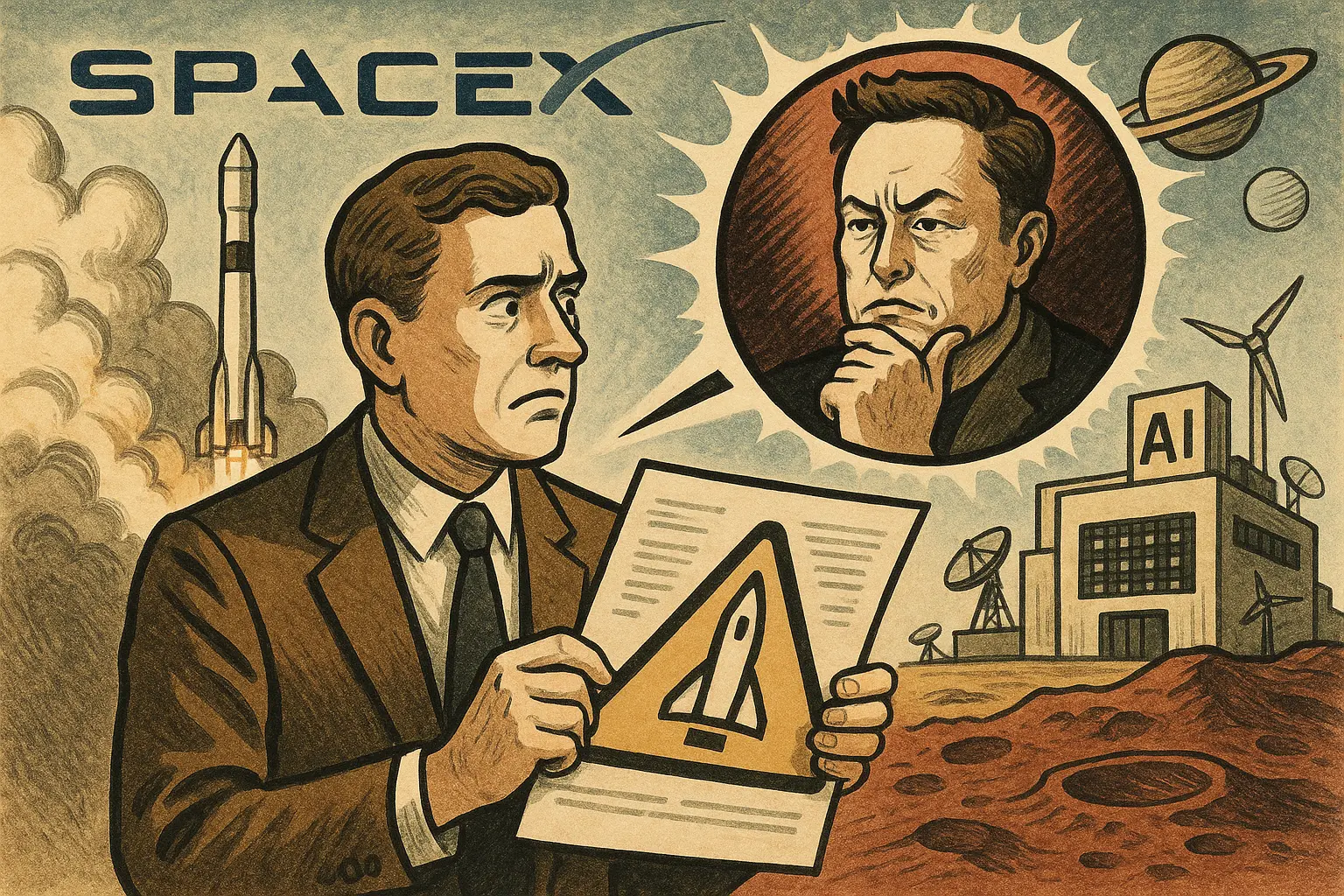
According to a report by Reuters on April 22, SpaceX, in a draft of its soon-to-be-filed S-1 registration statement, issued a warning to potential investors, saying that its plans to develop space AI data centers and to industrialize the Moon and interplanetary space are “still in the early stages,” involving “significant technical complexity and unproven technologies,” which “may not achieve commercial viability.” This stands in sharp contrast to the optimism expressed publicly by its CEO, Musk, this year.
Three Core Key Risks Disclosed in the Prospectus
Inherent Dangers of the Space Environment: The document says that any future AI orbital data centers would operate in “harsh and unpredictable outer space environments,” facing widespread and unique space-related risks that could lead to equipment failure or complete shutdown.
Severe Reliance on Starship: The prospectus clearly states that if there are “any failures or delays” in the scaled development of Starship or in achieving the required launch cadence, reusability, and related capabilities, it “would delay or limit the ability to execute its growth strategy.” Starship has already experienced multiple delays and test failures to date.
Uncertainty About Commercial Viability: The prospectus directly acknowledges that the space AI computing and interplanetary industrialization plans may “fail to achieve commercial viability,” which is a rare case of such public acknowledgment of commercial uncertainty in legal filings by a company in this kind of cutting-edge technology.
The Gap Between Musk’s Public Statements and the S-1 Filing
SpaceX’s cautious internal expectations, as presented in its IPO prospectus, differ significantly from Musk’s recent public remarks. Earlier this January, Musk told the World Economic Forum in Davos that building AI data centers in space is “a no-brainer,” and said that within two to three years, space would become the most economically effective place to deploy AI. After he announced the merger between SpaceX and xAI in February, he went further, saying that “AI in space is clearly the only scalable path.”
As a statutory filing under U.S. securities law, the prospectus’s risk-factor disclosure is both a way to inform investors of potential risks and a tool to protect the company from future legal liability. It is typically more conservative than external public statements made by management.
SpaceX IPO Snapshot: Valuation of $1.75 Trillion, $75 Billion in Funding
SpaceX plans to complete its IPO within the next several months, targeting a valuation of about $1.75 trillion and raising $75 billion. If successful, it would become the largest IPO in history. Starship, at the core of the company’s growth strategy, is designed to significantly reduce launch costs for Starlink satellites, space data centers, and crewed lunar landing missions.
Frequently Asked Questions
Why is SpaceX’s IPO prospectus so cautious, compared with Musk’s optimistic remarks?
Under U.S. securities law, the S-1 registration statement must disclose comprehensive risk factors to inform investors of potential risks and protect the company from future legal claims. Therefore, the prospectus’s risk warnings are usually framed in more conservative language than what management has publicly stated, and should not be taken as directly equivalent to the company’s actual level of strategic confidence.
How do Starship delays affect SpaceX’s space AI plans?
The prospectus makes clear that the scaled development of Starship is the fundamental prerequisite for space AI data centers and the interplanetary program. If there are any failures or delays in Starship’s launch cadence or reusability, it would directly slow down the space AI growth strategy, while also affecting the deployment cadence of Starlink’s satellites.
What are the scale and expected timeline for SpaceX’s IPO?
SpaceX plans to complete its IPO by 2026, targeting a valuation of about $1.75 trillion and raising $75 billion. If successful, it would become the largest IPO in history, surpassing Saudi Aramco. The specific listing date has not been announced. SpaceX has not offered any public comments on the details of the prospectus.
Disclaimer: The information on this page may come from third parties and does not represent the views or opinions of Gate. The content displayed on this page is for reference only and does not constitute any financial, investment, or legal advice. Gate does not guarantee the accuracy or completeness of the information and shall not be liable for any losses arising from the use of this information. Virtual asset investments carry high risks and are subject to significant price volatility. You may lose all of your invested principal. Please fully understand the relevant risks and make prudent decisions based on your own financial situation and risk tolerance. For details, please refer to
Disclaimer.
Related Articles
TradFi Rise Alert: FCEL (FuelCell Energy Inc) Rises Over 22%
Gate News: According to the latest Gate TradFi data, FCEL (FuelCell Energy Inc) has surged by 22% in a short period. Current volatility is significantly higher than recent averages, indicating increased market
GateNews20m ago
Solana Holds $87 Support as ETF Inflows Top $22M
Key Insights
Solana ETF inflows reached $22.14 million this week, signaling sustained institutional accumulation and reinforcing short-term support above the 50-day EMA level.
Futures open interest climbed to $5.53 billion, highlighting increased retail participation and growing
CryptoNewsLand24m ago
Trump Media CEO Devin Nunes Exits as TMTG Stock Plummets 90%
Nunes exits as TMTG undergoes a major leadership shakeup, underscoring the company's ongoing struggle to turn Trump's influence into a viable platform, with stock down about 90% since its debut.
Abstract: The article reports Devin Nunes's departure as CEO of Trump Media & Technology Group, signaling a significant leadership change for the company. It notes that despite Truth Social's prominence, TMTG has failed to translate the president's influence into a profitable platform, with its stock illustrating the broader challenges the company faces in turning political notoriety into sustainable market success.
GateNews28m ago
Trump extends Iran ceasefire on the first day: Hormuz docks 2 ships, oil prices near 100, U.S. stocks close lower
CNBC combines three reports: On April 22, after Trump extended the Iran ceasefire and maintained the blockade of Hormuz, the IRGC seized two cargo ships. Market oil prices are approaching $100 per barrel, and U.S. stocks closed down about 0.6%. The extension of the ceasefire is seen as a negotiating window rather than the end of hostilities, and maritime risks remain. Shipping around Hormuz is nearly at a standstill; Brent is near $100 and WTI is above $90. Oil price movements depend on factors such as the progress of negotiations, the direction of the blockade, and the resumption of shipping.
ChainNewsAbmedia34m ago
Bitcoin breaks through $78,000, and the market moves out of the extreme fear range
The crypto market is recovering, with BTC trading above $78k, up about 2% day over day. After breaking $75k, a short squeeze emerged; spot ETFs have seen consecutive net inflows, and MicroStrategy’s additional purchases have driven growth in institutional holdings. Open interest is rising, funding rates are falling, and even turning negative, suggesting potential explosive upside. Tensions on the geopolitical front have eased, and the fear index has rebounded back into a fear range—sentiment has improved, but it’s not yet a full bull market. To hold the $78k–$83k range steadily, improve liquidity, and maintain macro stability, we can enter a long-term bull market. This article was first published by Chain News ABMedia.
ChainNewsAbmedia35m ago
Chegg Stock Crashes 99% as AI Disrupts Edtech Market
Summary: Chegg soared during online-education demand, then AI tools disrupted its model, triggering massive layoffs and a collapse below $2, with broader AI-driven shifts hitting crypto miners and fintech firms.
Abstract: This article examines Chegg's rise as a pandemic-era edtech darling and its ensuing decline amid the rapid adoption of generative AI, which provides quick answers and undercuts Chegg's value proposition. It documents 2025 layoffs and the stock's plunge toward delisting, and frames Chegg's experience within a broader AI disruption reshaping tech and crypto: Bitcoin miners pivot to AI operations, and AI-native strategies redefine competitiveness in fintech and beyond.
CryptoFrontier48m ago


