A new on chain poll has started to attract attention across the Proof of Work crypto community. The vote asks a simple question. Which Proof of Work cryptocurrency stands out as the favorite among participants today? Early results show Kaspa (KAS) taking the lead over several well known names such as Bitcoin and Monero.
The poll appears on Hoosat Vote, a decentralized governance platform built for the Hoosat Network. Crypto analyst observers have pointed to the vote as an interesting snapshot of community preference inside the Proof of Work ecosystem. The poll remains active and will continue collecting responses until March 31, which means the current standings may still change before the final result appears.
The poll runs on Hoosat Vote, a decentralized voting system launched in late 2025 for the Hoosat Network (HTN). Hoosat Vote records each poll and vote directly on a GhostDAG-based blockchain. This structure removes the need for centralized polling tools that store results outside the blockchain environment.
Hoosat Vote allows users to create community questions and record responses in a transparent way. Votes become permanent blockchain entries, which creates a verifiable history of community decisions and sentiment. The system operates with fast confirmation speeds and low network costs. These features make the platform suitable for frequent community governance activities.
The current poll asks users to select their favorite Proof of Work crypto among several well known assets. Options include Bitcoin, Dogecoin, Bitcoin Cash, Monero, Litecoin, Ethereum Classic, Zcash, Dash, Bitcoin SV, and Kaspa.
Source: Hoosat Vote
Early Voting Results Show Kaspa (KAS) Leading The Proof Of Work Poll
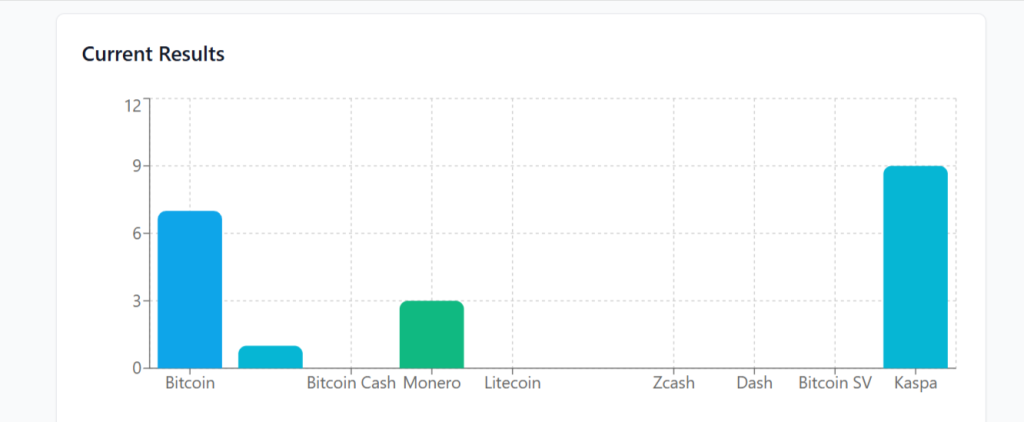
The results displayed in the poll interface reveal an early advantage for Kaspa (KAS). The latest snapshot shows Kaspa holding 9 votes, which represents about 45% of the total responses recorded so far.
Bitcoin follows in second place with 7 votes, which equals 35% of the poll. Monero holds the third position with 3 votes, representing 15% of the total responses. Dogecoin currently sits behind the top three with 1 vote.
Several other Proof of Work assets such as Litecoin, Zcash, Dash, Bitcoin Cash, Ethereum Classic, and Bitcoin SV have not yet recorded votes in this poll snapshot.
A visual chart of the results reinforces this ranking. Kaspa appears clearly ahead of the other candidates in the current stage of voting. Bitcoin remains the closest competitor based on the latest numbers.
Kaspa Popularity Reflects Interest In New Proof Of Work Architecture
Kaspa has gained attention inside Proof of Work circles because of its unique blockchain design. The network uses a GhostDAG protocol, which allows blocks to exist in parallel rather than following a single chain structure. This design allows faster confirmation speeds without abandoning the Proof of Work model.
The Kaspa network therefore combines traditional mining security with higher throughput than older Proof of Work chains. Supporters believe this structure could keep the network competitive as blockchain infrastructure evolves.
Top Analyst Reveals Bitcoin (BTC) Roadmap and Key Price Levels For the Next 2 Years_**
Bitcoin and Monero continue to represent established pillars of the Proof of Work ecosystem. Kaspa, however, represents a newer generation of networks that attempt to expand the capabilities of the mining model.
The Hoosat Vote poll remains open for another 16 days, which means the ranking may still evolve as more users participate. The final outcome will become clear once voting closes on March 31. Until then, the poll offers an interesting view into which Proof of Work projects attract attention among early participants in this on chain governance experiment.
Disclaimer: The information on this page may come from third parties and does not represent the views or opinions of Gate. The content displayed on this page is for reference only and does not constitute any financial, investment, or legal advice. Gate does not guarantee the accuracy or completeness of the information and shall not be liable for any losses arising from the use of this information. Virtual asset investments carry high risks and are subject to significant price volatility. You may lose all of your invested principal. Please fully understand the relevant risks and make prudent decisions based on your own financial situation and risk tolerance. For details, please refer to
Disclaimer.
Related Articles
AI Data Center Gold Rush Sparks Debate on Bitcoin’s Impact
A renewed debate is growing over whether a sustained pivot from Bitcoin (CRYPTO: BTC) miners toward artificial intelligence could impact the network’s security and its role as a store of value. On one side, energy and capital are increasingly chasing higher returns in AI compute, prompting fears
CryptoBreaking49m ago
SEC Chair Calls for Action on Bitcoin and Crypto Market Rules
Gary Gensler, head of the SEC, urges Congress to expedite crypto regulation to provide clear rules, reduce confusion, and foster investor confidence. The crypto community reacts with mixed feelings as lawmakers debate potential legislation.
Coinfomania58m ago
Bitcoin Surges to Local High of 74,000 USD, US-Iran Conflict and Oil Rally Drive Crypto Market's 320 Billion Dollar Spike
Bitcoin's price briefly surged to $74,451 on March 16, reaching a 40-day high, influenced by US-Iran conflicts and rising oil prices. The market has gained over $320 billion in total, but uncertainties still exist. Analysts suggest dollar-cost averaging between $60,000 and $70,000. Investors should exercise caution to manage potential risks.
GateNews1h ago
Research: 72% of Submarine Fiber Optic Cables Would Need to Fail Simultaneously to Significantly Impact Bitcoin Network
Latest research shows that the Bitcoin network has strong resilience against global submarine cable failures. Approximately 72% to 92% of submarine cables would need to fail simultaneously to cause more than 10% of Bitcoin nodes to go offline. Using the Tor network can enhance interference resistance, with 64% of nodes concealing their locations. Historical failure events have had minimal impact on Bitcoin prices, with resilience determined by the structure of submarine cables.
GateNews1h ago


