The institution reported that argt, a peso-linked stablecoin, constitutes a security, subject to the regulatory regime for capital markets for these instruments. The stablecoin, issued by Twin Finance and listed by Belo, offered up to 32% APR.
Regulator Classifies Argentine Peso Stablecoin as a Security, Blocks Operations
The Argentine equivalent of the SEC, the CNV, executed the first measure against a stablecoin linked to the national fiat currency, the Argentine peso.
On March 12, the institution issued a resolution ordering the suspension of the listing, offering, and intermediation of argt, stating that the token was classified as a security offered to investors without complying with the rules established for these assets.
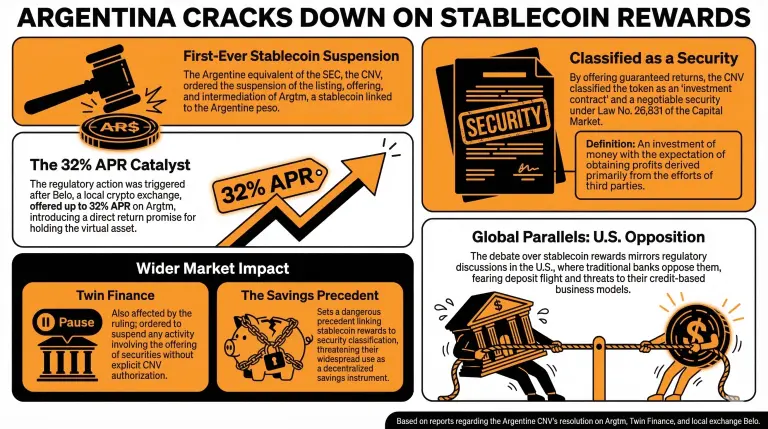
The action comes after Belo, an exchange that listed the stablecoin, offered up to 32% in APR, introducing a return promise linked to holding the virtual asset. As a consequence, the CNV assessed that this would make it “fall under the figure of an investment contract included in the definition of negotiable security provided for in article 2 of Law No. 26,831 of the Capital Market, which results in its classification as a negotiable security subject to the public offering regime.”
The institution clarified that when these assets meet the criteria of an investment contract, “an investment of money in a joint venture with the expectation of obtaining profits derived primarily from the efforts of third parties,” it can be considered a security, and will be subject to the compliance regime described for these assets.
The action also affects Twin Finance, which will have to suspend any activity, including the offering of securities, without the CNV’s authorization.
The development sets a precedent in Argentina, linking the offering of rewards for holding a stablecoin to its classification as a security, closing the potential savings use case for these instruments in the future, with no regulation tackling this issue.
The subject of stablecoin rewards is also being discussed in the U.S., as banks have opposed it, alleging that it could fuel deposit flight from the financial system and affect their credit intermediation-based business model.
FAQ
- What recent action did Argentina’s CNV take regarding a stablecoin?
The CNV suspended the listing and intermediation of argt, classifying it as a security being offered without regulatory compliance.
- Why was argt classified as a security?
The token was categorized as a security because it was linked to an investment contract promising up to 32% APR for holding the virtual asset.
- What implications does this resolution have for Twin Finance?
Twin Finance must halt all activities involving the stablecoin, including offering securities, without prior authorization from the CNV.
- What broader impact does this decision have on stablecoin offerings in Argentina?
This action sets a precedent by linking rewards for holding stablecoins to their classification as securities, potentially limiting their use for savings in the country.
Disclaimer: The information on this page may come from third parties and does not represent the views or opinions of Gate. The content displayed on this page is for reference only and does not constitute any financial, investment, or legal advice. Gate does not guarantee the accuracy or completeness of the information and shall not be liable for any losses arising from the use of this information. Virtual asset investments carry high risks and are subject to significant price volatility. You may lose all of your invested principal. Please fully understand the relevant risks and make prudent decisions based on your own financial situation and risk tolerance. For details, please refer to
Disclaimer.
Related Articles
BETS OFF Act Introduced by US Democrats Would Prohibit War Betting Markets
The proposed legislation aims to regulate prediction markets by prohibiting trading on non-economic government actions and sensitive events. It addresses ethical concerns and seeks to clarify regulatory boundaries amid rising scrutiny and ongoing controversies.
CryptoBreaking26m ago
CFTC approves! Phantom Wallet receives a "no-action exemption," allowing the integration of compliant derivatives trading
The U.S. CFTC issued a no-action letter to crypto wallet developer Phantom, permitting it to integrate regulated derivatives trading interfaces without registering as a broker. The exemption comes with three major compliance requirements, including risk and conflict of interest disclosures, marking a gradual blurring of lines between DeFi and traditional markets, with significant implications for clarifying regulation of non-custodial wallets.
動區BlockTempo51m ago
Argentina Blocks Polymarket as Crackdown on Prediction Markets Expands
Argentina has banned the betting platform Polymarket due to its unlicensed gambling activities and concerns about minors' access. This move follows similar actions in Colombia and reflects a broader trend of regulatory enforcement in Latin America and beyond.
CryptoBreaking1h ago
'It's a Rug-Pull': Adam Back Issues Warning to Bitcoin Users Over BIP-110 - U.Today
Adam Back criticizes BIP-110, arguing it jeopardizes Bitcoin's stability by enabling potential risks like fund freezing and chain splits. He views it as an unnecessary response to spam that could harm users and damage Bitcoin's reputation.
UToday2h ago
HSBC and Standard Chartered Near Hong Kong Stablecoin Licenses
Hong Kong regulators received 36 stablecoin license applications but plan to approve only a few issuers.
HSBC and Standard Chartered are expected among the first licensed HKD stablecoin issuers.
The licensing framework builds on a sandbox program launched in 2024 to test stablecoin
CryptoFrontNews3h ago
Lawmakers Eye Clarity Act Talks at DC Crypto Summit
Discussions at the DC Blockchain Summit will focus on the Clarity Act and stablecoin yield rules, with lawmakers aiming to resolve disagreements that could lead to new regulations, especially banning idle balance yields while permitting transaction-based rewards.
CryptoFrontNews3h ago


