Source: Glassnode; Compilation: Wuzhu, Golden Finance
Summary
- After Bitcoin broke $105,000 for the second time at the end of January, the market entered a contraction phase, with sharp declines in the monthly price momentum of major assets.
- Bitcoin remains relatively stable, while Ethereum, Solana, and Memecoins are facing deeper adjustments, reflecting changes in risk preferences.
- Solana has become the market leader in capital inflows over the past two years, while Ethereum has relatively struggled to attract sustained demand.
- However, this week, capital flows of all digital assets except Bitcoin have sharply declined, and Solana and its related memecoin ecosystem have been relatively hard hit.
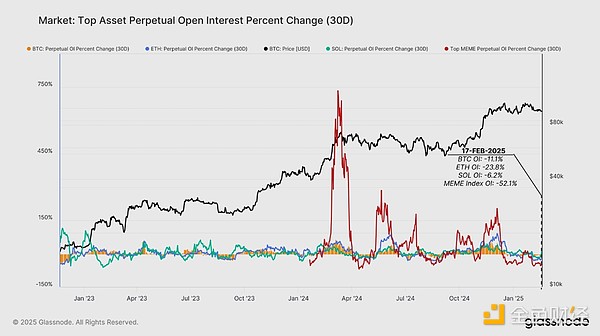
- Bitcoin (-11.1%), Ethereum (-23.8%), Solana (-6.2%), and Memecoins Index (-52.1%) perpetual futures open interest contracts all declined, reflecting reduced interest in leveraged speculation.
The market momentum takes a breather
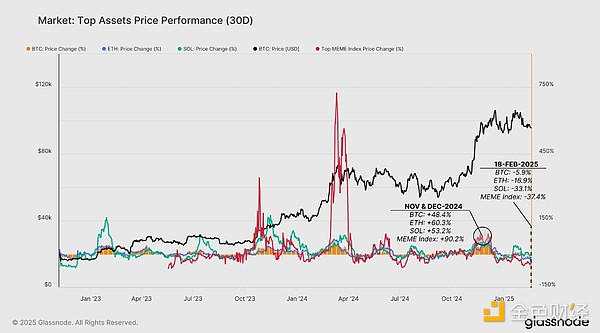
In late January 2025, the Bitcoin market attempted to break the all-time high and return to the price discovery phase. However, this rebound failed to gain the necessary momentum, and the market subsequently entered a period of contraction and consolidation, with the prices of major assets plummeting sharply.
- Bitcoin: +48.4% (November 2024) → -5.9% (February 2025)
- Ethereum: +60.3% (December 2024) → -16.9% (February 2025)
- Solana: +53.2% (November 2024) → -33.1% (February 2025)
- Meme Coins Index: +90.2% (December 2024) → -37.4% (February 2025)
It is worth noting that Memecoins and Solana thrive in strong market conditions, but they also tend to experience significant pullbacks during downturns. Ethereum has consistently been one of the weakest performing currencies throughout the entire cycle, although its performance this week is better than Solana, a strong surpass trend has yet to form.
Evaluate performance to date
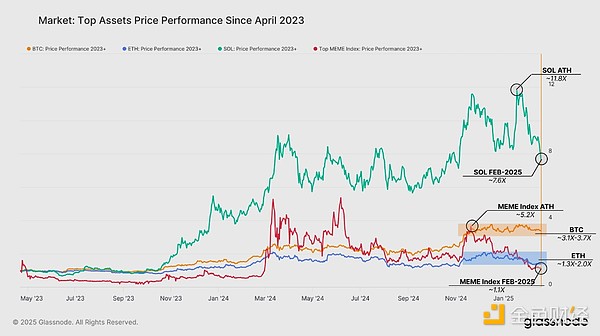
The recent slowdown comes after a long period of strong growth in major digital assets. Looking at the performance since the beginning of 2023, we can see significant differences in the performance of each asset in the cycle so far:
- The trading range of Bitcoin is about 3.4 times higher than in April 2023, providing a benchmark return profile.
- Compared to its peers, Ethereum is struggling, with returns ranging from 1.3 to 2.0 times compared to April 2023.
- Solana’s return since 2023 peaked at 11.8 times in early January 2025, but then sharply dropped to around 7.6 times with the current correction implemented.
- Memecoins Index: The mid-2024 price saw an explosive increase, which was basically in line with Solana’s outstanding performance, reaching a peak of 5.2 times since 2023. However, in recent weeks, the industry has been hit quite hard, and the overall performance is now the worst among the four assets.
This reflects Solana’s high-beta nature, as it has experienced both the strongest rise and the most severe pullback. Bitcoin’s more stable trend highlights its resilience as a benchmark return characteristic in the digital asset field. Especially Memecoins, the recent decrease in investor demand indicates a shift in risk preference.
Capital flow drives the market
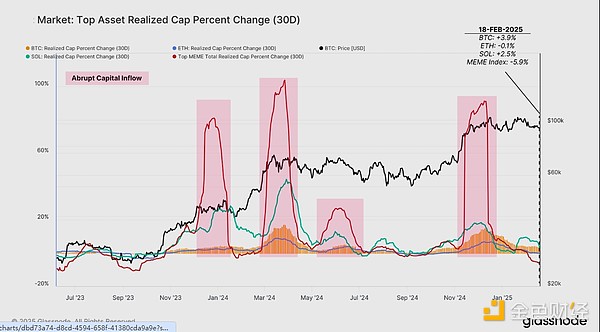
Solana’s strong performance in the past two years is consistent with the continuous capital inflows brought by investor demand. Looking at the monthly changes in realized market value, we can see clear capital flow patterns of various digital assets:
- Solana: It has been attracting relatively high capital inflows, supporting its strong price appreciation.
- Ethereum: Among major currencies, capital inflows are the weakest, which explains its relatively poor performance.
- **Memecoins:**Experienced several sudden but unsustainable surges in capital inflows, reflecting speculative bursts but no sustained momentum.
However, in recent weeks, the capital inflows of all digital assets have declined. It is worth noting that Ethereum and top Memecoins have now turned negative (capital outflows), with Ethereum’s realized market value net outflow at -0.1%, and Memecoins index net outflow even more severe at -5.9%.
This indicates a significant cooling of speculative desire and suggests that capital may flow out of higher-risk assets in the future.
Futures market weakness
As the momentum in the spot market begins to weaken, we can also see a decrease in capital inflows into the perpetual futures market. The cooling of spot demand has led to a sharp decline in the perpetual open interest of all major assets, indicating a reduction in speculative activity and a decrease in spot and arbitrage yields.
In the past 30 days, the change rate of open positions has highlighted the general retreat of capital:
- Bitcoin OI: -11.1%
- Ethereum OI: -23.8%
- Solana OI: -6.2%
- Memecoins OI:-52.1%
The trend of a comprehensive decrease in open contracts suggests that speculators are reducing leverage exposure, possibly due to weakening market momentum and increasing market uncertainty. The biggest drop is in Memecoin, which tends to attract more short-term leveraged bets, but it quickly loses its appeal as long as market sentiment weakens.
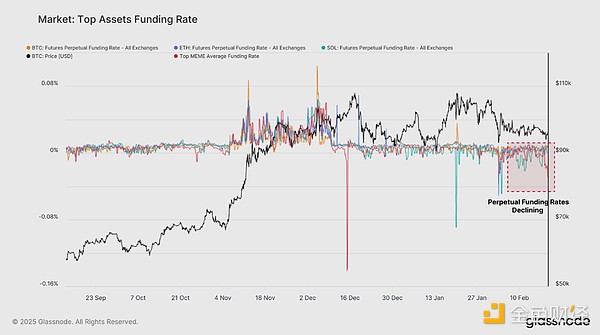
The display of financing rates shows bearish sentiment
The further decline in perpetual futures financing rates has further exacerbated the weakness of open positions, reflecting a shift in bearish sentiment and the unwinding of leveraged positions, especially in higher-risk assets.
- The financing rates of Bitcoin and Ethereum are still slightly positive, and their underlying liquidity conditions often have positive financing rates, unless there is a significant decline in leverage ratios.
- Solana’s funding rate has dropped slightly in recent weeks and turned negative, indicating a cooling demand for long speculative positions.
- The financing rate of Memecoins has turned very negative, indicating that the bears now dominate in these highly speculative assets, and many traders are liquidating (or being liquidated).
The negative financing rates of Solana and Memecoins indicate a net turnaround in the bearish sentiment of high-risk assets, and excessive long leverage is being liquidated.
ETF flow and market impact
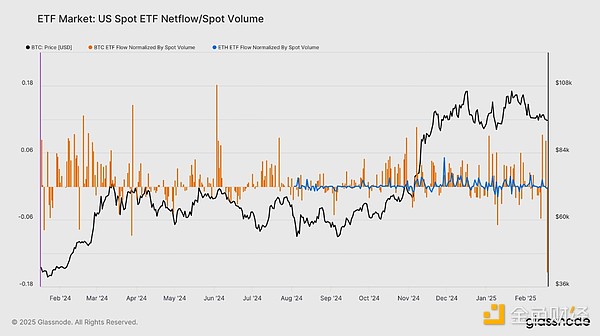
As the market is in a contraction phase, institutional interest in Bitcoin and Ethereum has slowed down according to the spot ETF flow. By standardizing the net inflow volume with the native spot volume of each asset, we can measure the weight and impact of ETFs on market dynamics.
- Last week, the outflow of Bitcoin ETF exceeded 200 million USD/day, but then there was a strong rebound in buying activity, exceeding 8% of the global spot trading volume, highlighting institutional demand (similar to “buying on dips” behavior).
- Ethereum ETF demand has significantly cooled down, still much smaller compared to Bitcoin. ETH ETF activities hover near zero in terms of net inflows and outflows, indicating a lack of strong traditional investor demand and participation.
So far, this divergence has been the theme of this market cycle, solidifying Bitcoin’s dominant position in institutional asset portfolios. Ethereum still struggles to attract sustained inflows of capital, further explaining its relatively poor performance in recent years.
Key Bull and Bear Thresholds
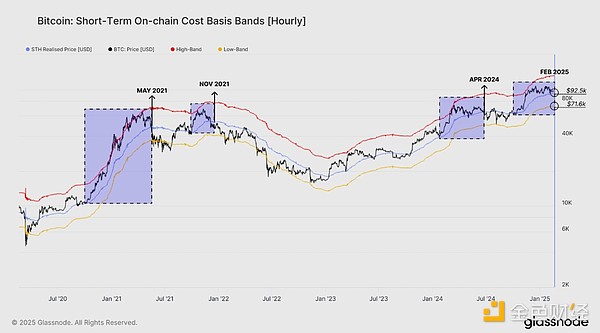
**Bitcoin is currently trading at $1,000-$5,000 above the short-term holder (STH) cost base, sitting at $92,500. Historically, this level has been a key pivot point between the local bull and bear phases, the pivot point at which the average buyer has moved between unrealized profit and loss states in recent times. **
Looking back at the previous situations where Bitcoin reached new highs and then corrected downwards, we can see similar patterns in May 2021, November 2021, April 2024, and February 2024.
In each case, the downtrend extends to the lower bound of the STH cost basis model, specifically below the cost basis -1 standard deviation (σ). Currently, this lower bound is at $71,600, helping to predict the potential downside risk if these historical patterns were to repeat.
Consolidation After Reaching All-Time Highs
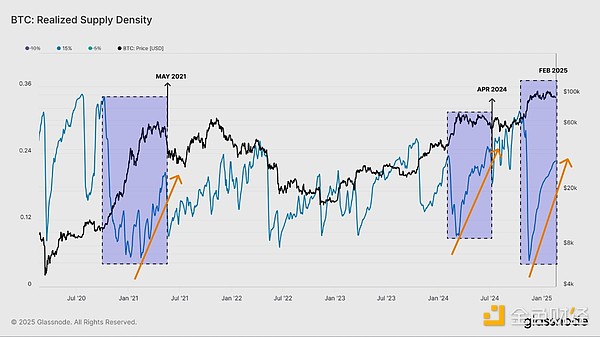
In previous instances of Bitcoin reaching new highs, we have observed a consistent post-rebound pattern, where the substantial surge in actual supply density occurs within a ±15% range of spot prices. This is due to the market shifting from an aggressive uptrend to price consolidation, as the market trades within a relatively narrow range.
This behavior is very obvious at the previous cycle tops, where:
- As the market rebounds within the price discovery range, the actual supply density has been declining all the way to the price peak.
- Then, when the market enters a correction or consolidation phase, market participants begin to reallocate tokens.
- This usually happens when it approaches the STH cost basis, as the beliefs and demand situation of new investors will be tested.
The current actual supply density is consistent with the typical post-ATH consolidation phase, with buyers and sellers attempting to establish a new balance before the next major trend unfolds.
Approaching a decisive moment in the market
To better understand the market’s sensitivity to this supply density, we can analyze the supply held by short-term holders (STH) in the distribution phase after the recent ATH. This helps measure the pattern of accumulation by new investors and whether the current situation is similar to past cycle peaks.
When comparing the changes in STH supply, we observed:
- The recent accumulation phase is very similar to May 2021, suggesting that the supply is just as large and investors will be sensitive to a price drop below $925,000.
- In April 2024, new investors also accumulated a large amount, but the magnitude of the upward trend in STH supply in the current cycle is more consistent structurally with May 2021 rather than 2024.
Given these similarities, we are now very close to a decisive moment in the market - the stage where price action is ready to unfold. If demand remains strong, Bitcoin may establish a new range above the ATH. However, a lack of sustained buying pressure may lead to a deeper distribution-driven adjustment, similar to the post-ATH stage. This may be driven by the recent buyers’ panic as they see the tokens they recently purchased transition from profit to holding unrealized losses.
Conclusion
Bitcoin has been consolidating around $95,000 for weeks, and the trading range is relatively stable. However, the broader digital asset space is not the same. Ethereum, Solana, and Memecoins have all fallen sharply from their cyclical highs. Especially, the demand for Memecoins has significantly cooled down, and the outflow of capital, a sharp drop in prices, and bearish sentiment in the futures market are clear evidence.
For Bitcoin, the key level to watch is the short-term holders’ cost basis around $925,000. This is a critical point where most recent buyers will turn into unrealized losses. With the emergence of panic sentiment, this could lead to further downside. In any case, the current consolidation phase seems to be nearing its end, and the market appears ready to move in one direction again.


