Author: Daii Source: mirror
Today’s crypto market is a bit strange, institutions and retail investors seem to live in different worlds, and their perception of the current market is completely opposite.
1. Why is there such a big contrast between institutions and retail investors?
Institutional investors are very optimistic about cryptocurrencies. This year, institutions have been buying continuously. Various ETFs and companies have collectively purchased approximately 104,000 bitcoins. You should know that the Bitcoin network has also only ‘minted’ 18,000 new bitcoins this year.
Retail investors, however, are immersed in a sense of disappointment. Bitwise’s Chief Investment Officer Matt Hougan said that according to the latest Crypto Emotion Index, retail investor sentiment is approaching historic lows.
! 4HG9Vrw6OczFffCueReUFeb3xSlbFCJNhebqF4Sb.png
Despite Bitcoin’s nearly 5% rise since the beginning of the year, the performance of other cryptocurrencies has been disappointing. The returns of more altcoins, including XRP, Solana, and BNB, as well as ETH, have been negative (see the chart below). Therefore, it’s no wonder that retail sentiment is low.
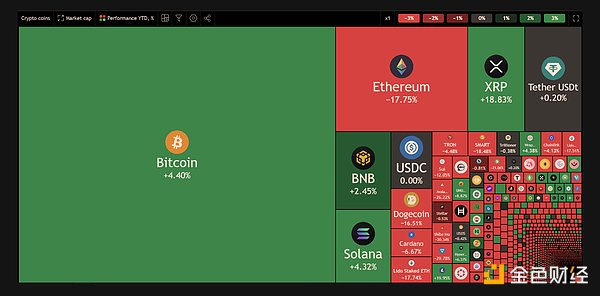
However, Matt Hougan believes that the spring of altcoins is coming. Maybe this is not a consolation, it may really be the case, but I think there is a better strategy for retail investors to choose. That is to follow the strategy and learn from institutional investors.
2. More institutions are entering?
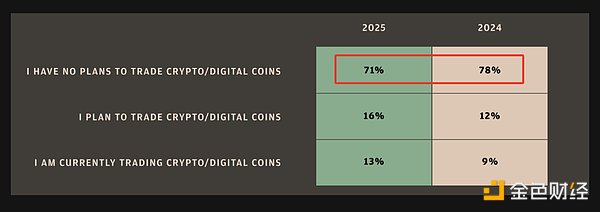
In fact, following the strategy is also becoming the choice of more institutions. According to JPMorgan’s latest survey, the percentage of institutional traders who have ‘no plans’ to participate in cryptocurrency trading this year has decreased from 78% last year to 71%. In other words, it is possible that 7% more institutional traders will start trading cryptocurrencies in 2025. That is to say, 29% of institutional traders may start trading cryptocurrencies this year.
So, what are institutional investors who have already started encrypted trading doing?
There are so many institutions, who should we learn from? However, you should also know that there are high-level institutional retail investors, as well as low-level retail-type institutions. For example, in the past few days, retail-type institutions have started selling Bitcoin ETFs, with net outflows for 4 consecutive days, totaling over 5 billion US dollars (see the figure below).
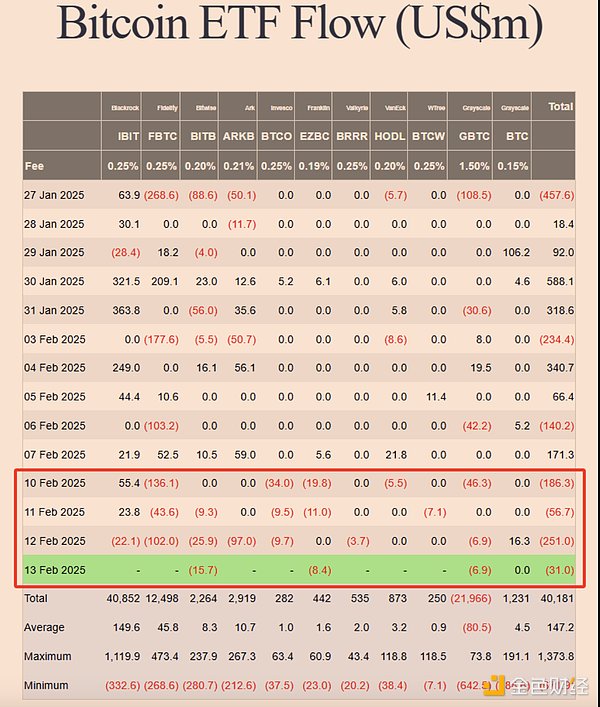
However, don’t worry, the departure of retail institutions has not had much impact on the market. This is because large institutions have been taking advantage of the fall in the price of bitcoin to reduce their positions (see chart below).
IntoTheBlock data shows that on February 5th, when the Bitcoin trading price fell below $97,600, large institutions (whales) bought over 39,620 BTC worth more than $3.79 billion in a single day.
I think we should learn from these institutions and buy when others are fearful. For example, Goldman Sachs should be a good learning model.
3. Why learn from Goldman Sachs?
Goldman Sachs, as a leading global investment bank, has demonstrated extraordinary wisdom in contrarian investment in its historical investment performance, especially during the financial crisis. During the 2008 financial crisis, Goldman Sachs made significant profits by accurately judging the market and asset allocation, purchasing undervalued assets during market panic. Its unique vision and firm belief enabled it to quickly recover and achieve substantial growth after the crisis.
In addition, Goldman Sachs’ successful investments in multiple emerging markets, such as its early optimism about the rise of the Chinese economy, have brought substantial returns. In the field of cryptocurrency, Goldman Sachs has also made early layouts, launching cryptocurrency investment products to capture the growth potential of emerging assets such as Bitcoin.
Goldman Sachs’s investment philosophy emphasizes a long-term perspective and judgment of market cycles, and firmly believes in a contrarian investment strategy. Buying in a market downturn and selling in an overheated market helps it move steadily through multiple market fluctuations. Therefore, retail investors can learn from Goldman Sachs’s strategy, especially in the case of low market sentiment, dare to enter the market, seize investment opportunities, and gradually achieve capital appreciation.
4. Is Goldman Sachs “sweeping up”?
In the fourth quarter of last year, Goldman Sachs accelerated its crypto layout, and it is not an exaggeration to describe it as a sweeping.
In the fourth quarter of 2024, Goldman Sachs significantly increased its holdings of Bitcoin ETF. Specifically, its holdings in Blackstone’s iShares Bitcoin Trust Fund (IBIT) increased from the previous quarter’s $600 million to over $1.5 billion, an increase of 177%.
Goldman Sachs’ investment in Ethereum ETF surged from $22 million in the previous quarter to $476 million, an increase of 2000%. This remarkable increase demonstrates Goldman Sachs’ strong confidence in the future growth potential of Ethereum. Specifically, Goldman Sachs purchased two major Ethereum ETFs, Blackstone’s iShares Ethereum Trust (ETHA) and Fidelity’s Ethereum Fund (FETH), with approximately half of the funds invested in these two funds.
To sum up, Goldman Sachs has invested nearly 2 billion USD in cryptocurrency ETFs, with a ratio of 3:1 between Bitcoin and Ethereum. You should have no problem copying this, but of course, you have the advantage over Goldman Sachs as you can directly buy spot.
Conclusion
Overall, Goldman Sachs’ investment strategy fully embodies the wisdom of contrarian investing, and it has excelled in the cryptocurrency space through accurate market judgment and bold layout. For retail investors, learning from Goldman Sachs’ approach, especially when the market is in a downturn, will not only help to grasp investment opportunities, but also reap strong returns in the future market recovery. Rather than following the crowd, it is better to take advantage of the successful experience of institutions and adopt a more forward-looking investment strategy to steadily achieve wealth appreciation.


