Author: Revc, Golden Finance
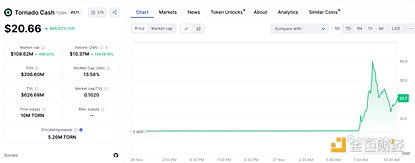
On November 26th, the decision of sanctions against Tornado Cash was overturned by the U.S. Fifth Circuit Court of Appeals. Influenced by this news, the price of Tornado Cash Token TORN soared by 486.02% in the past 24 hours, with a volume close to $10 million, a 24-hour increase of 15438.18%.
In recent years, with the rapid development of blockchain technology and Crypto Assets, the contradiction between privacy and regulation has become increasingly prominent. In this game, the Cryptocurrency mixer Tornado Cash has become one of the important targets for the U.S. government to combat illegal activities. However, the controversy over the sanctions against Tornado Cash not only concerns privacy protection, but also involves the boundaries of administrative power and legal interpretation.
Encryption Mixers and Privacy Challenges
Cryptocurrency is known for its transparent nature of transactions, where anyone with technical knowledge can track the flow of funds through the blockchain. However, this openness also brings privacy risks. Violent crimes, hacker attacks, and malicious activities targeting sensitive transactions are not uncommon, making the need for privacy increasingly urgent. As a result, cryptocurrency mixers have emerged.
Tornado Cash is a privacy service based on the ETH blockchain, which anonymizes transactions through Smart Contract technology. However, this privacy protection tool has not only attracted legitimate users, but also become a tool for criminals and hackers to launder funds. According to the US Department of the Treasury’s Office of Foreign Assets Control (OFAC), since its establishment in 2019, about $7 billion in cryptocurrency has flowed through the platform, some of which is related to criminal activities.
Legal Controversy of OFAC Sanctions
In 2022, OFAC announced sanctions on Tornado Cash, prohibiting US citizens from participating in its transactions. This sanction has sparked important legal disputes about whether the exercise of executive power has exceeded its bounds. According to the International Emergency Economic Powers Act (IEEPA), the President and authorized agencies can freeze the property and property interests of foreign entities. However, whether the nature of Tornado Cash falls within this definition has become the crux of the case.
In multiple lawsuits, plaintiffs have argued that Tornado Cash’s core technology – the immutable Smart Contract – is Open Source software code, not an entity or person, and therefore does not constitute sanctionable “property.” In addition, the lawsuit argues that OFAC’s expansive interpretation could lead to an unrestricted expansion of executive power, posing a threat to individual privacy, Open Source development, and legitimate transactions. **
The Milestone Significance of the Court’s Ruling
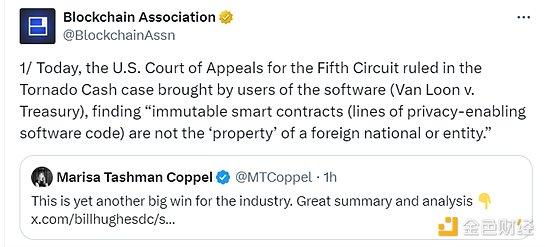
The Fifth Circuit Court of Appeals ruled that the Smart Contract of Tornado Cash is not “property of foreign nationals or entities”, and its immutable nature makes it beyond the jurisdiction of IEEPA. This ruling marks a clear boundary of government power in addressing issues related to new technologies by the judicial system.
The court pointed out that although Smart Contract technology may have adverse consequences, legislation should be led by Congress rather than resolving technological issues through expansive interpretations by administrative agencies. After the ruling, Tornado Cash’s native token TORN soared in the market, showing the encryption community’s positive response to the ruling.
The Future Balance between Regulation and Privacy
Although the court ruling temporarily gave Tornado Cash a victory, the case is not over. The government may still hold the platform responsible through other legal means, while its developers face legal challenges. Recently, Tornado Cash developer Alexey Pertsev was convicted of Money Laundering and faces up to 5 years in prison, further highlighting the tense relationship between regulatory agencies and Open Source developers.
The significance of this ruling lies not only in its direct impact on Tornado Cash, but also in its profound implications for the entire encryption industry, the Open Source technology community, and privacy protection. As a landmark case in the field of Decentralized Finance (DeFi), the Tornado Cash case will serve as an important reference for future regulation and the development of privacy technology.
Summary
The Tornado Cash case reveals the complexity of regulatory agencies in dealing with emerging technologies. The balance between privacy protection and national security requires a more detailed and clear legal framework, rather than relying on the expansion of executive power. Congress should play a more proactive role in enacting regulations that adapt to technological changes, avoiding over-enforcement or privacy infringement caused by regulatory vacuum.
For the encryption industry, this ruling reinforces the importance of privacy protection, while also reminding practitioners to pay attention to the integration of technology and law. However, Tornado Cash still faces legal challenges such as Money Laundering and financial stability, and investors should be aware of the related risks.
Privacy is a right, not a crime. In an era of continuous technological innovation, the challenge of balancing privacy and regulation is just beginning.
Disclaimer: The information on this page may come from third parties and does not represent the views or opinions of Gate. The content displayed on this page is for reference only and does not constitute any financial, investment, or legal advice. Gate does not guarantee the accuracy or completeness of the information and shall not be liable for any losses arising from the use of this information. Virtual asset investments carry high risks and are subject to significant price volatility. You may lose all of your invested principal. Please fully understand the relevant risks and make prudent decisions based on your own financial situation and risk tolerance. For details, please refer to
Disclaimer.


