Author: Alex O’Donnell, CoinTelegraph; Translation: Tao Zhu, Golden Finance
A report from Blocknative on August 20th shows that private transactions now dominate the order flow of Ethereum as users seek to protect their transactions from frontrunners’ interference.
Blocknative said that although private order flow still accounts for only about 30% of ETH transactions, it consumes more than half of the gas on the network. The report states that this shift has created a “new centralized carrier, as private transaction order flow can only be accessed by authorized network participants”.
Private orders involve sending trades directly to validators, a practice known as ‘dark pool’, rather than entering the public queue. Public trades may be front-run by automated trading ‘bots’, which profit at the expense of user interests - a practice known as maximal extractable value (MEV).
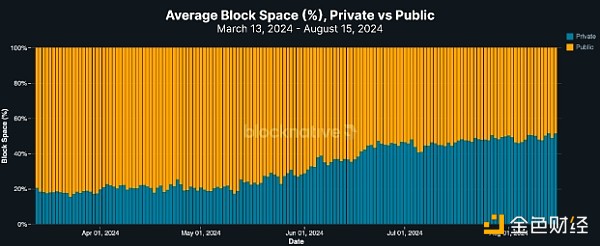
Private orders consume more than 50% of the gas on the ETH block. Source: Blocknative
Blocknative said, “To protect MEV, users often choose to transmit transactions privately, especially when conducting more complex (and therefore gas-intensive) on-chain operations (such as exchanges).” “In turn, these transactions consume more gas per transaction than non-MEV transactions.”
According to Blocknative, private order flow is mainly dominated by a few Block builders, namely Beaver, Titan, Rsync, and Flashbots, all of which have shown a significant rise in private order flow since March. The report states that during this period, the gas consumption of these Block builders has risen by 130% to 150%.
According to Blocknative, the rise of the dark pool has had a negative impact on users participating in the public transaction queue, including more unstable and unpredictable gas prices.
“When most of the Block space is occupied by transactions sent privately, the observability of the on-chain gas fees will drop,” the report said.
The report added: “This means that either you have priced the transaction too low, resulting in it getting stuck, or you have priced the transaction too high to ensure it goes through, which increases the likelihood of this happening.”
Disclaimer: The information on this page may come from third parties and does not represent the views or opinions of Gate. The content displayed on this page is for reference only and does not constitute any financial, investment, or legal advice. Gate does not guarantee the accuracy or completeness of the information and shall not be liable for any losses arising from the use of this information. Virtual asset investments carry high risks and are subject to significant price volatility. You may lose all of your invested principal. Please fully understand the relevant risks and make prudent decisions based on your own financial situation and risk tolerance. For details, please refer to
Disclaimer.


