Solana leads the NFT market recovery, and the Ethereum NFT market is expected to follow in 2024.
**Written by Gabe Parker, **Galaxy Research
Compiled by: Luccy, BlockBeats
Editor’s note: As the crypto market continues to evolve, Solana and Ethereum are engaging in a fierce competition as the main NFT ecosystem. Galaxy Research analyst Gabe Parker provides a detailed analysis of the performance of Solana and Ethereum NFTs in 2023, highlighting the rapid recovery of NFT trading activity on Solana and the challenges facing Ethereum.
Gabe Parker pointed out that Solana’s NFT market, driven by Blur and Tensor, has performed well in terms of the number of active users and transaction volume. Although Ethereum still dominates the market, it faces the challenge of declining active NFT users. As the NFT market evolves, the competition between Solana and Ethereum will continue to heat up in 2024. BlockBeats compiles the original text as follows:
Key Points
- NFT trading activity on Solana resumed 2.6 times faster than Ethereum.
- In 2023, Ethereum contributed more than 90% of weekly NFT transaction volume 67% of the time.
- As of January 8, 2024, Solana’s weekly NFT trading volume accounted for 25% of the total NFT trading volume.
- In 2023, the number of active NFT users on Ethereum dropped by 73%, while the number of active NFT users on Solana increased by more than 80%. NFT users are identified as unique addresses that mint, buy, sell or transfer NFTs within a day.
- With the increasing popularity of the advanced NFT trading platform Blur, the NFT market concentration has changed significantly in 2023. Unlike existing players such as OpenSea, Blur relies heavily on incentive programs such as token airdrops to attract users.
- In 2023, Blur accounted for 67% of the total Ethereum NFT transaction volume. Before the launch of Blur, OpenSea once accounted for more than 80% of NFT transaction volume, but only accounted for 29% of the total Ethereum NFT transaction volume in the same year.
introduce
The fourth quarter of 2023 saw a meaningful recovery in the NFT market. As of January 16, 2024, Ethereum NFT trading volume has increased 4x since their respective lows in 2023, while Solana NFT trading volume has increased more than 10x. As NFT trading volume recovers from all-time lows, the floor prices of top NFT projects on Ethereum and Solana are rising as well. This research report will highlight the resurgence of NFTs in the Solana and Ethereum ecosystems and provide insights into their growth in 2024. This report will also analyze the characteristics of incentive-driven NFT markets such as Blur and Tensor, which have been consolidating significant market share against existing NFT markets such as OpenSea.
Ethereum NFT Market
Ethereum NFT trading volume bottomed out in September 2023, hitting a monthly low of $143 million. The week of October 9 to October 16, 2023 was particularly challenging, with Ethereum NFT trading volume plummeting to just $40 million. However, there was a significant shift after October 9, 2023, when Ethereum NFT weekly trading volume surged an astonishing 380%. This sharp rise is mainly attributed to the Blur Season 2 airdrop that took place on November 20, 2023. Blur incentivizes NFT bidding, listing, and lending on its platform through the $BLUR token. Notably, NFT traders are actively involved in trading weeks before such airdrops, as evidenced by a similar trend during Blur’s Season 1 airdrop on February 14, 2023. In addition, the consequences of the airdrop triggered a wealth effect, prompting NFT traders to reinvest funds in the airdrop into NFT to maintain their points farming.
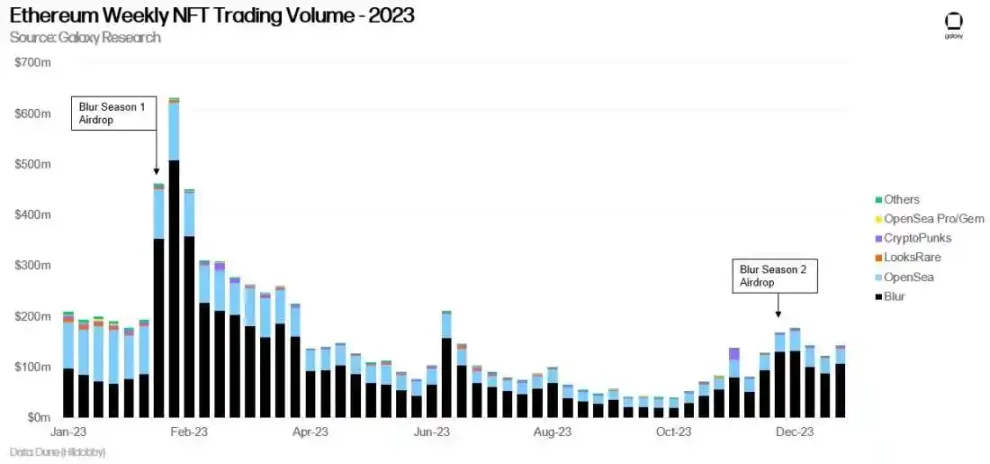
While Ethereum’s weekly NFT trading volume is up 380% from its 2023 lows, it is still down 89% from its all-time high in March 2022. Ethereum’s NFT market still has a long road to recovery. Entering 2024, the next cycle of the Ethereum NFT ecosystem will likely be driven by advanced NFT trading platforms such as Blur and Blast incentivizing trading activity through airdrops.
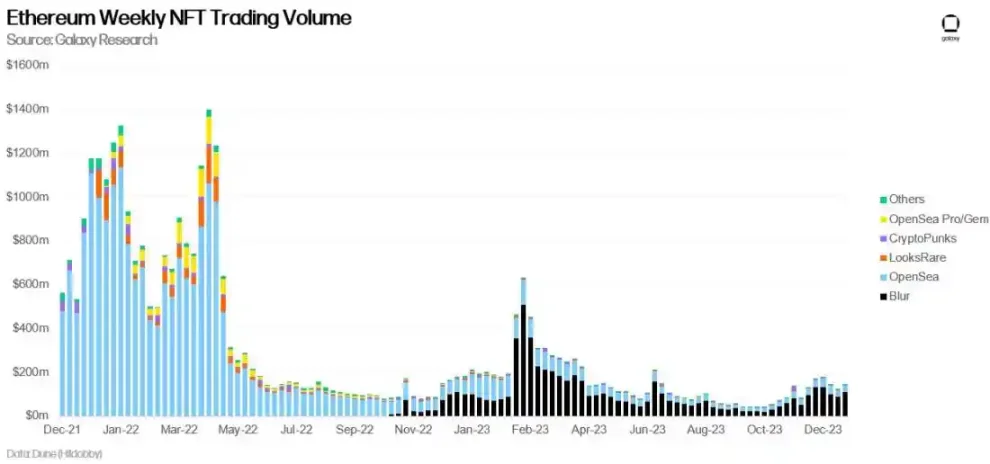
OpenSea launched a professional trading platform in April 2023 to compete with Blur; however, since September 2023, OpenSea Pro has only accounted for 9% of Ethereum NFT trading volume. Blur’s dominant position in professional NFT trading remains, mainly due to its first-mover advantage and UX/UI design. For example, Blur’s utilization of an order book system allows NFT traders to assess the depth of a project’s price floor better than any other market. This, combined with Blur’s native NFT lending platform Blend, gives NFT traders the tools to build complex trading strategies.
Looking ahead to 2024, Blur’s position is solidified with the upcoming Season 3 airdrop scheduled for May 2024. The campaign is expected to further incentivize NFT traders who have used Blur before, as 50% of the next airdrop will be distributed to existing $BLUR token holders. Blur’s strategic advantages extend beyond its first-mover status to the comprehensive ecosystem it has developed.
Blur’s proactive approach to token economics is reflected in its recent governance proposals. The proposal advocates for a community activation fee conversion that would charge a 1% market fee for purchases made using the generated funds, which are intended to be used to buy back and burn $BLUR tokens, thus reducing the $BLUR supply. While this governance proposal is currently pending, it demonstrates Blur’s continued focus on refining platform token economics to position itself as a significant player in the evolving NFT market landscape.
While the recent surge in NFT trading volume has been attributed to crypto-native users re-engaging in NFT markets such as Blur, there are still a large number of NFT traders remaining on the sidelines. Notably, the number of weekly traders on OpenSea is down 86% from its all-time high in January 2022, indicating that there are still a large number of retail users who have not yet re-entered the market. Although Blur is the most popular NFT marketplace among the cryptocurrency community, it primarily caters to a more mature and affluent group of NFT traders. Against this backdrop, monitoring OpenSea’s share of trading volume is critical to gauging the resurgence of retail interest in NFTs.
Solana NFT Market
Solana’s NFT trading volume also bottomed out in September 2023, with trading volume reaching $30 million that month. Solana NFT trading volume had its worst week from October 9 to October 16, 2023, generating only $4.3 million in trading volume. Since October 16, 2023, Solana’s weekly NFT trading volume has increased more than 10 times. The massive increase in Solana NFT’s weekly trading volume can be attributed to two main factors:
- Announcement that Tensor, Solana’s advanced NFT trading platform, is about to undergo an airdrop.
*Major repricing and extra attention on all Solana NFTs due to the massive increase in SOL tokens.
Tensor is Solana’s version of Blur, launched in 2022, where NFT traders can develop complex trading strategies. The Tensor Season 2 airdrop ends in August 2023, and the next airdrop is expected to be sometime in January 2024, so Solana NFT collectors are increasing trading activity at farm points. One of the more critical impacts driving the Solana NFT ecosystem is the wealth effect that Solana holders are experiencing. With SOL up 615% for the full year of 2023, and other Solana applications being distributed generous airdrops to the community, Solana has seen increased activity across various application types, including NFTs.
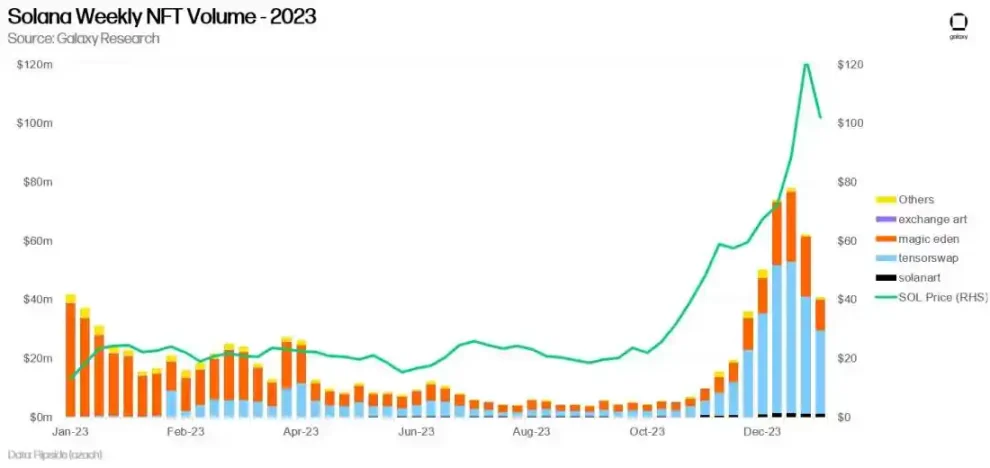
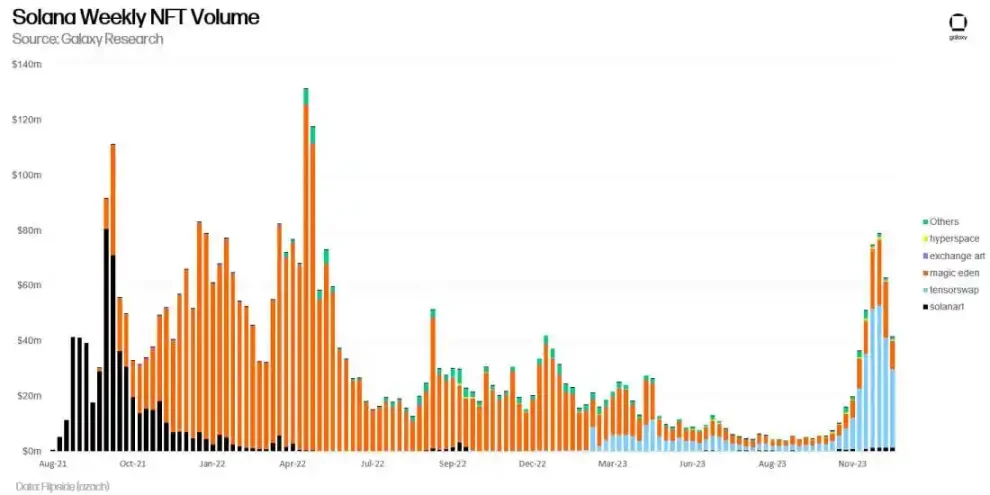
Although Solana’s NFT ecosystem is recovering faster than Ethereum, weekly Solana NFT transaction volume is still down more than 60% from its all-time high in May 2022. Like Ethereum, Solana has a strong NFT ecosystem that provides users with a cost-effective, user-friendly experience. Trade NFTs. Additionally, Solana’s NFT infrastructure is maturing rapidly, as wallets and other NFT applications have features such as displaying NFTs next to fungible tokens to better support the growth of the digital collectibles ecosystem. Overall, Solana’s next NFT market cycle, like Ethereum’s, is likely to be driven by trading activity on advanced trading platforms such as Tensor.
Market concentration
Advanced trading platforms such as Blur and Tensor have grown rapidly and accounted for a large portion of NFT trading volume on their respective chains. NFT market concentration is a mutually beneficial outcome for active NFT traders, who rely on ample liquidity to enter and exit extremely volatile assets. Blur and Tensor incentivize users to contribute liquidity to their markets by rewarding airdrops, which sellers can use to measure the market depth of a given NFT. Before Blur and Tensor, traditional NFT markets such as OpenSea used a quotation system without incentives. Buyers lack incentives to submit competitive offers, resulting in offers that are scattered and significantly lower than the NFT’s asking price.
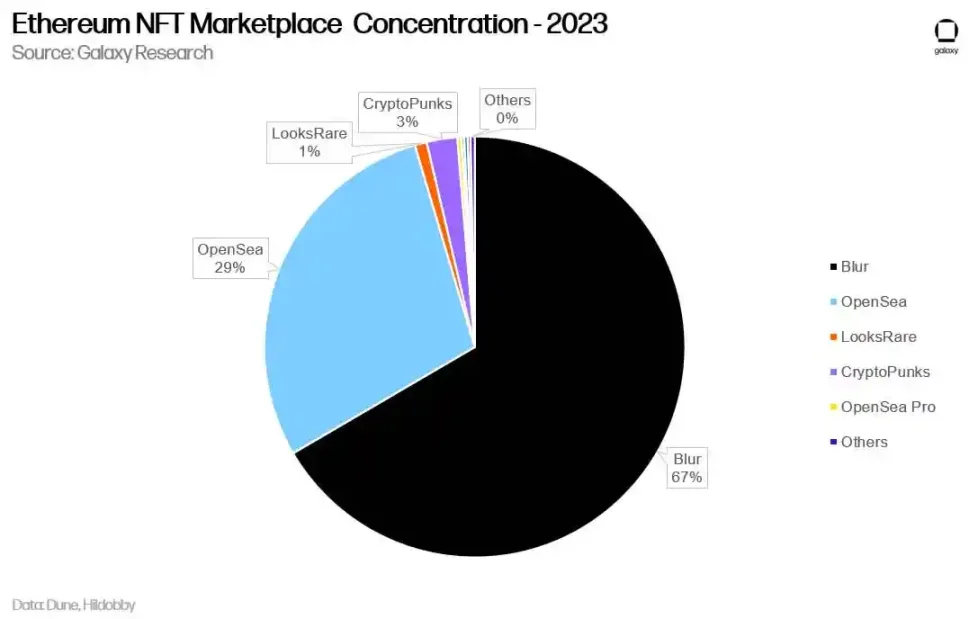
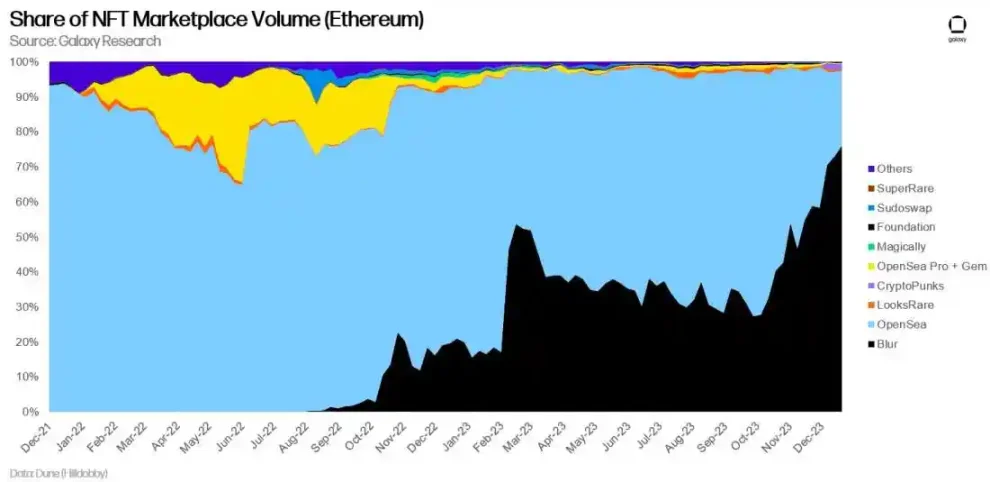
In 2023, Blur accounted for 67% of the total Ethereum NFT transaction volume. Before the launch of Blur, OpenSea once accounted for more than 80% of NFT trading volume, but currently accounts for only 29% of the total Ethereum NFT trading volume.
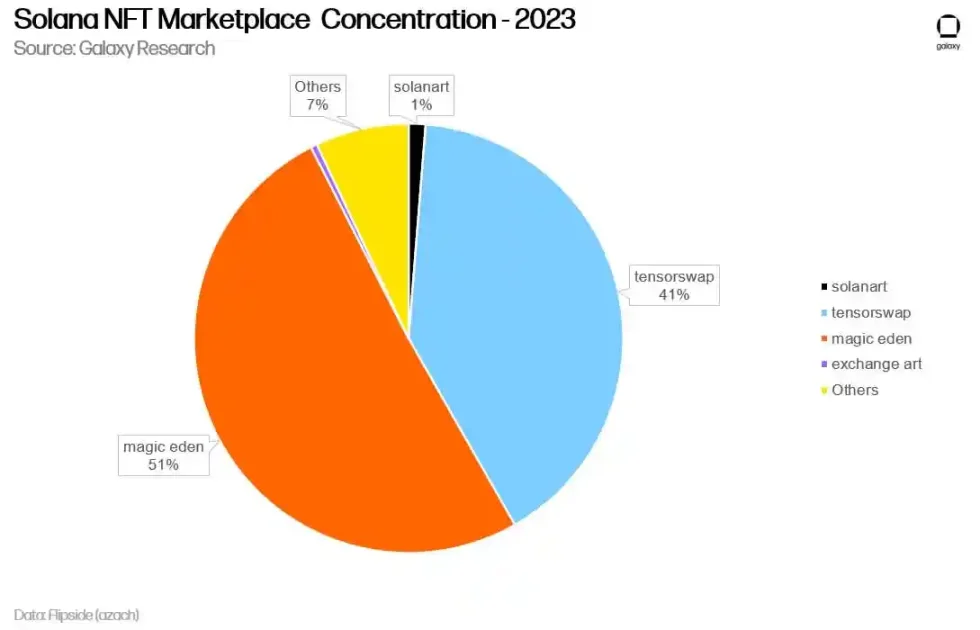
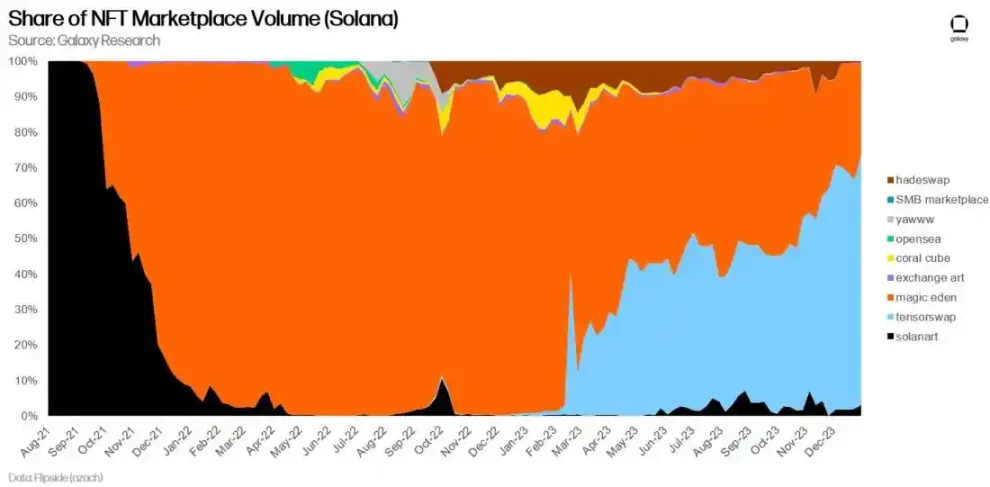
In 2023, Magic Eden dominated the Solana NFT trading space, accounting for an impressive 51% of the total trading volume. However, firmly in second place is Tensor, which accounted for 41% of Solana NFT trading volume in the same year.
Although Magic Eden is ahead of Tensor in 2023, there have been days this year when Tensor’s transaction volume exceeded Magic Eden, especially during the NFT market recovery in October 2023. From October 1, 2023 to January 1, 2024, Tensor surged ahead, with transaction volume 50% higher than Magic Eden.
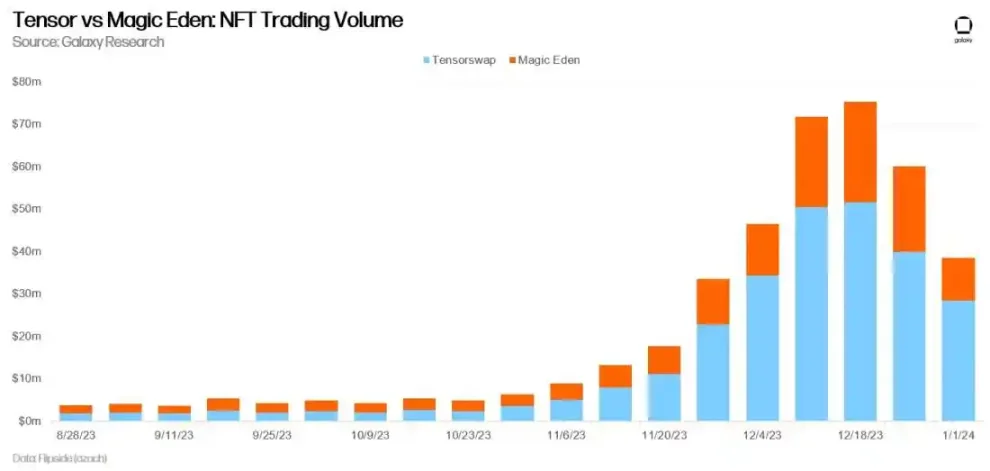
Tensor is expected to surpass Magic Eden’s market share in the NFT market in 2024 as the advanced trading platform prepares for Q3 airdrops and other incentive-driven programs to attract liquidity.
The impact of Blur and Tensor on NFT market concentration shows that advanced trading platforms are finding clear product-market fit. Although Blur and Tensor were platforms launched during a bear market, these platforms managed to capture market share from well-known traditional markets such as OpenSea and Magic Eden.
Ethereum vs Solana: Weekly NFT transaction volume and active users
In 2023, Ethereum dominated the NFT space, accounting for more than 90% of weekly NFT trading volume for 60% of the year. This metric excludes Ordinals and BRC-20 transaction volume on Bitcoin. Notably, Ordinals and BRC-20 generated $1.8 billion in transaction volume in 2023, making Bitcoin the second most popular digital collectible network during this period. This report only focuses on the NFT market of Solana and Ethereum. To learn more about Ordinals, please read this Galaxy Research report.
Between May and September 2023, Solana NFTs faced fierce competition with Ethereum NFTs for market dominance. During this period, Solana NFT trading volume accounted for less than 10% of total NFT trading volume (including Ethereum and Solana NFT trading volume). However, Solana NFT finally hit its stride in November 2023 and has quickly gained NFT trading volume market share since then. In December 2023, Solana NFT’s weekly trading volume accounted for at least 22% to 37% of the total NFT trading volume.
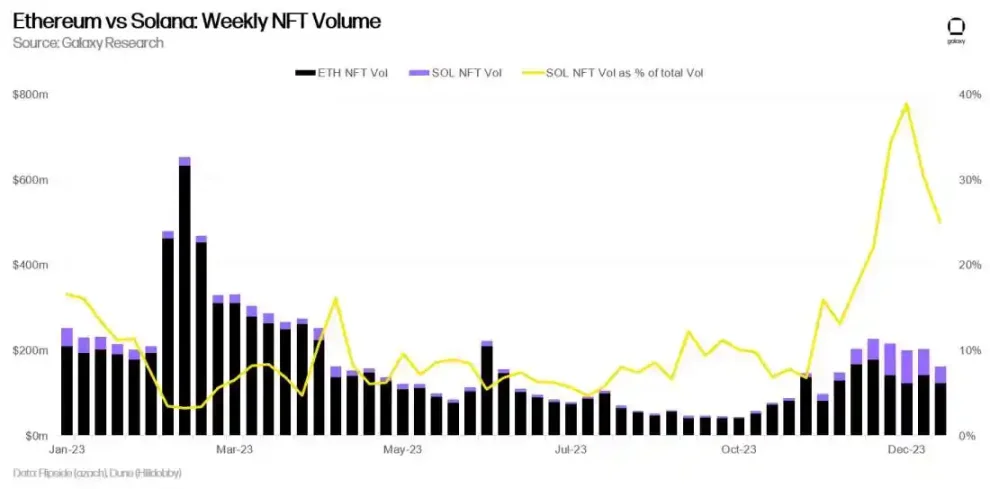
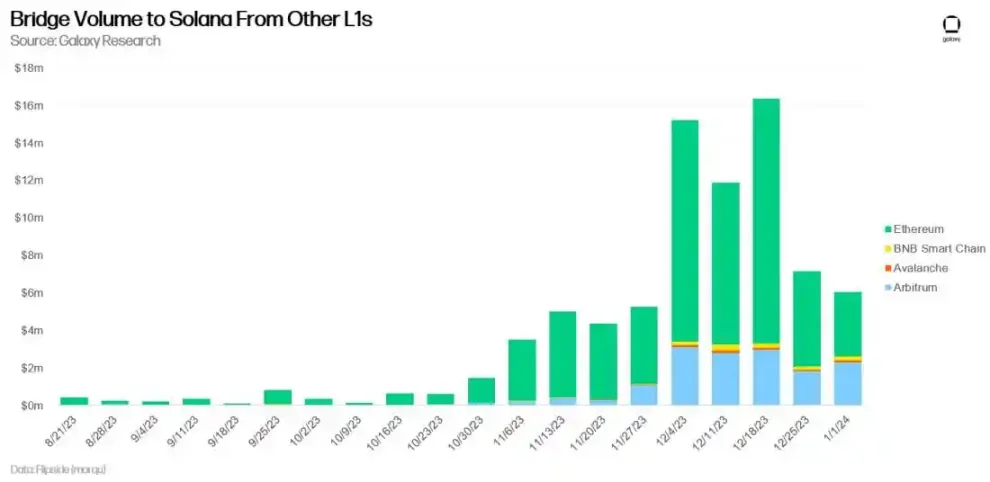
In 2024, Solana NFT transaction volume will continue to compete with Ethereum’s NFT transaction volume. Since December 1, 2023, $50.5 million has been bridged to Solana from other blockchains such as Avalanche, BNB Smart Chain, Arbitrum, and Ethereum. While new capital flowing into Solana may be driven by airdrops and yields offered by Solana’s decentralized finance (DeFi) applications, which can exit the ecosystem as soon as they enter the ecosystem if incentives change, we can expect some New capital will flow into Solana NFT. Depending on how quickly Ethereum NFT recovers, Solana NFT trading volume could reach 30%-50% of total NFT trading volume in 2024, based on the amount of new capital flowing into Solana as of December 2023.
The lack of new users in the Ethereum NFT market is evident by observing the on-chain activity of wallets buying, selling, or minting NFTs in a single day. In 2023, the number of active NFT users on Ethereum dropped by 73%, while the number of active NFT users on Solana increased by more than 200% during the same period. The number of active NFT users of Solana surged on December 19, 2023, surpassing the number of active NFT users of Ethereum. Applying a 30-day moving average to the number of active NFT users on Ethereum and Solana, we can see that Solana now has more daily active NFT users than Ethereum.
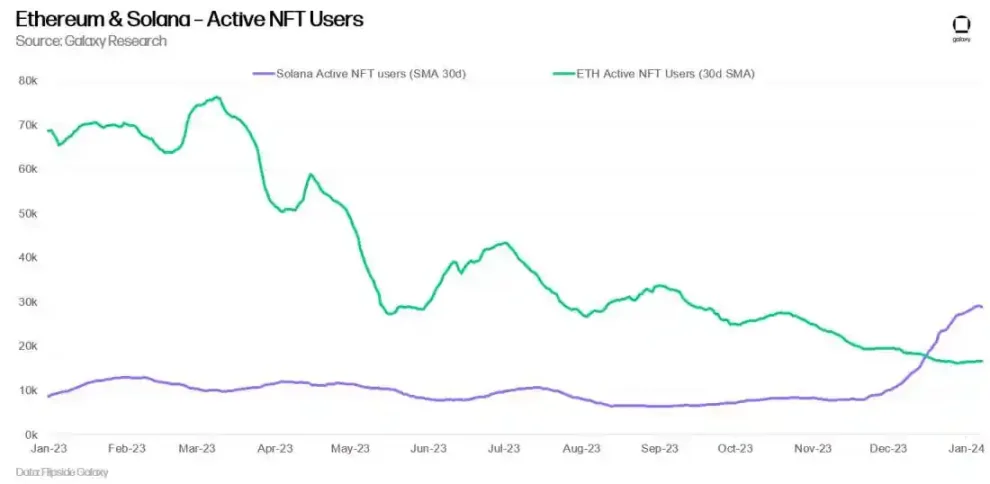
Something to note about the data in the image above is that active NFT users are identified as unique addresses that mint, buy, sell, or transfer NFTs within a day. Unique addresses may be owned by a single person or entity, and the number may be larger on Solana since the cost of transacting on the network is cheaper than on Ethereum.
in conclusion
The upcoming NFT cycle will be driven by advanced NFT trading platforms, novel airdrop incentives for NFT holders, and the wealth effects of the broader crypto market recovery. Advanced NFT trading platforms have solidified their position in the market, and as liquidity will be integrated into these types of platforms, their market dominance will continue to be between 50%-60%. Overall, with Solana’s NFT ecosystem experiencing its first repricing moment, one of the most noteworthy developments in 2024 will be the repricing of Ethereum NFTs if the price of ETH also rises significantly.


