Author: PeterG Source: X (formerly Twitter) @PeterG2100
- Bitcoin ecological assets led by Sats are the first wave, setting off the wealth myth of Fair Launch community-driven and fair wealth creation 2. BTC L2, a new infrastructure built to build the Bitcoin ecosystem, is the second wave. BTC L1 gameplay is too limited, and BTC L2 with higher performance and more scalability is needed to build an ecosystem. 3. Based on BTC L2, a large number of BTC ecological applications have begun to appear, which is the third wave. It is currently in the transition period of Phase 1-2.
This article will avoid obscure professional terms and formulas to the greatest extent, and strive to outline the whole picture of the Bitcoin Layer 2 ecosystem in an easy-to-understand way. First of all, what is BTC Layer2? And what are the success factors of a BTC Layer2 that can be landed?
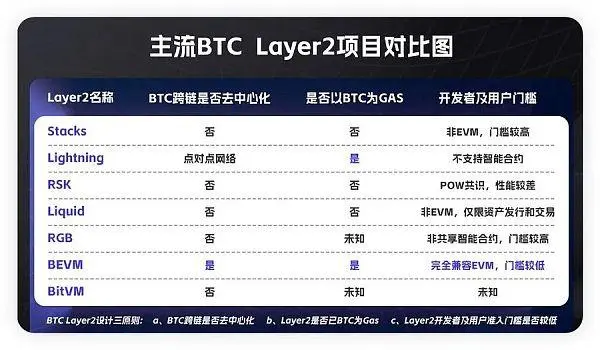
Essence and Design Principles of BTC L2
BTC L2 is essentially the same as ETH L2, the essence is decentralized cross-chain + a high-performance smart contract network, and the core significance is that high-performance scenarios and applications that cannot be achieved by L1 can be switched to L2 to be realized. Therefore, a BTC L2 that can be landed is essentially two parts: it can cross-chain BTC on Bitcoin L1 to L2 in a decentralized way, and then allow BTC to implement a series of complex smart contract application scenarios on L2
On the other hand, the mainstream L2 of ETH, whether ARB, OP or ZKsync, also follows the same design principles, and BTC L2 is no exception. Based on the above consensus, we can further conclude that a successful BTC L2 must at least follow the following design principles:
1. Whether BTC crosses the chain to L2 in a decentralized way
2. Can BTC L2 gain the consensus and support of L1 mainnet users
3. Is BTC L2 friendly enough for developers and users
1. Whether BTC crosses the chain to L2 in a decentralized way
The first step for users to use L2 is to cross assets from L1 to L2, and whether this process is decentralized and secure enough determines the asset size of L2 and directly determines the life and death of L2. Before the Taproot upgrade of Bitcoin, Bitcoin could not achieve true decentralized cross-chain, and most of the BTC running on other chains were implemented by centralized packaging or multi-signature schemes
For example, RenBTC was implemented by multisig (which was later stopped due to team problems), while WBTC relied on BitGo to endorse it. The so-called BTC L2 born before 2021 has not achieved true decentralized cross-chain, so the BTC L2 ecosystem has not grown.
However, Bitcoin’s 2021 Taproot upgrade, which brought Schnorr signatures and Musig2 aggregate signature technologies, laid the technical foundation for decentralized BTC cross-chains. **
2. Can BTC L2 gain the consensus and support of L1 mainnet users
Since L2 is an extension of L1, then L2 is based on the existence of L1, and at the same time, L2 can also feed back and gain L1, and whether the operation of the L2 network is based on the L1 mainnet token as Gas, is almost the only criterion for judging, ** If the Layer2 network only uses L1 as a data backup layer, L2’s economic system and GAS tax have no gain on L1, and it will inevitably not be able to obtain L1 support. **
This is no different from rebuilding a new L1, and the difficulty of success can be imagined. At present, the mainstream Layer 2 of the Ethereum ecosystem uses ETH as GAS, while some projects in the Bitcoin ecosystem that claim to be BTC Layer 2 do not use BTC as GAS, so they have not achieved good development.
Therefore, whether BTC Layer2 uses BTC as GAS determines whether it can gain consensus and support from the Bitcoin community. **
3. Is BTC L2 friendly enough for developers and users
The core significance of L2 is to help L1 expand applications and scenarios, so that functions that cannot be implemented in L1 can be easily and conveniently implemented in L2, so the development language and entry threshold of L2 should be as user-friendly as possible.
If the design of L2 is too complex or has too high barriers to entry for developers and users, it will be difficult for L2 to realize its true scalability
As we all know, smart contract developers in the entire Crypto field have grown and expanded in the EVM ecosystem, and according to public data, there will be about 400,000 smart contract developers worldwide in 2022, of which more than 80% are EVM developers. As a result, we see that most successful L1s and L2s are launched in an EVM-compatible way, while most L1s that do not have EVM-compatible are facing the problem of difficult ecosystem growth due to the high migration cost of developers and users
Therefore, whether it is Bitcoin Layer 2 or Ethereum Layer 2, whether it is compatible with EVM is not only a matter of choosing a development language, but a strategic issue involving whether Layer 2 can really help Layer 1 achieve ecological prosperity.
Most of the successful Ethereum L2s have chosen to be EVM-compatible, while many Bitcoin L2s have refused to be EVM-compatible by touting so-called Bitcoin fundamentalism or so-called legitimacy, and have instead adopted some niche programming languages and development environments, which is one of the important reasons why Bitcoin L2 has not been developed.
Based on the above BTC L2 design principles, let’s take stock of some of the current mainstream BTC L2 and compare the advantages and disadvantages of all parties.
Introduction to mainstream BTC L2 and the advantages and disadvantages of all parties
Stacks Stacks
Stacks Stacks is positioned as Bitcoin’s smart contract layer, with the mainnet going live in 2018. It uses a “peg” approach to achieve BTC cross-chain, which is achieved by issuing sBTC on the Stacks network, which is essentially a centralized mapping method, and its network gas uses its mainnet token STX instead of BTC, and miners participating in Stacks’ network mining will consume staked BTC to mine its network tokens
Not only will such a network design not be supported by Bitcoin users, but it will even be extremely disgusting, and its ecosystem will adopt the relatively niche Clarity as a programming language, which will greatly limit the influx of developers. Its ecosystem has been developing for 5 years, but most of the projects have received mediocre or stagnant responses, and the entire ecosystem TVL is currently less than 25 million US dollars.
Summary: According to the three principles of BTC Layer 2 design, Stacks’ Bitcoin cross-chain scheme is still a centralized method;Stacks network does not use BTC, which has almost no gain to Bitcoin Layer 1, and it is difficult to gain the support of the Bitcoin community;Its network development language Clarity is relatively niche, it is difficult to introduce developers, and the ecology has not been developed on a large scale for 5 years,Stacks has proved that the design direction of Stacks is not an ideal BTC Layer2 solution
Lightning Network
Lightning Network is the most “legitimate” Bitcoin Layer 2, its goal is to achieve Bitcoin’s “global payment”, the core is to make Bitcoin in the Lightning Network, a layer 2 network to achieve fast and convenient micropayments, however, Lightning Network does not support smart contracts, therefore, it is impossible to develop Bitcoin-related ecological applications on Lightning Network
Currently, the Lightning network has about 4,000 BTC staked. Perhaps given the success of the Ordinals protocol, the Lightning team recently proposed a Bitcoin asset issuance protocol for Taproot Assets. However, even if assets can be issued based on Taproot Assets and then quickly circulated on the Lightning Network, such a combination only provides a solution for the issuance and circulation of Bitcoin assets, and still cannot support complex applications.
Summary: Lightning Network is undoubtedly the most “legitimate” BTC Layer 2, but its network does not support smart contracts, and its goal is to expand the payment scene of Bitcoin, so it is not a typical Bitcoin Layer 2. **
**At present, Lightning Network has pledged 4,000 bitcoins, about 140 million US dollars, and although it has been in operation for 3 years, its ecological development is still in the early stage. **
RSK
RSK is positioned as a Bitcoin L2 that supports smart contracts, and it uses Hash lock to cross the mainnet BTC to the RSK network, but Hash lock is still a centralized way, and it is difficult to obtain the trust of Bitcoin users, so the number of BTC that uses RSK for cross-chain is only a handful;
Therefore, although the RSK mainnet has been launched in 2018, its ecology has hardly developed at all, and as one of the “Top Ten Heavenly King Projects” of that year, it has gradually been forgotten.
**Summary: According to the three principles of BTC Layer2 design, RSK’s cross-chain solution for Bitcoin assets is centralized, and the performance of RSK’s mainnet is poor, and the ecological development is better than nothing. As it turns out, RSK is also not an ideal BTC Layer 2 solution. **
Liquid
Liquid is a Bitcoin L2 launched by Blockstream, in essence, Liquid is a Bitcoin sidechain, Liquid services are mainly for institutions and asset issuers, providing asset issuance and circulation services based on Bitcoin sidechain for the B side, therefore, Liquid’s Bitcoin cross-chain scheme is relatively centralized, using 11 certified multi-signature nodes to host Bitcoin, Liquid’s solution is similar to a consortium permissioned chain.
Since it provides financial asset issuance services for institutions, Liquid is more concerned about security and privacy, so the Liquid network is a consortium blockchain solution that requires permissioned access. Liquid, as a B-side service-oriented Bitcoin sidechain network, has its rationale for existing. However, in order to gain the support and use of the Bitcoin community and crypto users, decentralized and permissionless BTC Layer2 is the more promising direction.
Summary: Liquid is a bitcoin sidechain for institutional services, which is essentially a permission-only consortium chain, and its service objects are mainly traditional institutions and asset issuers with high requirements for security and privacy, and the main functions of Liquid are focused on asset issuance and trading, which is not friendly to complex smart contract functions. Therefore, the scope of Liquid’s services is relatively limited, which is fundamentally different from the mainstream decentralized BTC L2
RGB
RGB is based on BTC UTXO and BTC L2 of the Lightning Network. Since RGB was proposed in 2018, it has been in a slow development stage due to several technical points that are difficult to achieve. The core design of RGB has three points: UTXO state compression and encapsulation, client verification, bridging the Lightning Network to run non-shared smart contracts, and the most respected legitimacy of RGB is that the data running on RGB will be compressed and encapsulated into every UTXO of Bitcoin. **
That is, the core data running on RGB is attached to the Bitcoin blockchain with the help of UTXO, and the Bitcoin network is used to ensure the security of assets, but this is also a function that RGB has not been able to achieve; even if this function is realized, it still faces two problems, because the client needs to trace the upstream UTXO of each asset when verifying the asset, which involves a large amount of data verification, and the more times the asset is transferred, the greater the difficulty of verification and the cost of verification;
Even if the asset can be verified, however, RGB’s smart contract does not really run on the chain, each RGB-based smart contract is not interactive, it is independent, if the two tokens issued based on RGB need to build Swap, it is not possible to directly realize Swap interaction like the assets issued on the EVM, but need to be transferred to the Lightning Network for interaction, and its complexity can be seen.
Summary: According to the three principles of BTC L2 design:
Layer 2 needs to carry the historical mission of high performance, easy development and user-friendliness, BTC Layer 2 is directly oriented to applications and users, and cannot just stop at the so-called cool design concept. At this point, the RGB architecture is undoubtedly inconsistent with the three principles of BTC Layer 2, whether it is the encapsulation of the UTXO state that has not yet been verified, the client verification, or the running of non-shared smart contracts on the Lightning Network
All of this undoubtedly brings a huge barrier to entry for developers and users on the BTC Layer2, and the user experience of building Bitcoin applications on such a Layer2 can be imagined. Since it was proposed in 2018, the progress of RGB development has been slow, which in a certain way also reflects the high complexity of RGB and the difficulty of its implementation, which can also be imagined for its future ecological developers and users.
BEVM
**@BTClayer2 Bitcoin L2 with BTC as GAS and EVM compatible. **The core design of BEVM is based on the BTC Taproot upgrade in 2021, using Musig2 aggregate signatures to achieve decentralized BTC cross-chain, and the Musig2 aggregate signature algorithm is brought by the Taproot upgrade, which can allow 1000 Bitcoin light nodes to form a decentralized asset network, through which the transfer of BTC assets can be processed, so as to ensure the security of assets on BTC L2
The most important thing is that BEVM is fully compatible with EVM, and applications such as DeFi and GameFi that can run in the EVM ecosystem can be seamlessly migrated to Bitcoin Layer 2, and users can directly use BEVM ecological applications in mainstream crypto wallets (such as Metamask, OK Wallet, etc.). In the future, BEVM will also be compatible with more non-EVM Layer 1 networks
In this way, BTC and BTC on-chain assets can be expanded to any chain and the Bitcoin ecosystem will be expanded to the greatest extent. At present, the BEVM pioneer network has been launched, and there are nearly 10 applications in the ecosystem, for example, users can use the fully decentralized BTC DEX on BEVM, and users can deposit BTC/Sats and other assets as LPs to enjoy DEX returns.
Summary: BEVM uses Musig2 aggregate signatures to realize the decentralized cross-chain of BTC, uses BTC as GAS to obtain the consensus and support of the Bitcoin community, and is compatible with EVM, which can lower the entry threshold for smart contract developers and users, so it is more practical and in line with the three principles of BTC Layer2 design. However, unlike many BTC Layer 2s that preach the legitimacy of Bitcoin, BEVM seems to be less “legitimate”. BEVM does not improve the design of UTXOs with limited capacity in the block space or limited functions of Bitcoin, but chooses to directly introduce BTC into the mature EVM network in a decentralized way, thereby reducing the difficulty of expanding the Bitcoin ecosystem, which is the design highlight of BEVM, and at the same time, it will also be labeled as not “orthodox” enough by some Bitcoin fundamentalists. However, in the BTC Layer 2 track, whether “legitimacy” is more important, or whether the developer and user experience are more important, I believe the market will give the final answer.
BitVM
BitVM is a BTC L2 solution that was proposed in 2023 and is still in the theoretical stage. The most discussed version of BitVM is its more “hardcore” technical implementation. The core logic is to run a fraud proof similar to optimistic rollups on the BTC script, the so-called fraud proof, that is, when an asset transaction is disputed, the user can initiate a report, and if the transaction is really wrong, the asset of the dishonest party
It will be confiscated, and the effective reporting time is generally within 7 days (similar to 7 days for unconditional returns), however, if the user initiates a report after 7 days, it is invalid, even if there is a problem with the asset transaction, it will be automatically saved on the blockchain and continue to run. BitVM’s smart contract layer runs off-chain, and each smart contract does not share state, and BTC cross-chain uses traditional hash locks for asset pegging, without realizing a truly decentralized BTC cross-chain
Summary: The design highlight of BitVM is to abstract the complex smart contracts under the chain into fraud proofs, and let this fraud proof run on the Bitcoin blockchain in the form of Bitcoin opcode.
Since the testable network has not yet been released, it is not known in which language it will be developed in, and given that its biggest design highlights are still in the theoretical stage, we are in a state of observation for BitVM.
Summary
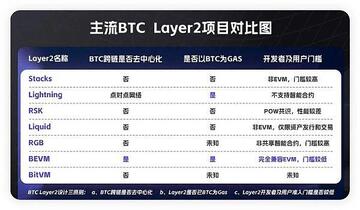
Since the Bitcoin blockchain is non-Turing-complete and does not support smart contracts, there have been entrepreneurial teams exploring Bitcoin L2 for many years. The essence of BTC L2 is to break BTC out of the shackles of L1 in a decentralized way, so that BTC can realize all complex application scenarios on high-performance and high-scalability L2. Therefore, a good Bitcoin L2 should follow some of the most basic design principles
For example, whether to cross-chain BTC to L2 in a decentralized way determines the market size and value cap of L2, whether BTC is used as GAS, which determines whether L2 can be recognized and supported by the Bitcoin community, and whether the development language and infrastructure are friendly enough for developers and users, which determines whether the L2 ecosystem can grow rapidly.
Through the inventory of the current mainstream BTC L2 project, we can roughly figure out the evolution path and development trend of Bitcoin Layer 2, the BTC Layer 2 track, naturally carrying the mission of expanding the Bitcoin ecosystem, we have reason to believe that BTC Layer 2, which can obtain the support of the Bitcoin community, can obtain the trust of Bitcoin users, and is friendly enough to developers and users, will surely achieve excellent results in this round of Bitcoin ecological wave.


