
On March 11, Bitcoin’s price remained stable around $70,000, driven by three synchronized catalysts: U.S. President Trump declared that the military conflict with Iran is “almost completely over,” causing crude oil prices to plummet by over 28%; the U.S. spot Bitcoin ETF saw approximately $167 million in inflows on Monday, ending two consecutive days of outflows; MicroStrategy purchased an additional 17,994 Bitcoins, spending about $1.28 billion.
Geopolitical Cooling: Oil Price Collapse Releases Risk Appetite Pressure
The core driver behind Bitcoin’s rebound is the rapid reversal of global macro sentiment. Oil prices recently surged to $119 per barrel amid Middle East conflicts. After Trump announced the conflict was winding down, WTI crude oil intraday plunged over 28%, eventually settling near $80.
The collapse in oil prices has a chain reaction: reducing inflation rebound expectations, diminishing the Federal Reserve’s reasons to maintain tightening policies, and creating a more favorable liquidity environment for stocks and digital assets. This transmission explains the fundamental reason for Bitcoin’s rise today—investors shifted from a “energy crisis panic mode” to a “risk appetite recovery mode,” with Bitcoin as a high Beta asset benefiting first.
It’s important to note that Trump’s remarks do not mean geopolitical risks are fully eliminated. He also warned that if oil supplies are disrupted, Iran could face harsher U.S. sanctions, implying that oil prices and market sentiment could quickly reverse depending on developments.
Institutional Capital Flows: ETF Reflows and Seiler’s Heavy Buying Signal
Monday’s U.S. spot Bitcoin ETF inflow provides a key institutional confirmation: approximately $167 million in net inflows, ending two consecutive days of outflows. This shift occurred during a window when oil prices started declining and market sentiment was beginning to improve, indicating institutional investors quickly seized the macro environment’s positive turn.
In contrast, ETFs related to Ethereum, Ripple, and Solana experienced outflows for the third consecutive trading day, reflecting a capital rotation from high-risk altcoins to market leaders like Bitcoin.
MicroStrategy’s latest disclosure further reinforces this trend. During Bitcoin’s price decline from March 2 to 8, the company purchased 17,994 Bitcoins at a total cost of about $1.28 billion, with an average price of approximately $71,100 per Bitcoin. This “buying the dip” strategy signals a clear long-term holding stance, anchoring market sentiment.
Technical Analysis: Is $71,000 a Foundation or a Breakout Point?
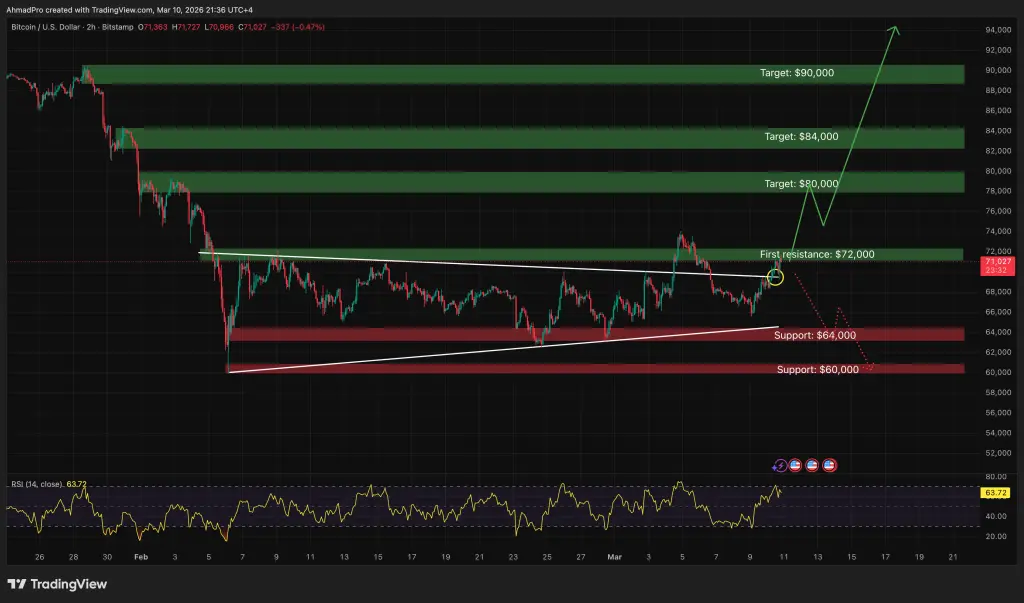
(Source: TradingView)
From a technical perspective, Bitcoin is currently testing real resistance around $71,000:
- Key Resistance: $72,000 — if a daily close above this level is achieved and it turns into support, it could open the door to breaking the six-figure mark.
- Key Support: $65,000 — if broken, the market may need to undergo a correction before a genuine upward trend resumes.
- “Rainbow Chart” Indicator: Technical signals suggest pressure may persist until the end of March, with prices testing lower support levels before the next rally.
- Long-term Targets: Institutional analysts’ cyclical forecasts range between $110,000 and $170,000, contingent on continued macro trends.
Spot buyers are actively absorbing supply, but derivatives traders remain cautious, creating a structural divergence between short-term momentum and long-term expectations.
FAQs
Why did Bitcoin rise today, and is it directly related to oil prices?
Yes, the immediate trigger for this rebound was the collapse in oil prices. Falling oil reduces inflation fears and lessens market expectations for the Fed to keep interest rates high, benefiting risk assets overall. As a high-volatility risk asset, Bitcoin tends to react first in such macroeconomic improvements.
What is the significance of MicroStrategy buying 17,994 Bitcoins?
MicroStrategy’s large purchase has a dual significance: quantitatively, it absorbs a substantial supply of nearly 18,000 Bitcoins from the market; qualitatively, their strategic accumulation during a price dip signals strong long-term confidence, supporting market sentiment among retail and institutional investors.
Can Bitcoin retake $72,000 within this month?
Technical analysis shows the “Rainbow Chart” still indicates resistance until the end of March. The $72,000 level is a genuine resistance zone, not easily broken. If Iran’s situation continues to cool as Trump suggests, oil prices stay low, and ETF inflows persist, breaking $72,000 is possible. However, if geopolitical tensions escalate again, the previous rally could quickly reverse.
Disclaimer: The information on this page may come from third parties and does not represent the views or opinions of Gate. The content displayed on this page is for reference only and does not constitute any financial, investment, or legal advice. Gate does not guarantee the accuracy or completeness of the information and shall not be liable for any losses arising from the use of this information. Virtual asset investments carry high risks and are subject to significant price volatility. You may lose all of your invested principal. Please fully understand the relevant risks and make prudent decisions based on your own financial situation and risk tolerance. For details, please refer to
Disclaimer.


