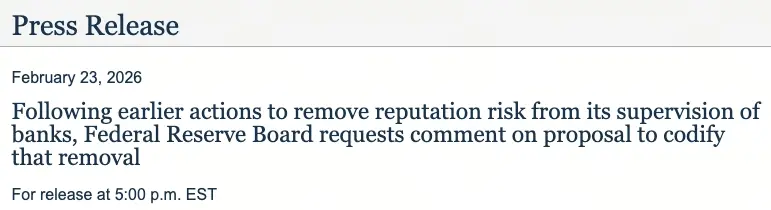
The Federal Reserve Board officially launched a 60-day public comment period on February 24 for a proposal aimed at explicitly removing “Reputational Risk” from the bank supervision and examination framework through regulation, starting from the publication of the proposal in the Federal Register. Bitcoin Magazine noted that if the proposal is formally approved, it could significantly alleviate the long-standing de-banking regulatory pressures faced by crypto companies.
Background of the Proposal: “Reputational Risk” as a Regulatory Controversy
(Source: Federal Reserve)
“Reputational Risk” was originally an assessment indicator within the banking supervision framework, referring to the potential loss a institution might suffer due to negative public perception. However, in practice, this concept has been criticized for lacking clear financial quantification standards, becoming highly subjective, and potentially serving as a tool for regulators to pressure financial institutions.
Bowman explicitly stated in a declaration that refusing to provide financial services based on clients’ political stance, religious beliefs, or legal business activities constitutes illegal behavior and does not align with the Federal Reserve’s regulatory framework. The Federal Reserve Board announced in June 2025 that “Reputational Risk” would no longer be included in routine bank examinations. The purpose of this proposal is to formalize that declaration into regulation, giving it greater legal authority.
Core Content of the Proposal and Its Impact on Crypto Industry Regulation
The main focus of this proposal is to shift the supervisory emphasis from subjective reputation judgments to quantifiable substantive financial risk indicators, reaffirming that financial institutions cannot deny or terminate services based solely on clients’ legal activities.
Three Key Points of the Proposal
-
Official Removal of “Reputational Risk” Clause: Legally eliminate reputational risk as a basis for bank supervision and examination.
-
Protection of Legal Business Financial Services: Clearly prohibit de-banking based on clients’ lawful activities.
-
Enhancement of Regulatory Transparency: Ensure regulatory actions are based on actual financial risks, strengthening predictability and consistency of rules.
The proposal also clarifies that this change does not alter the Federal Reserve’s existing expectations for banks to maintain sound risk management and compliance; the scope of adjustment is limited to the definition and application boundaries of “Reputational Risk.”
For the cryptocurrency industry, this proposal has direct practical implications. In recent years, many crypto firms have reported accounts being closed without cause by banks, a phenomenon widely believed to be related to regulatory pressure using the “Reputational Risk” framework. If the proposal is enacted into law, the regulatory basis for de-banking crypto companies will be explicitly regulated by law.
Frequently Asked Questions
What is “Reputational Risk,” and why has it become a regulatory controversy?
Reputational Risk refers to the potential loss a financial institution might suffer due to negative public perception. In banking regulation, this concept has been criticized for lacking objective quantification standards and is suspected of being used selectively against certain client groups (including crypto firms), without clear financial risk justification.
What is “de-banking,” and what specific impact does it have on the crypto industry?
De-banking refers to banks terminating or refusing to provide financial services to specific clients. The crypto industry has long been troubled by this, with many exchanges and blockchain companies reporting unexpected account closures, affecting daily operations—especially during the tighter regulatory environment of 2022 to 2023.
When will this proposal take effect, and how can the public submit comments?
The proposal is open for a 60-day comment period starting from its publication in the Federal Register. During this time, the public can submit written comments to the Federal Reserve Board. Whether the proposal is ultimately enacted into law will depend on the feedback received and subsequent legislative procedures.
Disclaimer: The information on this page may come from third parties and does not represent the views or opinions of Gate. The content displayed on this page is for reference only and does not constitute any financial, investment, or legal advice. Gate does not guarantee the accuracy or completeness of the information and shall not be liable for any losses arising from the use of this information. Virtual asset investments carry high risks and are subject to significant price volatility. You may lose all of your invested principal. Please fully understand the relevant risks and make prudent decisions based on your own financial situation and risk tolerance. For details, please refer to
Disclaimer.
Related Articles
BTC异动分析
# BTC 2026年3月10日00:15-00:30(UTC)价格异动深度归因报告
## 一、概述
2026年3月10日00:15至00:30(UTC)期间,比特币(BTC)价格出现明显异动,收益率达+0.82%。本报告将基于链上数据、市场行情、宏观环境、资金流向、衍生品市场、网络舆情等多维度,系统分析该时段BTC价格异动的可能原因,并进行深度归因。
## 二、行情回顾与数据概览
###
GateNews2m ago
Bitcoin vs Gold: ETF Flows Signal Early Capital Rotation
Bitcoin ETF flows have shifted into positive territory over the last 30 days, even as gold ETF demand shows signs of fatigue after a prolonged rally. In the latest data pulse, bitcoin-focused funds logged a net inflow of $273 million on March 6 after a $1.9 billion outflow in February, while GLD—the
CryptoBreaking5m ago
The orbital data center company will begin mining Bitcoin in space
Starcloud – An orbit data center startup backed by Nvidia – will become the first company to mine Bitcoin from space when their second spacecraft is launched later this year. This is
TapChiBitcoin11m ago
Bitcoin funding rates hit a three-month low, are the bears "jumping the gun" before the non-farm payroll data?
This article analyzes the dynamics of the Bitcoin derivatives market, pointing out that before macroeconomic data releases, the market shows downward risks through funding rates, open interest, and liquidation data. Negative funding rates, high open interest, and the subsequent employment report collectively influence market direction, revealing how the derivatives market quickly reflects macro pressures and trader sentiment.
PANews27m ago
Crypto Market Review: Is Bitcoin (BTC) Bull Mode Switched On? XRP Looks Hopeless at $1, Solana (SOL) Heads to $95 in Surprising Mini-Bull Run - U.Today
Bitcoin sees structural change
Why $70,000 was important
Solana wakes up again
What fueled demand?
XRP under control
Bitcoin is showing early signs that momentum may be shifting back in favor of buyers. XRP is moving in an extremely dull sideways trend, while Solana is heading upwards for
UToday29m ago


