


Trump Family Stablecoin USD1 Suddenly Loses Peg! WLFI Claims It Was a Coordinated Attack

On February 23, the stablecoin USD1, issued by World Liberty Financial (WLFI), a DeFi project associated with the Trump family, temporarily lost its dollar peg, dropping briefly to $0.994 before quickly rebounding. WLFI characterized the incident as a hacker-led “coordinated attack,” but rumors of Eric Trump deleting posts and an undisclosed insider trading investigation suggest the turmoil is far from over.
Complete Timeline of the USD1 Depegging Event
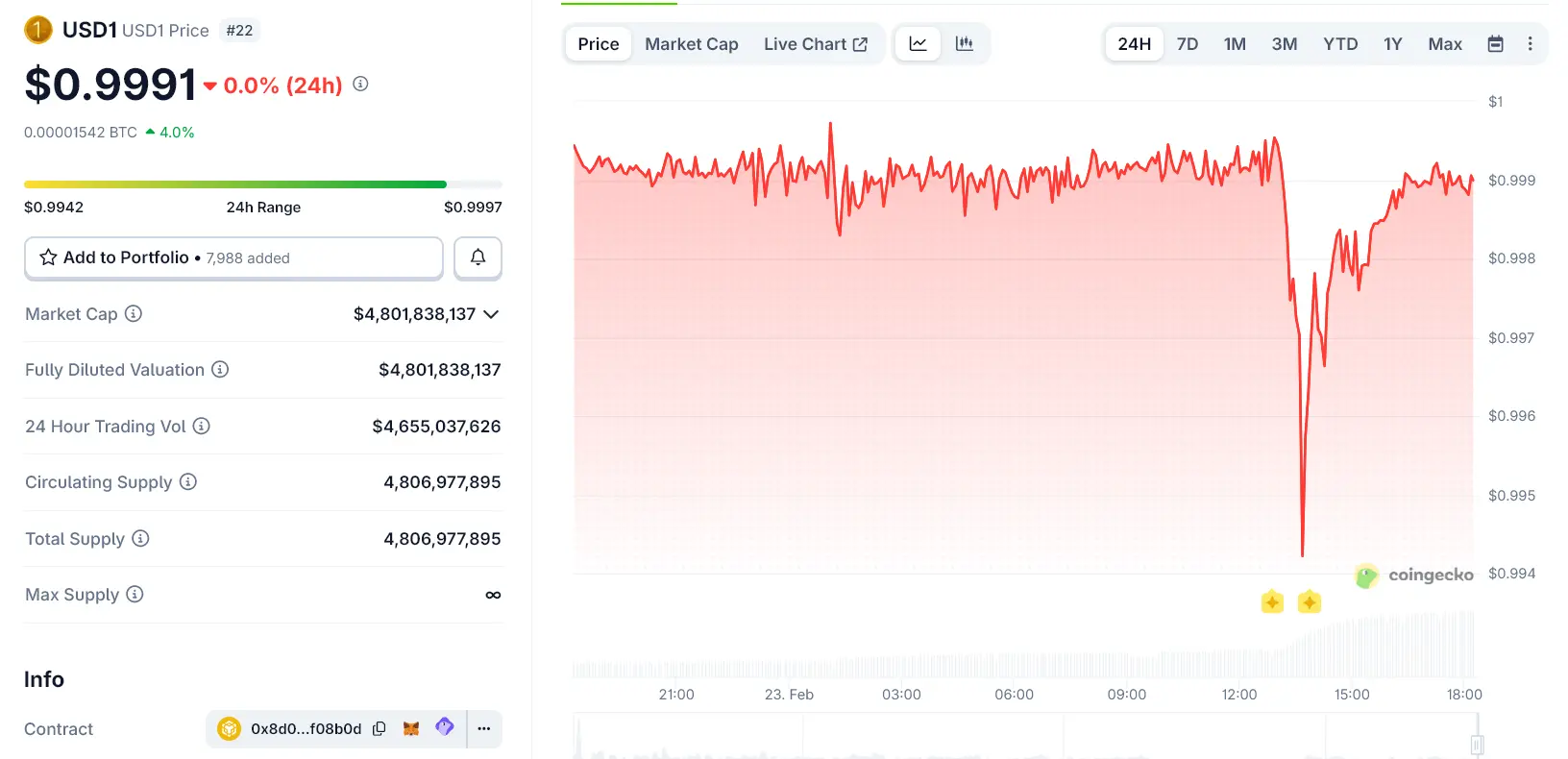
On February 23, USD1 fell below its $1 peg within minutes, reaching a low of $0.994, then rapidly recovered to parity. Although the decline was less than 1%, for an asset claiming a 1:1 peg with the dollar, any deviation is enough to trigger market alarm.
After the news broke, panic spread quickly on social media, with some users comparing this depegging to early warning signs before the TerraUSD collapse in 2022, further fueling market anxiety.
WLFI issued an official statement within hours, attributing the incident to an organized external attack, emphasizing that the infrastructure remained fully operational, and successfully handled a large volume of redemption requests within 24 hours.
Four Key Allegations in WLFI’s Statement
Account Compromise: Attackers infiltrated several co-founders’ social media accounts.
Fake Information Campaign: Stolen accounts spread false content targeting USD1, intentionally inciting panic.
Pre-planned Short Positioning: Attackers established short positions beforehand, aiming to profit from panic selling.
System Stability Maintained: WLFI stressed that the redemption mechanism and core infrastructure were unaffected throughout the incident.
Lingering Doubts: Rumors of Post Deletion and Insider Investigation
The official statement did not fully dispel external suspicions. Screenshots circulated on social media claimed that Eric Trump deleted related promotional posts during the USD1 depegging. However, no independent verification has confirmed this, and the authenticity remains questionable.
Adding to market unease, blockchain investigator ZachXBT publicly announced he would release a report later this week on insider trading involving major crypto firms, but he deliberately did not specify the targets. Some social media users immediately pointed fingers at WLFI, though no direct evidence has emerged.
These two unverified narratives have led to fundamental disagreements about the nature of the incident—was it a successful external attack repelled, or an internal crisis deliberately spun? The truth may become clearer once ZachXBT’s report is published.
USD1 and TerraUSD: Similar Appearances, Fundamental Differences
In the face of market panic, clarifying the core differences between USD1 and TerraUSD is crucial. TerraUSD relies on an algorithmic arbitrage mechanism to maintain its peg, with stability built on market confidence in the LUNA token. Once confidence collapses, it triggers an unstoppable “death spiral.”
USD1 claims to use a 1:1 full-reserve backing model, supported by actual assets, and theoretically its redemption mechanism does not depend on market sentiment. The quick rebound from the depegging incident partly demonstrates the effectiveness of its liquidity mechanism.
However, the lifeline of any stablecoin is ultimately market trust, not just technical architecture. WLFI has not disclosed technical details of the attack, and subsequent investigation disclosures over the coming days will determine whether USD1 can maintain the trust underpinning its $4.8 billion market cap.
Related Articles
Solana staking business expansion drives SOL Strategies stock price up more than 20% in a single day, with nearly 700,000 SOL locked on the STKESOL platform
Spot and derivatives trading volumes have long ranked among the top three globally.
The top account in Coincoin's real trading profits is currently long on $30.31 million worth of ETH and BTC.
Overview of popular cryptocurrencies on March 5, 2026, with the top three in popularity being: Bitcoin, Ethereum, XRP
PI (Pi) increased by 7.51% in the past 24 hours