
Former Olympic athlete Ryan Wedding involved in transnational drug trafficking and apprehended in Mexico, authorities reveal extensive use of stablecoins and multi-chain laundering, highlighting new challenges in cryptocurrency regulation.
Former Olympian turns into transnational drug lord, US-Mexico cooperation completes arrest
U.S. law enforcement agencies recently announced that a suspect listed among the Federal Bureau of Investigation’s Top Ten Most Wanted has been captured in Mexico. 44-year-old Ryan Wedding, who represented Canada in the 2002 Salt Lake City Winter Olympics snowboarding event, is now accused of being a core member of a cocaine smuggling group spanning Colombia, Mexico, the United States, and Canada.
The U.S. Department of Justice stated that Wedding had been hiding in Mexico for a long time and was arrested with the assistance of local law enforcement. He has been extradited to the U.S. for trial. U.S. Attorney General Pamela Bondi described the case as “a fall from Olympic athlete to suspected violent drug kingpin,” emphasizing its significance for North American and global security.
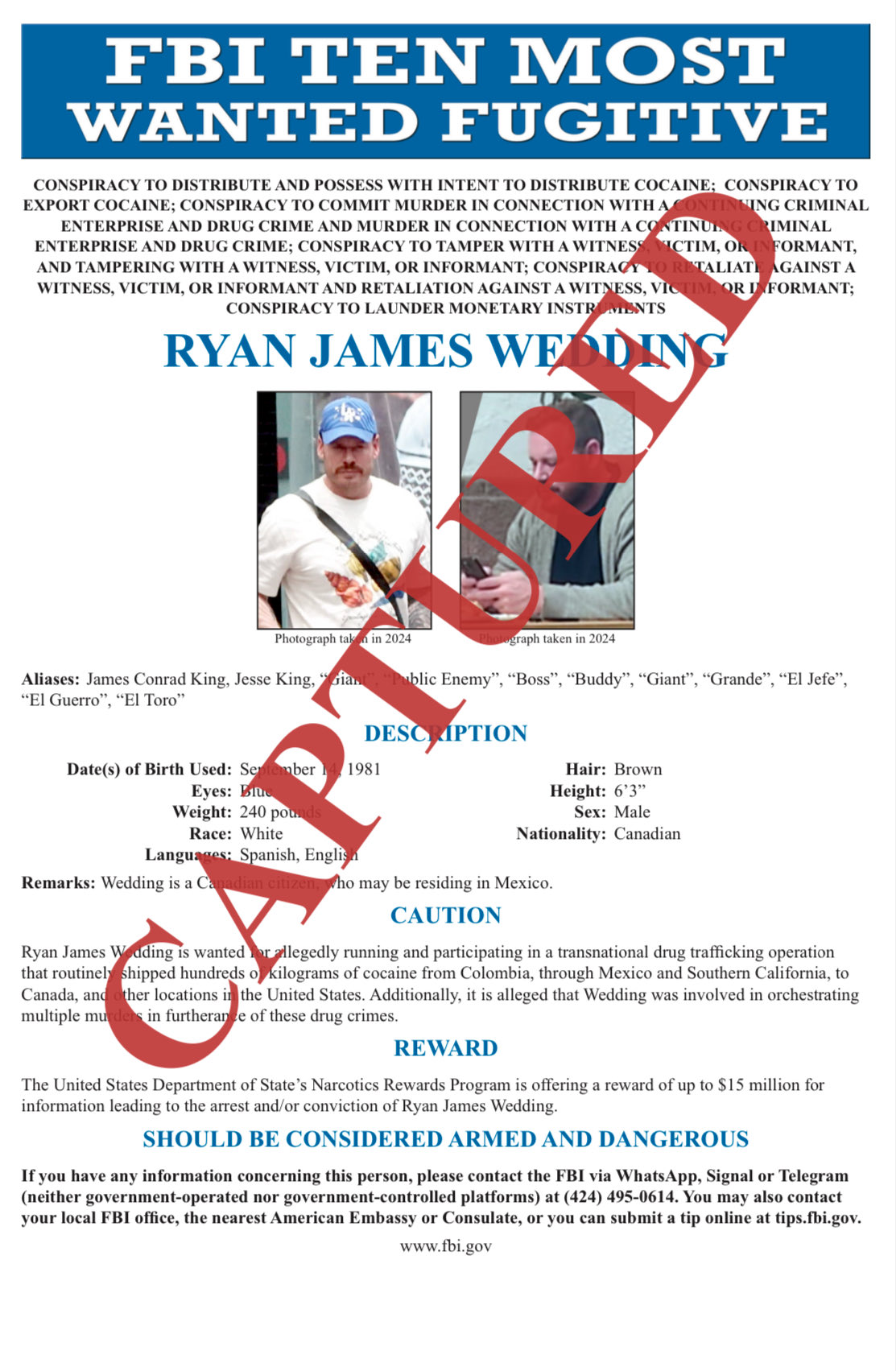
Image source: X/@FBIDirectorKash The U.S. Department of Justice announced that Ryan Wedding, one of the Top Ten Most Wanted, has been apprehended in Mexico.
Highly encrypted drug money flow, stablecoins become transaction tools
Investigations show that Wedding’s organization extensively used Bitcoin and stablecoins for drug transactions and money laundering, deliberately avoiding traditional financial regulation. The U.S. Treasury Department has placed Wedding and related individuals on sanctions lists in November 2024, directly accusing the group of “using cryptocurrency networks to transfer and conceal large amounts of illegal proceeds.”
The indictment states that members of the drug trafficking group received drug payments via QR codes using $USDT and transferred funds across multiple blockchains to obfuscate the source. The flow of funds spans major chains such as Bitcoin, Ethereum, Tron, Solana, and BNB Chain, demonstrating a highly sophisticated and large-scale money laundering architecture.
Sanctions and seizure operations underway, crypto assets as key evidence
Prior to the arrest, U.S. law enforcement had launched multiple strikes against Wedding’s criminal network. By the end of 2024, they seized approximately 1 ton of cocaine, crypto assets valued at about $3.2 million, and multiple firearms. Several front companies, including a Toronto jewelry firm accused of aiding money laundering, were also targeted.
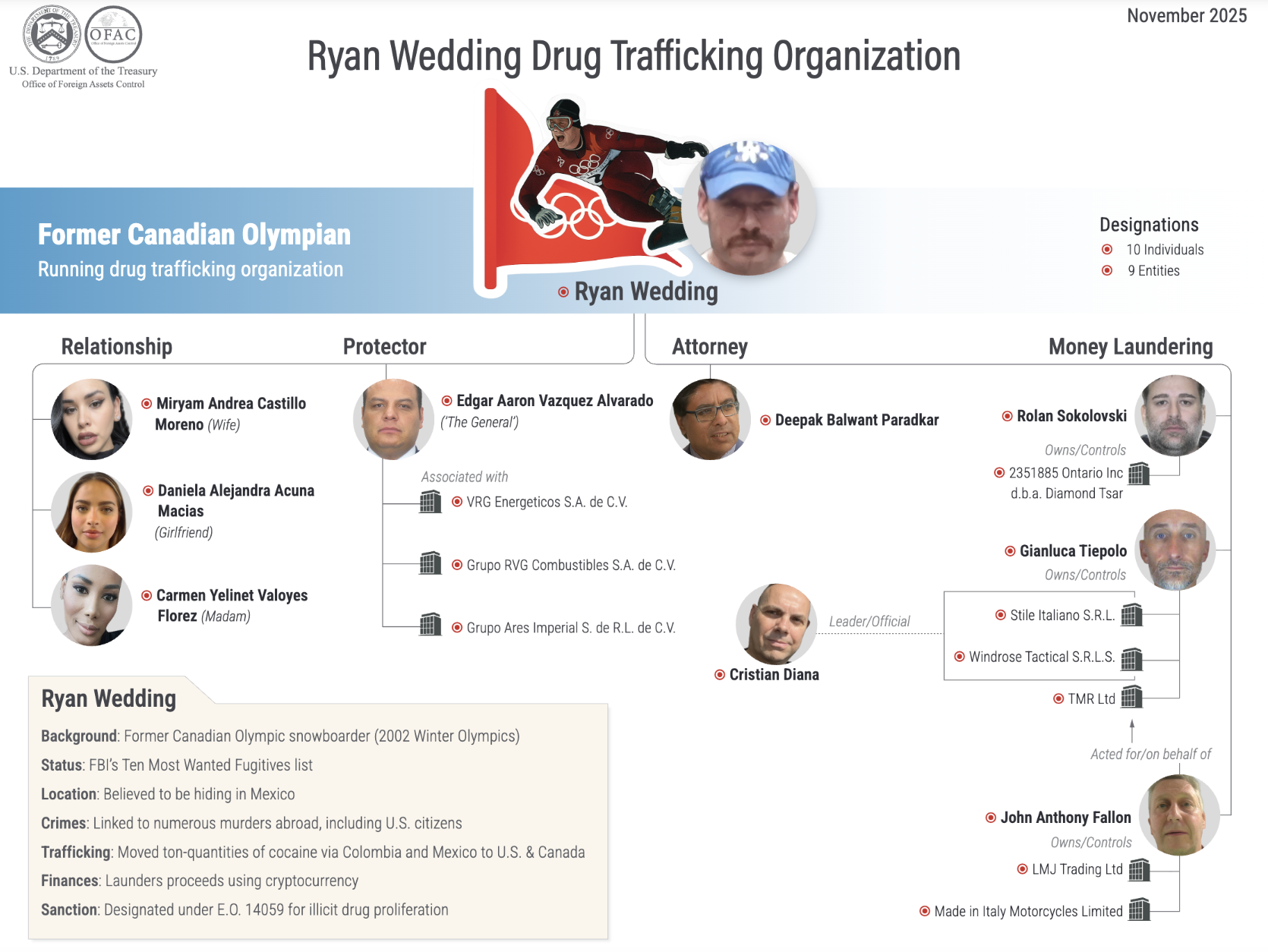
Image source: U.S. Department of the Treasury Office of Foreign Assets Control Ryan Wedding drug trafficking organization structure diagram
The U.S. Department of the Treasury also released over a dozen crypto wallet addresses associated with Wedding and his accomplices, aiming to cut off their ability to transfer funds via blockchain. Law enforcement officials pointed out that this “multi-chain money laundering model” is gradually becoming standard for large transnational criminal organizations, forcing regulators to enhance on-chain tracking and international cooperation capabilities.
Violence and political signals, case sparks crypto regulation debate
In addition to drug and money laundering charges, Wedding is also accused of inciting multiple violent crimes, including ordering the murder of a federal witness cooperating with investigations in Colombia in January 2025, and retaliatory shootings related to stolen drugs. U.S. prosecutors have filed additional charges under the “Continuing Criminal Enterprise” statute, with the maximum penalty potentially including life imprisonment.
This case has reignited discussions about the misuse of cryptocurrencies by criminal organizations. U.S. officials emphasize that the case does not discredit blockchain technology itself but highlights the regulatory challenges posed by anonymity and decentralization in cross-border crime scenarios. With Wedding’s successful capture, law enforcement signals that even with the use of crypto assets and multi-national cover-ups, transnational crime remains difficult to evade long-term investigation and judicial sanctions.
Disclaimer: The information on this page may come from third parties and does not represent the views or opinions of Gate. The content displayed on this page is for reference only and does not constitute any financial, investment, or legal advice. Gate does not guarantee the accuracy or completeness of the information and shall not be liable for any losses arising from the use of this information. Virtual asset investments carry high risks and are subject to significant price volatility. You may lose all of your invested principal. Please fully understand the relevant risks and make prudent decisions based on your own financial situation and risk tolerance. For details, please refer to
Disclaimer.
Related Articles
The U.S. Department of the Treasury recommends establishing a safe harbor mechanism for digital asset freezing, allowing for the temporary freezing of suspicious funds.
Gate News: On March 8, the U.S. Department of the Treasury submitted a report to Congress under the GENIUS Act, recommending that DeFi be explicitly required to undertake anti-money laundering and counter-terrorism financing (AML/CFT) obligations, and considering the establishment of a "hold law" mechanism for digital assets, allowing institutions to temporarily freeze assets during investigations of suspicious transactions without a court order. The report also revealed that the scale of crypto crimes continues to grow, with FBI records showing $9 billion in crypto scam losses in 2024.
GateNews14m ago
CFO Gets Prison Time After Losing $35 Million of Company Money in Crypto Side Hustle
Nevin Shetty, a Washington man, was sentenced to two years in prison for diverting $35 million from his employer to a DeFi platform, leading to significant company losses and layoffs. After investments collapsed, he confessed and was subsequently fired.
Decrypt5h ago
Justin Sun Settles $10M Lawsuit With SEC, Ending Legal Dispute
Justin Sun and the U.S. SEC have settled a $10M lawsuit that began in March 2023, resolving claims of market manipulation in the Tron ecosystem. This settlement closes a lengthy legal battle, providing relief to the crypto sector and fostering improved relations between blockchain projects and regulators.
BlockChainReporter9h ago
Trump signs executive order to combat cybercrime, requiring multiple agencies to submit action plans within 120 days
U.S. President Trump signed an executive order on March 6th to combat cybercrime and fraud, requiring relevant ministers to review frameworks and develop action plans. The order establishes an action team to coordinate the fight against transnational cybercrime and proposes a victim recovery plan to compensate victims of online fraud. At the same time, it calls for negotiations with countries that tolerate such crimes and measures to restrict them.
GateNews12h ago
Hong Kong Sheung Wan Money Exchange Customer Robbed at Knifepoint, Police Arrest Suspect Through Early Deployment
Recently, a knife robbery occurred in Sheung Wan, Hong Kong. Two victims were robbed after exchanging approximately 10 million HKD at a currency exchange shop. The police successfully apprehended the suspect, and the victims did not suffer any property loss. This is the third major cash robbery in the area within three months. The police have begun investigating the connection between the cases and the background of the criminal group.
GateNews18h ago
Pan Gongsheng: Continue to intensify the crackdown on illegal financial activities such as virtual currency speculation, with a focus on financial risk containment
People's Bank of China Governor Pan Gongsheng stated at the National People's Congress that over the past year, financial risks have been orderly resolved, and the financial system has operated stably. In the future, efforts will continue to combat illegal financial activities, prevent financial risks, and closely monitor the impact of external shocks.
GateNews20h ago


