Numbeo 2026 East Asia Cost of Living Rankings Announced: Hong Kong Remains Most Expensive, Taipei Ranked Third, Slightly Higher than Tokyo, New Taipei City Fifth, Taichung Sixth. Taiwan’s rent is relatively affordable, but purchasing power is lower than Japan and South Korea, reflecting that wage competitiveness still needs improvement.
(Previous summary: Taiwan speeds into “Super-Aging Society” twice as fast as Japan! Healthcare burden increases, labor shortages in companies… Population crisis emerging)
(Additional background: US finalizes tariff reduction to 15% for Taiwan, TSMC invests trillions to build five more US factories)
Table of Contents
- In-Depth Analysis of Taiwanese Cities
- Taipei: Asia’s third most expensive, cost of living slightly higher than Tokyo
- New Taipei City: Cost of living about 7% lower than Taipei
- Taichung: Central metropolitan area with moderate living costs
- Taiwan vs Japan: Whose cost of living is higher?
- Seoul’s groceries most expensive, Hong Kong dominates rent
- Chinese cities generally lower, but purchasing power performs well
Internationally renowned price comparison platform Numbeo recently released the 2026 Asia city cost of living index rankings. This article focuses on East Asia for further analysis.
First, Hong Kong ranks as the most expensive city in Asia with a cost of living index of 75.2, while Taiwan has three cities—Taipei, New Taipei City, and Taichung—ranking in the top ten, indicating that major metropolitan areas in Taiwan also have relatively high living costs in the Asian region.
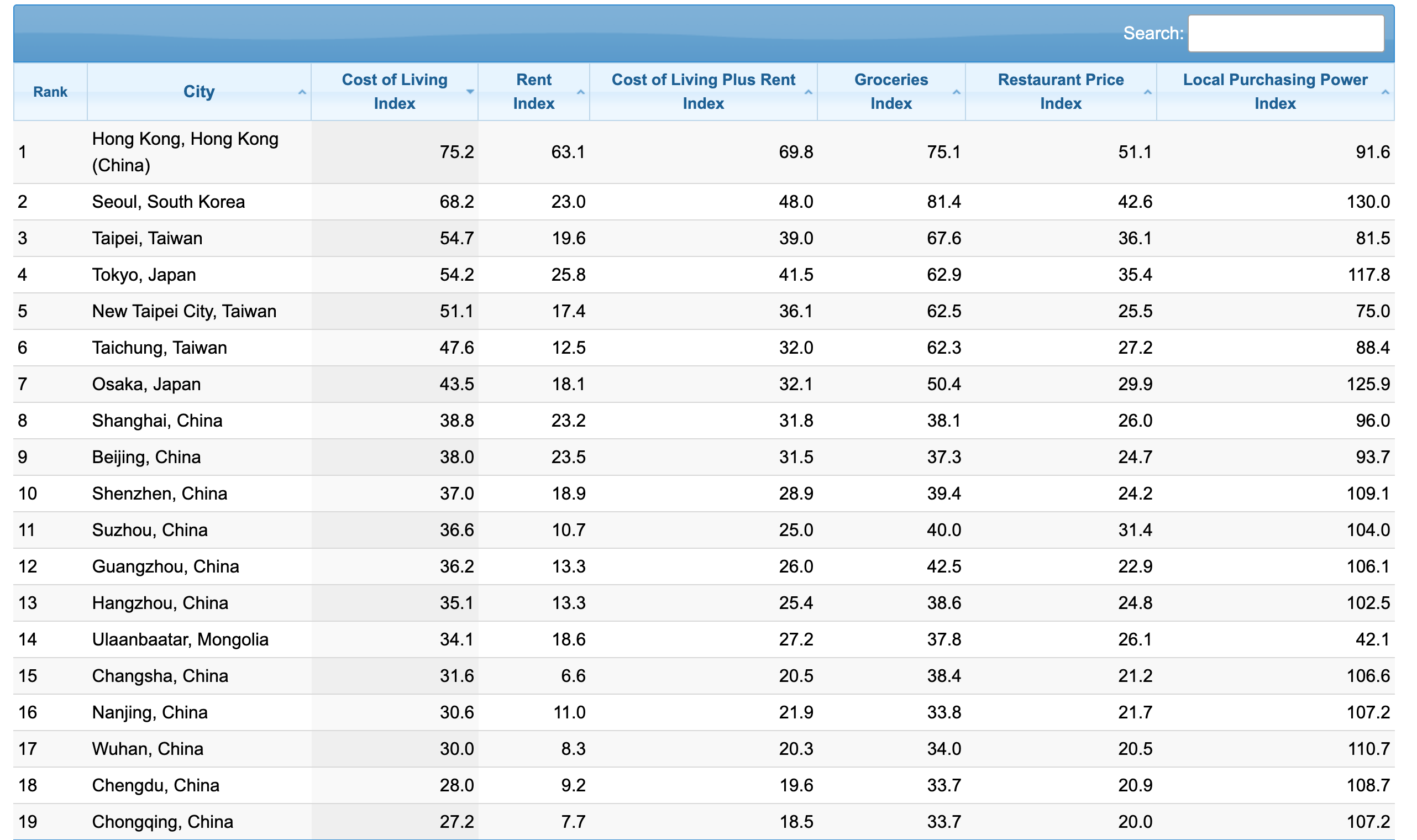
East Asia City Cost of Living Index Rankings
About the Numbeo Index:
| English Name |
Chinese Name |
Description |
| Cost of Living Index |
生活成本指數 |
Measures overall daily expenses (excluding rent) |
| Rent Index |
租金指數 |
Measures the cost of renting in the city |
| Cost of Living Plus Rent Index |
生活成本+租金指數 |
Overall indicator combining living costs and rent |
| Groceries Index |
雜貨指數 |
Measures supermarket shopping and food prices |
| Restaurant Price Index |
餐廳價格指數 |
Measures dining out costs |
| Local Purchasing Power Index |
本地購買力指數 |
Measures local salary relative to prices and actual purchasing power |
In-Depth Analysis of Taiwanese Cities
Taipei: Asia’s third most expensive, cost of living slightly higher than Tokyo
Taipei ranks third in Asia with a cost of living index of 54.7, just behind Hong Kong and Seoul, and slightly above Tokyo’s 54.2. Notably, Taipei’s rent index is 19.6, much lower than Hong Kong’s 63.1 and Tokyo’s 25.8, indicating that Taipei’s high living costs mainly stem from daily expenses rather than housing.
In terms of groceries, Taipei scores 67.6, ranking third among the top ten cities, behind Seoul (81.4) and Hong Kong (75.1), reflecting relatively high spending on daily shopping for residents.
New Taipei City: Cost of living about 7% lower than Taipei
New Taipei City has a cost of living index of 51.1, ranking fifth, about 7% lower than Taipei. Its rent index is 17.4, more affordable than Taipei’s 19.6, and restaurant prices index is 25.5, lower than Taipei’s 36.1, indicating significantly lower dining-out costs.
However, New Taipei City’s local purchasing power index is only 75.0, the lowest among the top ten cities, reflecting limited real purchasing power for residents.
Taichung: Central metropolitan area with moderate living costs
Taichung’s cost of living index is 47.6, ranking sixth, the lowest among Taiwan’s three listed cities. Its rent index is 12.5, the lowest among the top ten cities, making it an important reference for those considering moving to central Taiwan.
Additionally, Taichung’s local purchasing power index reaches 88.4, higher than Taipei (81.5) and New Taipei City (75.0), indicating residents enjoy relatively higher buying power.
Taiwan vs Japan: Whose cost of living is higher?
Many Taiwanese aspire to live in Japan, but data shows Taipei’s cost of living index (54.7) is actually slightly higher than Tokyo’s (54.2). However, Tokyo’s rent index (25.8) is significantly higher than Taipei’s (19.6), and its local purchasing power index (117.8) far exceeds Taipei’s (81.5), indicating that Japanese workers’ real income and purchasing power remain superior to Taiwan.
Osaka’s cost of living index is 43.5, lower than Taiwan’s three major cities, and its local purchasing power index is as high as 125.9. For Taiwanese considering overseas development, Japan’s quality of life may be more competitive than expected.
Seoul’s groceries most expensive, Hong Kong dominates rent
Data shows Seoul’s groceries index reaches 81.4, the highest among Asian cities, with ongoing concerns over food prices in Korea. However, Seoul’s local purchasing power index is 130.0, the highest on the list, indicating Korean wages support high living costs.
Hong Kong continues to lead in rent with an index of 63.1, more than twice Tokyo’s 25.8, making housing the biggest living expense and pressure point in Hong Kong.
Chinese cities generally lower, but purchasing power performs well
Living costs in top Chinese cities like Shanghai, Beijing, and Shenzhen are all below 40, far lower than major Taiwanese cities. However, their local purchasing power indices range from 93 to 109, higher than Taipei and New Taipei City, reflecting improving wage competitiveness in China’s first-tier cities.

Disclaimer: The information on this page may come from third parties and does not represent the views or opinions of Gate. The content displayed on this page is for reference only and does not constitute any financial, investment, or legal advice. Gate does not guarantee the accuracy or completeness of the information and shall not be liable for any losses arising from the use of this information. Virtual asset investments carry high risks and are subject to significant price volatility. You may lose all of your invested principal. Please fully understand the relevant risks and make prudent decisions based on your own financial situation and risk tolerance. For details, please refer to
Disclaimer.
Related Articles
Linea Leads Top Layer-2 Projects By Social Activity
LunarCrush recently ranked the top Layer-2 projects based on social activity, highlighting Linea as the leader. Other notable projects include Celo, Stacks, and Optimism, each showcasing varying engagement and interaction metrics.
BlockChainReporter15h ago
GameFi sector market cap $4.515 billion, FLOKI ranks first with $286 million
As of March 21, the GameFi sector has a market cap of $4.515 billion, with FLOKI, The Sandbox, and Undeads Games ranking at the top. The Solana Foundation chairperson believes blockchain gaming performance has fallen short of expectations, and multiple institutions have previously invested substantial capital in this sector.
GateNews22h ago
Trump-Linked American Bitcoin Holds 6,899 BTC
American Bitcoin, linked to the Trump family, has rapidly grown to become the 16th largest corporate Bitcoin holder, amassing 6,899 BTC. Despite facing market risks and competition, its rise indicates a shift in how companies view Bitcoin, moving towards long-term holding rather than trading.
Coinfomania03-20 12:17
American Bitcoin Expands Bitcoin Treasury to New Heights
Arkham reports that American Bitcoin, the Trump family's BTC mining company, now holds 6,899 BTC worth $486M, making it the 16th largest Bitcoin treasury. This growth signals increased institutional interest in Bitcoin and its role in decentralized finance.
BlockChainReporter03-20 11:14
Ethereum TVL Continues to Lead L1 Track: DeFi, Institutional Capital, and Network Effects Build Moat
Ethereum maintains its leading position in the L1 blockchain market with its superior Total Value Locked (TVL), continuously attracting concentrated capital and users. Its mature smart contracts and decentralized architecture deepen the ecosystem, attracting institutional participation. Although other chains have advantages in efficiency and cost, Ethereum still leads significantly in stability and application composability. Future competition will focus on performance and application scenarios.
GateNews03-20 06:09
DDC Enterprise Increases Holdings by 200 BTC, Total Position Reaches 2,383 BTC Worth $165 Million
DDC Enterprise increased its Bitcoin holdings by 200 BTC on March 20, bringing its total holdings to 2,383 BTC, valued at approximately $165 million. The company reported a Bitcoin return rate of 44.9% this year, currently ranking 32nd among corporate Bitcoin holders.
GateNews03-20 00:30


