Key Notes
- USDT market cap growth dropped from $15B to $3.3B over 60 days.
- Cooling stablecoin issuance historically leads to Bitcoin consolidation or downtrends.
- Tether burned 3B USDT, highlighting redemptions and cautious market sentiment.
The demand for Tether’s USDT stablecoin has slowed down significantly in January 2026.
Market experts believe that these concerns exist for the crypto market as the stalling USDT growth could put the brakes on future Bitcoin
BTC
$89 768
24h volatility:
1.2%
Market cap:
$1.80 T
Vol. 24h:
$53.30 B
price rally.
Tether USDT’s Circulating Supply Drops Sharply, Which Could Impact the Crypto Market
CryptoQuant data shows that Tether’s circulating supply is experiencing a sharp slowdown, signaling slower growth in stablecoin liquidity.
Historically, such slowdowns in USDT issuance can influence overall crypto market momentum.
The 60-day average of USDT market cap changes indicates that Tether’s expansion has declined significantly since late November 2025.
During this period, growth dropped from $15 billion to $3.3 billion. The slowdown could be temporary, however, as market experts still believe that stablecoin payments flow would reach $56 trillion by 2030.
Comparing this to Bitcoin’s price action reveals a familiar pattern from previous cycles.
Related article: UN, Tether Partner to Fight Crypto Scams, Trafficking in AfricaRapid increases in USDT market capitalization often coincided with Bitcoin rallies, showing higher liquidity entering the market.
When that liquidity growth slowed, Bitcoin usually entered a consolidation phase and, in some cases, moved into a downtrend.
So far, the 60-day market cap change metric has not yet turned negative. However, CryptoQuant noted that the 60-day market cap change metric has not yet turned negative.
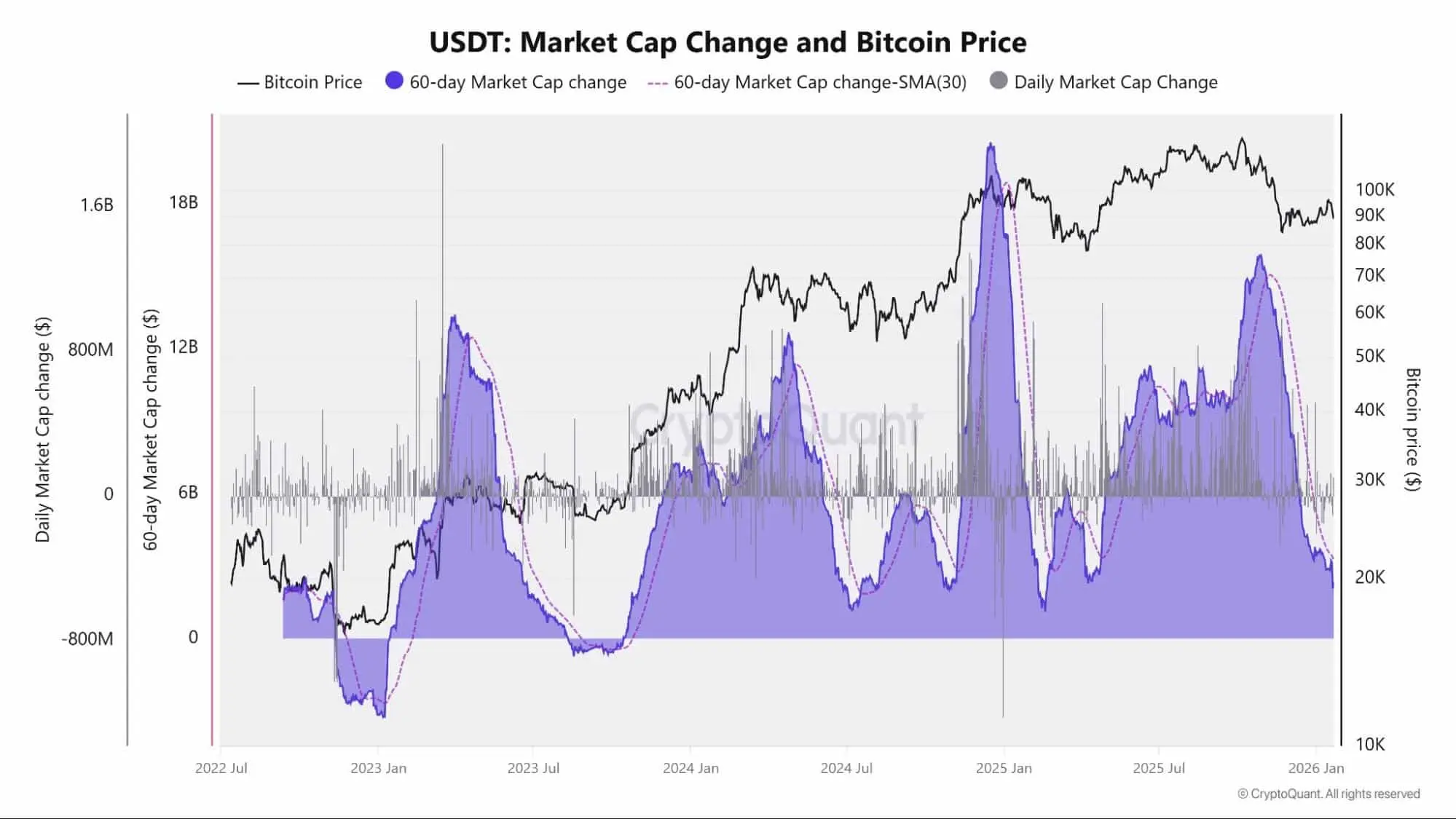 Market Cap Change and Bitcoin Price. | Source: CryptoQuant
One notable development is the decline in USDT market capitalization on Ethereum
ETH
$2 977
24h volatility:
1.6%
Market cap:
$360.39 B
Vol. 24h:
$31.81 B
over the past month.
During the same period, USDT has traded consistently below $1. CryptoQuant noted this isn’t a depegging event, but the combination of falling supply and sub-$1 pricing points to capital outflows.
This indicates that stablecoin holders are choosing to exit rather than deploy their crypto into new positions.
CryptoQuant also highlighted Tether Treasury’s recent burn of 3 billion USDT, the first since May last year, marking the largest USDT burn in the past three years.
USDT Burn Signals Caution as Stablecoin Outflows Rise
Some market participants see the burn as a cautious signal from large holders amid rising macro uncertainty and geopolitical risks.
USDT is removed from circulation when investors redeem the stablecoin for US dollars, prompting Tether to burn the corresponding amount.
If outflows accelerate, the stablecoin market’s two-month plateau near $308 billion in total capitalization could break and move into a corrective phase.
Such a shift could increase the risk of a broader downturn in crypto.
However, Tether has an unusual buyer: Iran’s central bank, which bought $507 million in USDT to bypass US sanctions and help stabilize the rial.
nextDisclaimer: Coinspeaker is committed to providing unbiased and transparent reporting. This article aims to deliver accurate and timely information but should not be taken as financial or investment advice. Since market conditions can change rapidly, we encourage you to verify information on your own and consult with a professional before making any decisions based on this content.
Disclaimer: The information on this page may come from third parties and does not represent the views or opinions of Gate. The content displayed on this page is for reference only and does not constitute any financial, investment, or legal advice. Gate does not guarantee the accuracy or completeness of the information and shall not be liable for any losses arising from the use of this information. Virtual asset investments carry high risks and are subject to significant price volatility. You may lose all of your invested principal. Please fully understand the relevant risks and make prudent decisions based on your own financial situation and risk tolerance. For details, please refer to
Disclaimer.
Related Articles
Delphi Digital: Sufficient collateral backing for stablecoins does not mean immunity from bank runs; the risk has shifted to the issuer level
Delphi Digital analysis points out that although Tether and Circle's stablecoins are backed by short-term Treasury bills and cash equivalents, they are not completely safe and still face bank run risks. The USDC depegging event in early 2023 demonstrated that stablecoin risks have shifted to issuers, highlighting the dangers posed by their centralization.
GateNews8h ago
Boris Johnson criticizes Bitcoin as a Ponzi scheme, with crypto industry leaders collectively refuting the claim
Former British Prime Minister Boris Johnson characterized Bitcoin as a "Ponzi scheme" and warned investors, particularly elderly individuals, to exercise caution using personal examples. Industry figures such as Michael Saylor quickly refuted the claim, pointing out that Bitcoin lacks a centralized operator, which is a key characteristic of Ponzi schemes. These remarks sparked widespread discussion and reignited controversy over the definition of Bitcoin.
MarketWhisper8h ago
Tether Announces Major AI Breakthrough, QVAC Serverless Intelligence May Usher in Open Source Era
Tether CEO Paolo Ardoino announced that a major breakthrough from the AI division will be released this week, marking progress in decentralized intelligent infrastructure. The QVAC platform aims to enable AI models to run locally on consumer-grade devices with efficient inference and task automation capabilities. Supported by Tether's financial resources, QVAC continues to iterate and involves multiple cutting-edge technologies, though its future breakthroughs still require observation of actual results.
MarketWhisper9h ago
Tether CEO Paolo Ardoino Teases 'True Breakthrough' in Decentralized AI
Tether CEO Paolo Ardoino announced on March 15, 2026, that the company's AI division will release what he described as a "true breakthrough" in the coming week, marking the next phase of the stablecoin issuer's decentralized intelligence strategy.
CryptopulseElite9h ago
Tether hints at a new "AI breakthrough," advancing the decentralized intelligence strategy
Tether's CEO announced a significant AI breakthrough coming soon, following the release of QVAC Workbench 0.4.1. This platform enables on-device AI operation without cloud servers, supported by Tether's substantial profits primarily from U.S. Treasury bonds.
TapChiBitcoin11h ago
Tether Freezes Approximately 11.96 Million USDT on Tron Chain Address
On March 15, Tether froze 11,960,680 USDT on a Tron chain address using the blacklist function of smart contracts. This action typically stems from law enforcement requests related to money laundering and fraud. Over the past several years, Tether has cumulatively frozen more than $4.2 billion in USDT.
GateNews23h ago


