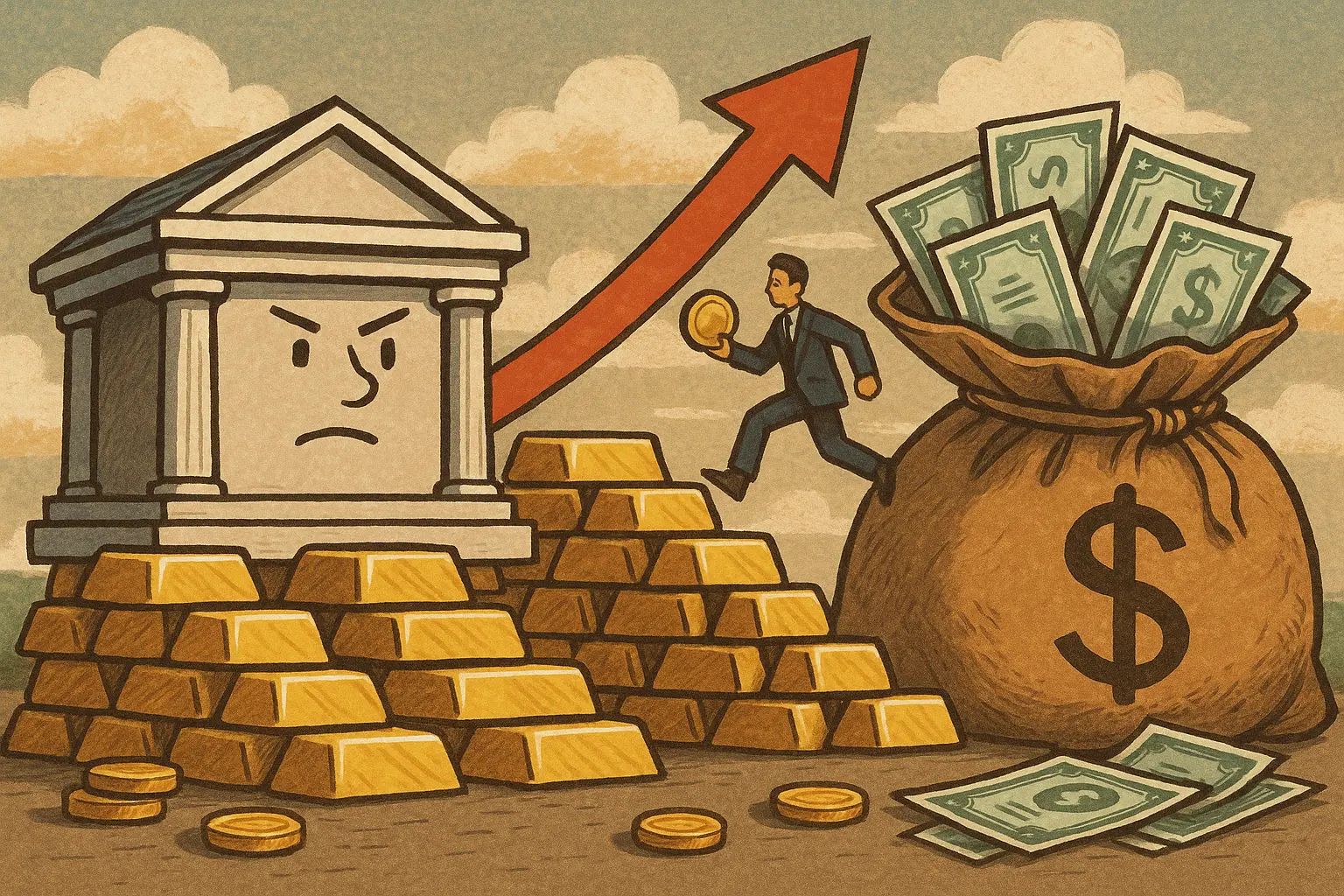
Hard assets are experiencing a full-scale breakout, with gold rising 78% over 13 months to $4,690, and silver surging 235% to break $94. Central bank gold reserves for the first time in 30 years surpass U.S. Treasuries, with 47 commodities seeing gains in 38 categories. Bank of America forecasts “all commodities will behave like gold.”
Gold and Silver Lead the Hard Asset Frenzy
Gold quickly established its leading position. Prices hit consecutive all-time highs, continuing the previous upward momentum. Currently, gold has outperformed the S&P 500 for six consecutive months—its longest winning streak since the 2008 global financial crisis. According to Lars Hansen, Research Director at Gold Silver Club, “Gold is now the best-performing major asset of 2020—outperforming stocks, real estate, and bonds on an annual basis.”
However, it is silver that is truly exploding in this wave. The gold-silver ratio has fallen to around 50, reaching its lowest level in nearly 14 years, after previously dropping sharply from over 100 set in 2025. The impact is profound. Gold prices have soared above $4,690 per ounce, up more than 78% in just 13 months from the opening price of $2,624 in January 2025. This rally is comparable to the early stages of the gold supercycle in the 1970s.
Silver’s rally is even more astonishing. Prices have surged above $94 per ounce—up over 32% this year alone, and more than 235% over just over a year. As Hansen points out, “Silver’s market cap has now surpassed $5 trillion—exceeding the entire U.S. bond market and surpassing Germany’s stock market.”
The significance of the gold-silver ratio dropping from 100 to 50 is immense. This ratio measures how many ounces of silver one ounce of gold can buy. When the ratio is 100, gold is extremely expensive relative to silver. When it drops to 50, silver’s relative value has significantly increased. Historically, ratios below 50 often occur during silver supply-demand imbalances, surging industrial demand, or speculative booms. The current decline may reflect explosive growth in demand for silver in solar energy, electric vehicles, and electronics industries.
Comparison of Hard Asset Gains in 2025-2026
Gold: 78% increase over 13 months (from $2,624 to $4,690)
Silver: 235% increase in 1 year (surging to $94)
Gold-Silver Ratio: Dropped from over 100 to 50 (new 14-year low)
Gold vs S&P 500: Outperforming for 6 consecutive months (longest since 2008)
The persistence and breadth of this rally indicate it is not a short-term speculative bubble but a long-term structural shift. When gold outperforms stocks for six months straight, it signals that global capital is systematically reallocating from financial assets to tangible assets.
Central Bank Gold Reserves Surpass U.S. Treasuries for the First Time in 30 Years
These structural factors cannot be ignored. For the first time in nearly three decades, the proportion of global central bank gold reserves exceeds that of U.S. Treasuries. Countries from China, India to Poland and Singapore are systematically converting paper gold into physical gold—reflecting growing concerns over the sustainability of sovereign debt and geopolitical divisions.
As Hansen bluntly states, “Gold is no longer a safe-haven asset but a vote of no confidence in the current monetary order.” This accurately captures the essence of the current hard asset frenzy. Central banks are not buying gold out of panic but due to long-term doubts about the dollar system. When the world’s most professional money managers sell Treasuries to buy gold, it is a strong sign of skepticism toward fiat currency credibility.
The shift in central bank behavior began after the Russia-Ukraine conflict in 2022. When the U.S. froze Russia’s dollar reserves, central banks worldwide realized the risks of holding reserves in a single currency. Gold, as a borderless, unfreezable asset, has regained strategic importance. Once this “de-dollarization” trend starts, it creates a self-reinforcing cycle: more central banks buy gold, the relative value of dollar reserves declines, prompting even more to follow suit.
Data shows that between 2023 and 2025, global central banks purchased over 3,000 tons of gold—hitting a record high for peacetime. This buying spree far exceeds private investors and is a primary driver of gold prices. When “smart money” like central banks makes large purchases, it often signals that assets are severely undervalued or about to enter a long-term upward trend.
47 Commodities, 38 Breaking Historical Highs
This is not just a story about a single metal. Uranium prices have surged to their highest levels since mid-2024. Copper, nickel, zinc, aluminum, platinum, palladium, and tin prices have all broken through multi-year, decade, or all-time highs—marking the most widespread commodity price breakout since the recovery from the 2009 crisis, with some even larger gains. Out of 47 listed commodities, 38 have risen this year, with over 24 approaching new all-time highs.
Such broad-based gains in hard assets are extremely rare. Usually, commodity markets show divergence—energy and metals move differently, agricultural and industrial commodities are independent. But when 38 out of 47 commodities rise simultaneously, it indicates this is not a supply-demand issue specific to certain commodities but a systemic monetary phenomenon—fiat currency purchasing power is declining, and all tangible assets are appreciating relative to it.
Since early 2025, Gold Silver Club has warned that ongoing fiscal expansion, weaponized trade policies, and tightening supply would collide, leading to a dramatic revaluation of real assets. This forecast is no longer speculation but an observable, measurable, and accelerating reality. Bank of America’s assertion that “all commodity charts will resemble gold charts” is gradually becoming reality. The visual similarity across commodity charts is increasingly evident.
Hansen describes this moment clearly: “Liquidity is increasing, purchasing power is decreasing, and scarcity is being re-priced in real time. In this environment, reaching $5,000 for gold in Q1 2026 and $100 for silver is not a distant goal but a milestone on the long road.”
The Cost of Waiting Could Be the Biggest Mistake of the Decade
The lesson of 2025 is that this trend is undeniable. The lesson of 2026 may be that this trend becomes unstoppable. Traders waiting for market stabilization may find that stability only arrives after the opportunity has vanished. As Hansen summarizes, “Markets reward accumulation, not hesitation. Long-term underexposure to metals could become the most costly strategic mistake of the next decade.”
This warning is not alarmist. Looking back at the 1970s gold supercycle, investors who hesitated early (1971-1974) missed the most explosive phase later (1978-1980). When gold rose from $35 to $200, many thought it was already too expensive. But ultimately, gold hit $850 in 1980—what looked like a peak in 1971-1974 was just the beginning.
The current hard asset bull market may be in a similar early stage. Although gold has already gained 78%, silver 235%, compared to the 24-fold increase in the 1970s, this may only be the beginning. The key question: have the structural drivers of this rally—central bank de-dollarization, fiscal expansion, geopolitical divisions—changed? The answer is no; these factors have not improved but are intensifying.
The “Year of Hard Assets” is no longer theoretical but a real environment. Those who remain on the sidelines will watch silently as one of the largest wealth transfers in our lifetime unfolds. The first weeks of 2026 have already made it clear: capital is abandoning faith-based financial assets and actively shifting toward scarcity assets. After more than a decade of neglect, energy, metals, and tangible assets are being repositioned as the most representative contrarian investments for 2026—an assessment now widely recognized among the world’s most influential investment banks.
For investors, the choice is clear: participate in this wealth transfer or watch purchasing power erode. Hard assets are no longer defensive allocations but offensive opportunities. $5,000 gold and $100 silver may just be the beginning, not the end.


