
Pi Network launches TokPi, bringing TikTok-style short videos, live streaming, and digital gifts into the Pi browser. Simultaneously releasing the Add Pi SDK tools, supporting Pi payments and wallet login. Mainnet shows 4.83 billion Pi locked, 3.55 billion unlocked. TokPi supports 10 languages, marking Pi Network’s transition from mining to practical applications.
What is TokPi? The First Entertainment and Social App of Pi Network
TokPi is a Web3 community application built specifically for Pi users. It operates similarly to TikTok but runs within the Pi ecosystem. Users can post short videos, live stream, build followers, and receive digital gifts paid with Pi. This provides a genuine social platform for Pi, where creators can earn money, fans can support them, and users can interact authentically with Pi.
TokPi allows users to watch creators’ live streams, send digital gifts with Pi, chat in real-time, and explore trending content. The app supports 10 languages, runs smoothly in the Pi browser, and features a clean, modern interface. For many Pi users, TokPi feels like the first truly entertainment-focused app built specifically for Pi.
This is more than just content consumption; it integrates Pi into daily entertainment. Community leaders have already begun urging users to give TokPi five-star reviews. Their goal is to improve TokPi’s ranking in the Pi app list and develop it into a key Pi community platform. The launch of TokPi signifies Pi Network’s shift from a simple mining tool to an ecosystem with real use cases.
From a business model perspective, TokPi provides a clear Pi usage scenario. Creators attract audiences through content, viewers purchase digital gifts with Pi to tip creators, and creators can spend or exchange the Pi they earn within the ecosystem. This closed-loop economy is highly desirable for crypto projects because it creates real token demand rather than speculative demand.
Add Pi SDK Opens the Ecosystem Door for Developers
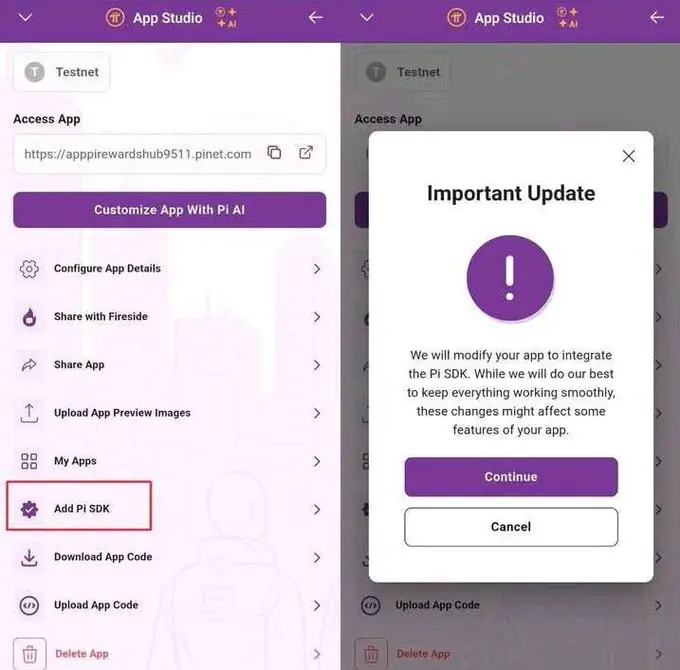
With the release of TokPi, Pi Network has introduced a powerful new tool called “Add Pi SDK” in Pi App Studio. This feature allows developers to connect their applications directly to Pi’s core system. Through the Pi SDK, apps can utilize Pi payments, Pi wallet login, mainnet transfer tools, blockchain interactions, and advanced security features.
Developers can now build real applications that use Pi for payments, login, and identity verification. This transforms Pi from a simple online platform into a true Web3 ecosystem. Applications using the Pi SDK will also gain higher exposure within the Pi ecosystem and reach millions of Pioneer users.
Core Features of Add Pi SDK
Pi Payment Integration: Apps can accept Pi payments directly, without complex wallet integrations
Pi Wallet Login: Users can log in with Pi Wallet with one click, no traditional username/password needed
Mainnet Transfer Tools: Help developers migrate testnet applications to the mainnet
Blockchain Interaction: Provide standardized APIs to query transaction records and account status
Advanced Security Features: Built-in encryption and verification mechanisms to protect user assets
The launch of Pi SDK lowers the barrier for development. Previously, building applications within the Pi ecosystem required deep understanding of blockchain tech, wallet protocols, and payment flows. Now, with standardized SDKs, developers can implement functionalities that once took weeks in just a few lines of code. This convenience will significantly increase both the quantity and quality of applications in the Pi ecosystem.
Strategically, Pi SDK is a crucial step for Pi Network to evolve from a closed ecosystem into an open platform. TokPi, as an official demonstration app, showcases the SDK’s capabilities and potential. Future third-party developers may use the SDK to create e-commerce, gaming, social, and utility applications, forming a thriving ecosystem. When hundreds or thousands of applications are in place, Pi’s use cases will be greatly enriched, and token demand will grow accordingly.
Mainnet Supply Data: 4.83 Billion Locked, 3.55 Billion Unlocked
Pi Network also shared the latest information on supply distribution. The total Pi on the mainnet is approximately 8.38 billion Pi, with about 4.83 billion Pi locked and about 3.55 billion Pi unlocked. The maximum supply is set at 100 billion Pi. Mainnet indicators show 4.83 billion Pi locked and 3.55 billion Pi unlocked.
Most Pi coins are still in a locked state, reducing short-term sell pressure and keeping circulating supply below book value. This locking mechanism helps protect the ecosystem while promoting the development of applications like TokPi and actual demand growth. The 4.83 billion locked Pi accounts for 57.6% of the total supply, indicating most users prefer long-term holding over immediate liquidation.
The unlocked amount of 3.55 billion Pi means that approximately 42.4% of the total supply is circulating in the market. This ratio is moderate among crypto projects. Too high a circulating supply can cause excessive sell pressure, while too low can impact liquidity and price discovery. Pi Network manages this balance through phased unlocking.
Note that the maximum supply is 100 billion Pi, meaning the current 8.38 billion only accounts for 8.38% of the max. This design leaves ample room for future ecosystem expansion. As applications grow and user base increases, Pi Network can gradually release new supply to meet demand.
Pi Network’s Strategic Shift from Mining to Application
Pi Network’s long-term goal has always been to realize practical applications. Specifically, with the upcoming release of a new developer hub and Pi SDK in early 2026, this vision is gradually becoming reality. By then, people will no longer just mine Pi but will be able to directly spend, send, gift, and use Pi within applications. Moreover, entertainment, payments, social media, and commerce sectors will begin integrating into a unified ecosystem.
This is what Pi calls the “real economy” phase—a stage driven by real applications, real users, and real use cases. TokPi exemplifies Pi Network’s commitment to building a complete Web3 world driven by everyday users. With Pi SDK, developers can now build applications more quickly. With social apps like TokPi, users finally have more engaging ways to use Pi.
Pi is transitioning from mining to more meaningful applications, and for the Pi community, this is just the beginning. Future applications may include e-commerce platforms for buying physical goods with Pi, Play-to-Earn gaming platforms, education platforms accepting Pi for courses, and local service platforms connecting offline merchants with Pi payments.
From a strategic perspective, Pi Network is replicating the successful model of mobile internet platforms. Early iOS and Android systems also started as closed platforms and gradually opened SDKs to attract third-party developers. When the number of applications reaches a critical mass, network effects kick in—users stay because of rich applications, developers continue to build because of a large user base, creating a positive cycle.


