According to on-chain data monitoring tool Whale Alert, on Sunday, Tether simultaneously froze a total of over $182 million worth of USDT across 5 wallet addresses on the Tron blockchain, marking the largest freeze operation on the Tron chain in recent months.
On-chain data shows that these 5 addresses hold between approximately $12 million and $50 million worth of USDT each; as for the specific reasons for freezing these assets, Tether has not yet provided an explanation.
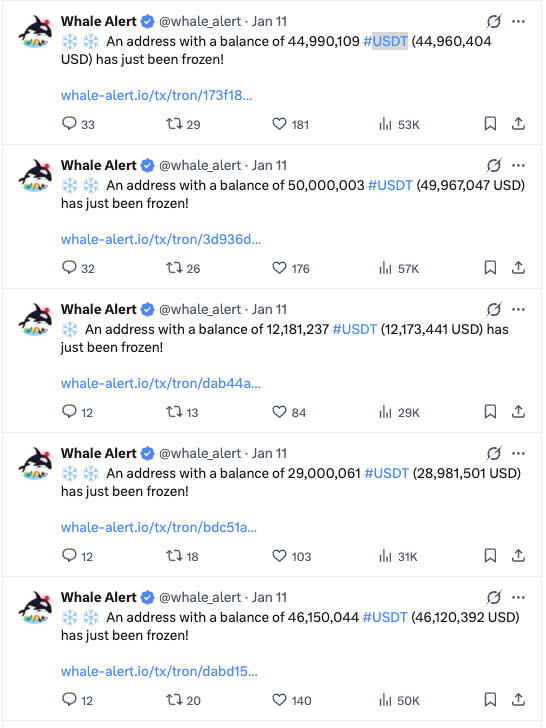 The freeze operation on January 11th coincides with Tether’s official implementation of its wallet freezing policy starting in December 2023. This policy is primarily designed to comply with the U.S. Department of the Treasury’s Office of Foreign Assets Control (OFAC) “Specially Designated Nationals (SDN)” sanctions list.
Tether explicitly states in its terms of service that it reserves the right to proactively freeze addresses or provide user information to relevant authorities when receiving court orders or when the company deems it “reasonable and necessary.”
According to information disclosed on Tether’s official website, to date, the company has assisted over 310 law enforcement agencies across 62 jurisdictions worldwide, freezing more than $3 billion worth of USDT.
By July 2025, Tether had frozen over 2,380 wallets, with assets totaling approximately $1.14 billion, in cooperation with U.S. law enforcement agencies such as the FBI and the Secret Service.
Tether simultaneously froze $182 million USDT involving 5 Tron wallets
Interestingly, Tether’s enforcement strength shows a significant gap compared to its competitor Circle (issuer of USDC). According to a report published by analytics firm AMLBot in December 2025, the total value of assets frozen by Tether since 2023 is 30 times that of Circle ($109 million).
Currently, USDT has a circulating supply of over $187 billion, dominating 64% of the stablecoin market share. In contrast, USDC, which follows a compliant route and is based in the U.S., maintains a total supply of around $75 billion.
The freeze operation on January 11th coincides with Tether’s official implementation of its wallet freezing policy starting in December 2023. This policy is primarily designed to comply with the U.S. Department of the Treasury’s Office of Foreign Assets Control (OFAC) “Specially Designated Nationals (SDN)” sanctions list.
Tether explicitly states in its terms of service that it reserves the right to proactively freeze addresses or provide user information to relevant authorities when receiving court orders or when the company deems it “reasonable and necessary.”
According to information disclosed on Tether’s official website, to date, the company has assisted over 310 law enforcement agencies across 62 jurisdictions worldwide, freezing more than $3 billion worth of USDT.
By July 2025, Tether had frozen over 2,380 wallets, with assets totaling approximately $1.14 billion, in cooperation with U.S. law enforcement agencies such as the FBI and the Secret Service.
Tether simultaneously froze $182 million USDT involving 5 Tron wallets
Interestingly, Tether’s enforcement strength shows a significant gap compared to its competitor Circle (issuer of USDC). According to a report published by analytics firm AMLBot in December 2025, the total value of assets frozen by Tether since 2023 is 30 times that of Circle ($109 million).
Currently, USDT has a circulating supply of over $187 billion, dominating 64% of the stablecoin market share. In contrast, USDC, which follows a compliant route and is based in the U.S., maintains a total supply of around $75 billion.
Disclaimer: The information on this page may come from third parties and does not represent the views or opinions of Gate. The content displayed on this page is for reference only and does not constitute any financial, investment, or legal advice. Gate does not guarantee the accuracy or completeness of the information and shall not be liable for any losses arising from the use of this information. Virtual asset investments carry high risks and are subject to significant price volatility. You may lose all of your invested principal. Please fully understand the relevant risks and make prudent decisions based on your own financial situation and risk tolerance. For details, please refer to
Disclaimer.
Related Articles
Tether Launches BitNet LoRA Framework Across Platforms
Tether's QVAC Fabric introduces the BitNet LoRA framework, enabling AI model training on consumer devices with reduced VRAM needs and improved performance. Users can fine-tune large models on smartphones, making AI development more accessible and efficient.
CryptoFrontNews5h ago
Tether CEO: Will Launch New Product Within 30 Days
Gate News reported that on March 18, Tether CEO Paolo Ardoino posted on social media stating that the Tether product team is preparing an "important new product" that is expected to launch within 30 days.
GateNews11h ago
Tether Launches Cross-Platform BitNet LoRA Framework for AI Training on Consumer Devices
Tether's QVAC division announced on March 17, 2026, the launch of the world's first cross-platform LoRA fine-tuning framework for Microsoft's BitNet models (1-bit LLMs), enabling billion-parameter AI training and inference on consumer GPUs and smartphones.
CryptopulseElite22h ago
Tether Launches AI Training Framework for Smartphones and Consumer GPUs
Tether has launched a new AI training framework that allows for fine-tuning large language models on consumer devices such as smartphones and non-Nvidia GPUs. By utilizing Microsoft’s BitNet architecture and LoRA techniques, it provides substantial reductions in memory usage and computational costs, supporting a variety of chipsets. This development is in line with the trend of cryptocurrency companies expanding into AI and computing infrastructure.
TapChiBitcoin23h ago


